My art world experience this past October can be summed up as critics worldwide have described the season: hectic, turbulent, and frankly phenomenal. From my annual pre-Frieze week gallery hop, to the run from Frieze Masters to London, to exhibitions at the Tate Britain and Modern, and all the way to Art Basel Paris, I’ve seen a ridiculous amount of art this autumn. While it’s nearly impossible to narrow it down, I’d like to share some of my October standouts.
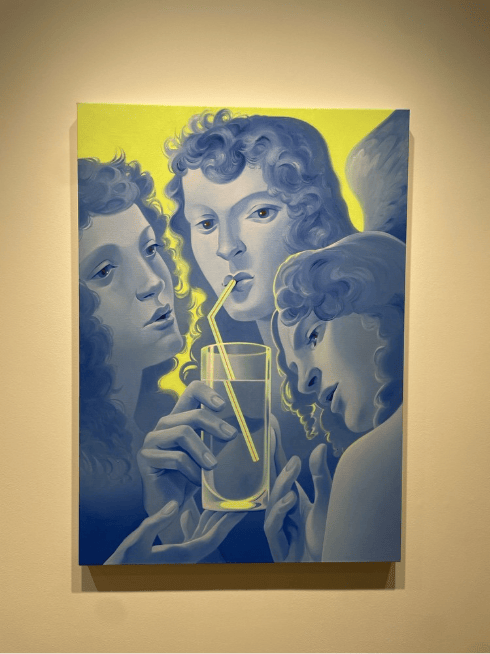
Starting strong with Robin F. Williams’ Holy Thirst Trap, (2026), my favourite work from Act Natural: PPOW Gallery’s first ever presentation in the UK at Frieze No. 9 Cork Street. Williams is fascinated by the contemporary revival of the gothic sublime, communicating the concerns and anxieties around increasing human reliance on Artificial Intelligence and social media. The title of the work directly references the content that appears on our devices every day; I hate to admit that I was initially attracted to this artwork because the angels uncannily resemble actor Connor Storrie. Williams admitted to me at the opening that the inspiration for this painting came to them as they were copying a painting of Michelangelo’s angels. Modelled on what they observed to be their effeminate and queer-coded appearances – with the angels gazing lustfully at the phallic-shaped glass, their slender fingers gently caressing its surface – in this painting, Williams uses this classicised and idealised image to realise a veritable Heated Rivalry edit in bright blue paint. The imitation of Michelangelo’s angels can be interpreted not only as a direct art-historical reference but also an echo to AI’s propensity to appropriate artists’ intellectual property when spewing out new images. The repetition of identical faces and hands recalls surreal, artificially generated amalgamations of limbs and the contorted conceptions of the human body created by language models such as Midjourney and GPT Image. The figures’ act of drinking water could more literally refer to water consumption at data centres. “This show is ultimately about hands and water,” Trey Hollis, Managing Partner of PPOW, remarked to me. The perfection and crispness of the lines, along with the carefully rendered and airbrushed textures of skin and reflections on flesh, suggest that they themselves could be artificially generated. However, Williams skilfully masters these effects in the traditional medium of oil paint and the labour of the human hand; in doing so, Williams may be simultaneously appropriating AI aesthetics while contending with technological perfection.
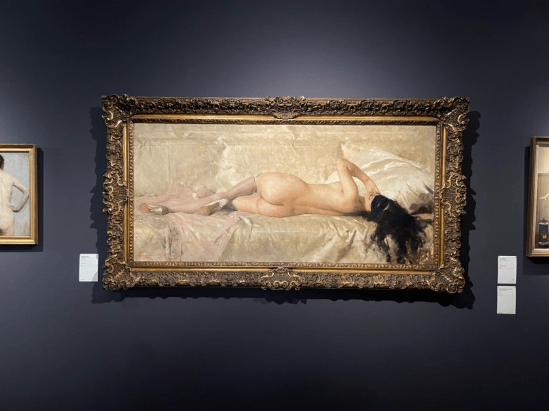
Moving on to Frieze Masters, La Nuda (1920), by Giacomo Grosso – could his name be more Italian – at Colnaghi particularly stood out to me. A classic reclining nude, a lateral figura serpentinata epitomising the concept of to-be-looked-at-ness, drawing direct parallels to Velázquez and Ingres. A contemporary of John Singer Sargent, Grosso meticulously captures the tactility of fashionable fabrics and flesh through careful attention to detail and meticulous handling of oil paint. The pinks and creams of the body are only distinguishable from the remarkably similar background through the artist’s alternating brushwork: impasto on the textiles and concealed strokes to capture the suppleness of the figure’s skin. The painting’s seductive nature lies not only in the figure’s in the nudity and pose but also in the accessories the artist deliberately includes. The figure wears nothing but a pair of white silk stockings, which appear to be rolling down her thighs, giving the image a sense of erotic anticipation. The inclusion of her cream satin mules adds to this erotic charge, recalling surrealist fetishism surrounding the shoe, particularly the high heel. The Venetian masquerade mask is another playful addition, concealing the identity of the clearly contemporary woman and creating a role-play-like scene. Like Manet’s Olympia, Grosso’s Nuda rejects the concept of placing the nude in a mythological or exoticizing scene, instead directly confronting and inviting the voyeuristic gaze, making it a controversial image for its time.
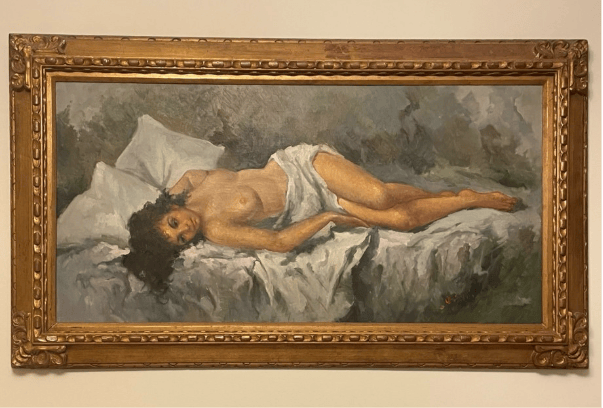
I feel an incredibly personal connection to this painting, mainly because it reminds me of one that has hung in my family home my whole life, from Chicago to London: another reclining nude with jet-black cascading hair.
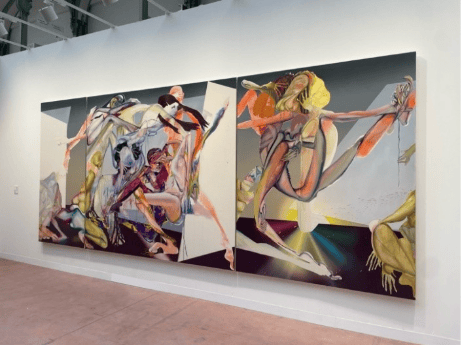
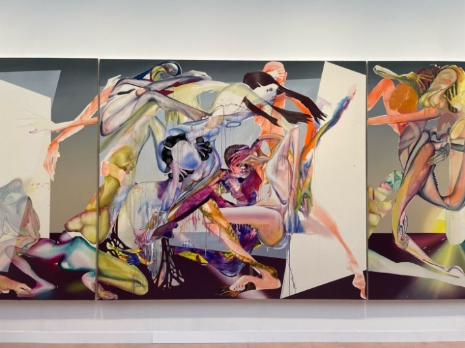
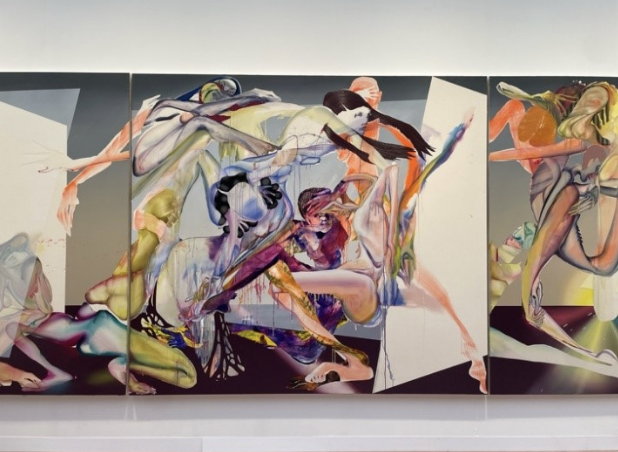
This autumn I had the privilege of attending my first-ever Art Basel Paris, unfortunately on the most eventful weekend of all time. Because the fair had been shut down over the weekend for fear of protests and looting, jumped straight off the Eurostar on Friday morning and rushed to Basel, exhausted and starving (for art, and maybe a baguette). Even more packed than Frieze London and Masters combined – and with somehow even more fashionable people – it definitely was a feast for the eyes, especially with it being hosted in the Grand Palais, a building that is, in itself, a masterpiece. I loved many of the booths, like the Klimt and Schiele sketches at Richard Nagy Gallery, and the infamous Modigliani nude priced at a whopping $100M at Pace, Di Donna and Schrader, yet it was the work displayed by Pilar Corrias that intrigued me the most. Carnivalesque, chaotic and enigmatic, Christina Quarles’ works can only be described as if a Juanita McNeeley nude descended a staircase – which, in the Duchamp sense, means they step a level deeper into abstraction. As a queer and mixed-race artist, Quarles explores the ambiguous, undefinable nature of identity through her exploration of existence in the physical body. In her works, complex compositions of leaping, squatting, and splitting amorphous figures fuse and coalesce into a colourful choreography. I was especially taken by Stay Up Late to See the Light/ Stain’ Up Late to See Tha Light/ Staid Up Late to See Tha Light (2026), a triptych composed of three differently sized rectangular canvasses whose sequence was altered daily throughout Art Basel week, offering alternate compositions of the work. The fragmented background, contrasting vivid figures with plain greyish and white hues, seems to serve as a liminal space for the figures to metamorphose. The dynamic quality of both the artwork’s composition and its mutable display, directly translate into painting the human experience of fluctuating identity and physical form over time.
To conclude, despite the volatility of the world around us, the art world, whilst being a force for human connection itself, also reminds us – through art – of our humanity; our ability to create, our physicality and our continual evolution.
Edited by Grace Gould
Cover image: Detail of Christina Quarles, Stay Up Late to See the Light/ Stain’ Up Late to See Tha Light/ Staid Up Late to See Tha Light, 2026. Photo by author.


Leave a Reply