
The colour red, 紅 (hóng), is one familiar to many Chinese people. From a young age, red’s symbolism for prosperity and luck has been hammered into the subconscious: the red packet envelope (紅包) we receive during Lunar New Year as children introduces us to the exciting idea of pocket money; the fiery red lanterns that light up the street on the rare occasion that we got to stay up late for the festivities; the silky, lush bridal attire (裙褂) that we project our future selves onto at our aunt’s wedding.
As we grow older, the meaning of this colour becomes more complex. For the global audience, red serves as a signifier of China’s contemporary history: The Red Guard, Red Sun, Red Terror… red has transformed into a colour of revolution, propaganda, and violence, a colour that deviates from its previous epoch.
What exactly makes up the colour? And why is red so powerful in Chinese visual culture, that it persists throughout dynasties, and across materials and mediums?
Historically, red is associated with one of the five elements (五行) – the Sun, and its vitalising energy. This is true in Chinese tradition and in many other East Asian visual cultures. Red exists naturally in plants, as well as iron, lead, and mercury-based minerals, offering an array of reds for artisans of different media, since the Yangshao Culture Period (仰韶文化,5000CE-3000CE). For example, in paintings, artists used the pigments cinnabar (also known as vermilion, 朱) and red lead to represent the scintillating elements of fire and the sun. Meanwhile, in textiles, safflower (紅花), madder (茜草), and sometimes cochineal insects were used to create red dyes that produce the rich colours of crimson (赤), orange (纁), and pink(桃紅) on fabrics, as well as the silk threads used in intricate embroideries. These red dyestuffs emerged through the material circulation networks of the Silk Road, as well as maritime trade with Southeast Asia and the West. Dyestuff technologies were passed down through centuries in literature such as the Compendium of Materia Medica《天工開物》. Red in historical textiles from China, therefore, represent more than artisanal luxury; it reflects an accumulation of the international exchange of materials and the wisdom of technological and scientific advancement.
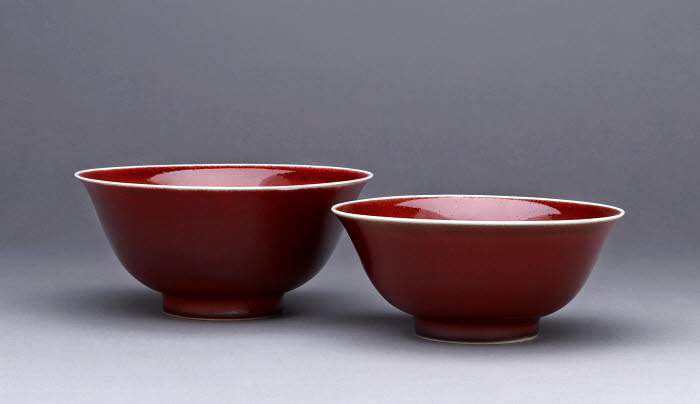
Chinese ceramicists at the imperial kilns in Jingdezhen developed one of the first stabilised red glazes, sacrificial red (祭紅), in 1426-35 during the Ming Dynasty (1368- 1644). Red-glazed ceramics were made specifically for ceremonial and ritual use by the emperor at the Sun Altar, giving these objects a significant status in dynastic power and sacristy. This deep red glaze was lost but later redeveloped into a glaze of a similar richness that resembled blood, the sang-de-boeuf (牛血紅), in 1705-12 during the Qing Dynasty (1644-1911). This unique monochrome glaze became sought-after by European dealers and collectors of Chinese export porcelain as the new height of ceramic aesthetics and technology. To this day, traces of this Qing artistic invention remain present in London, glazed over the faience walls of Mornington Crescent Underground Station and many more.
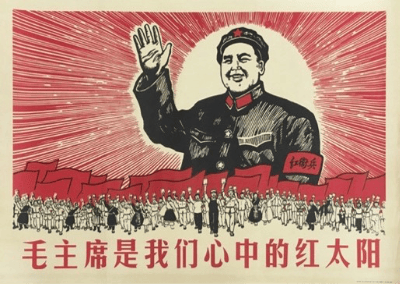
Things took a turn in the 20th century when the new Red Sun emerged from the mountains of Yan An in 1949. “Chairman Mao is the red sun in our hearts” was the propagandist slogan printed on mass-produced woodblock prints, the masses’ medium, and recited by every Chinese subject of the New China – a Maoist China. Red was utilised by the new Chinese Communist Party, reinventing the long traditions of the colour red into a symbol of the overt optimism powered by the new regime displacing the lineage of imperial rulership. Emotions ran on passion, fury, and rebellion — all things associated with red — at the hight of the Cultural Revolution (1966-76). The next ten years were a period of chaos, rampage of historic traditions, violence, and famine.
The year was 1964, the dawn of the Cultural Revolution, when the Chinese artist Liu Ye (劉野) was born. Liu’s oil painting, Gun (2001-02) is part of a three-part series exploring the memory and anxiety of spending his formative years against the backdrop of the Cultural Revolution. The innocent child figure, a frequent feature of Liu’s works, looks out to the horizon of a vermilion atmosphere. Her red hair bow, a symbol of childhood, is erased by the wash of overwhelming redness, and any whimsy or innocence left in her is juxtaposed by the gun she holds. “I grew up in a world that was covered in red — the red sun, the red flag, the red scarves,” Liu said. What the land of Red promised the child — prosperity, hope, and vitality — now clashes with a bleak reality of poverty, brutality, and despair. From her side profile, it is impossible for us to figure out what this little girl feels, or if she feels at all, for how can anyone imagine a childhood under the shadow casted by the power of the Red Sun?
The Chinese red of today is an entanglement of the strands of its complicated history. Within the generalised colour symbolism, we may identify a specific historical moment, but we cannot isolate it from the colour’s entire meaning, the same as when we attempt to read the meanings of Chinese art.
Edited by Grace Gould and Milly Howes
Cover Image: Liu Ye, Gun, 2001-02, M+ Museum



Leave a Reply