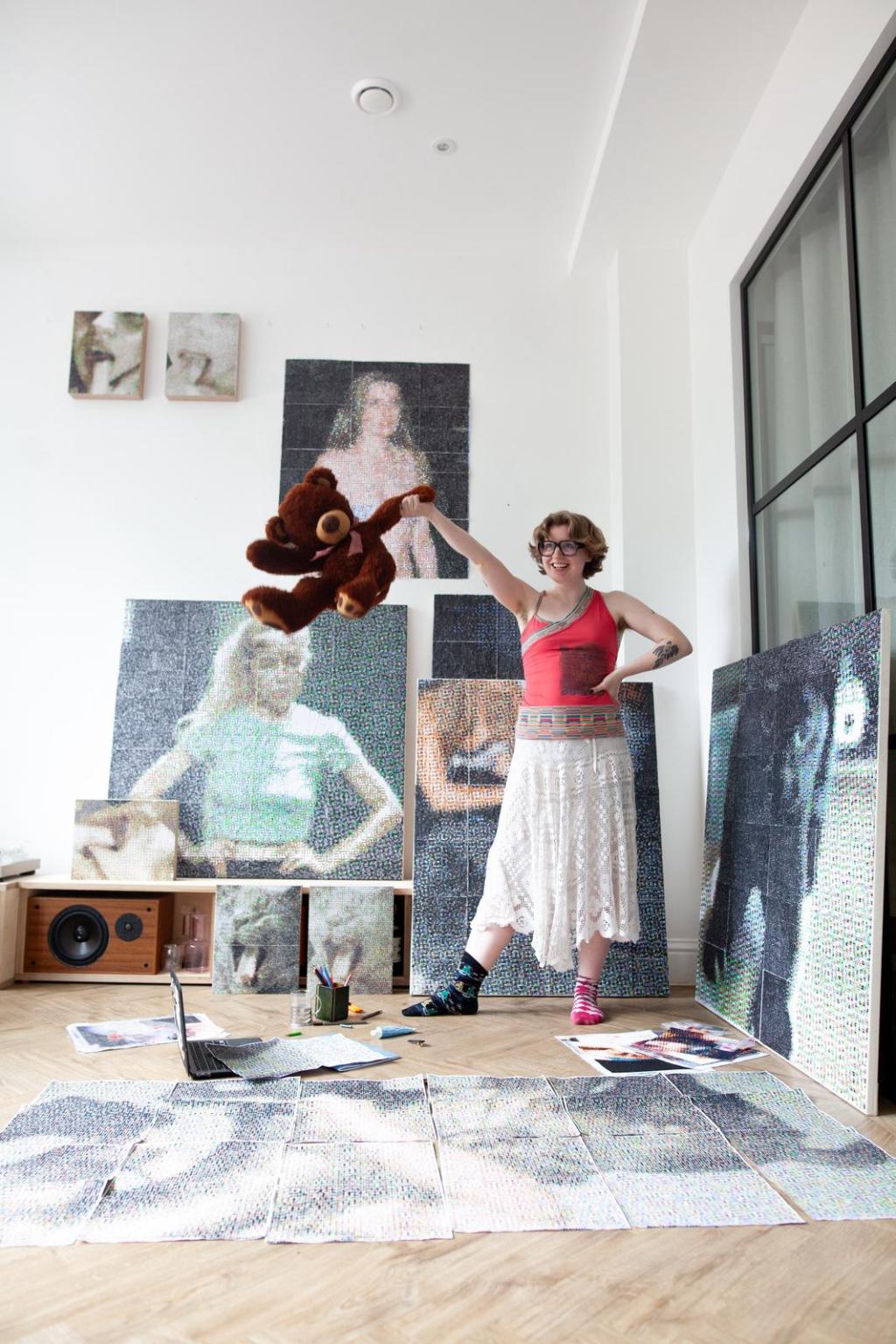
Recently I spoke with Lily Bunney, a young London-based artist, whose practice centres on human experience in the digital age. Her work explores intimate subjects such as her series More Peeing alongside ideas about celebrity and media representation, such as in Julia Fox (Lady Godiva). Her paintings often blur public and private relationships, examining the relationship with ourselves and the world through a digital lens. Lily spoke with me about the foundations of her striking pointillist visual style, her thoughts on technology and its effect on human connection, the role of shame and vulnerability in her work, and what her own digital obsessions have taught her about herself. This interview is intended to spark curiosity about an artist I find genuinely fascinating.
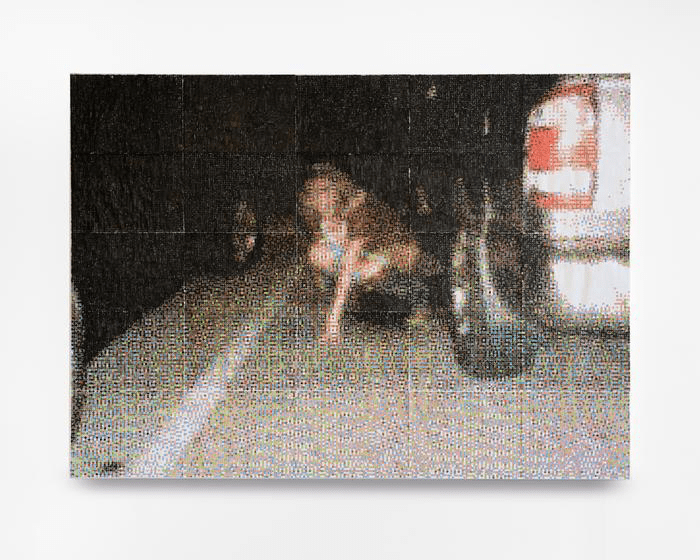
Miray Duran: Your visual style is quite distinct in its pointillist quality. How have you arrived at this technique?
Lily Bunney: It came from a few directions. Initially, I was inspired by the book Zeros + Ones: Digital Women + the new Technocultureby Sadie Plant, it looks at the history of the computer and technology from an alternative perspective. One thing she talks about is how the first computer’s hardware was heavily influenced by the jacquard loom, which is programmed using punch cards. This idea corresponded with me since I loved crocheting and knew about textile patterns. I was already interested in technologies and what its aesthetics look like in art, and I felt we have quite a limited aesthetic language for technology. Here I found an example of a contemporary form of tech being shaped by something domestic and craft based. At first my paintings were much closer to this craft side and very much looked like knit patterns than anything else, but over time they became their own thing. Some people still read them as textile patterns, but many also recognise it as pixel art, which is quite fun.
MD: What does the actual process of working on the painting look like? Do you use Photoshop first?
LB: Yes, I got the technique from an old website that taught you how to turn family photos into knit patterns, and I added a few steps of my own. So, I edit photos in photoshop first, but the whole process is based on the women’s website from the 2000s.
MD: How do you perceive the physical labour of creating the painting dot by dot? Do you put any conceptual value in it or just enjoy the process?
LB: I think of it both as a conceptual thing and a purely meditativeprocess since I am definitely drawn to it. I am the kind of person who likes to put something on while watching TV and that’s where it started. But I think there is something funny in finding trivial images and spending hours and hourspainstakingly recreating them. It’s the duration element of taking a fleeting moment and pinning it down in a really laboured way. That tension is important for me. I almost see myself as a printmaker more than a painter. Sometimes in the studio it feels like working in a factory, a very nice one obviously, and that makes me feel like a machine.
MD: Your practice is closely tied to technology and human relationships. Do you think technology brings us together or pulls us apart?
LB: It’s hard to give a definite response. I am not the person who remembers the time before the internet, for this reason I try not to have too strong value judgement about it. I think it just makes things different. It really changes how people interact. Sometimes, it makes it easier to stay in touch. Sometimes, it’s a barrier between you and everyone else.
MD: You once said that friendship is a beautiful solution to the isolation of late-stage capitalism. Does making art about it feel like an act of resistance, or something more personal?
LB: For me it’s more personal. I try to be as vulnerable as I can in painting. I really value my friends, so portraying them or the pop culture I consume feels like a way of being honest, and I hope to connect with people through that honesty. But in some way, it’s more of a reflection, rather than an action. What I’m really trying to do more is make space within my art and life to invite others to join me and be collaborative, rather than sitting in the room by myself.
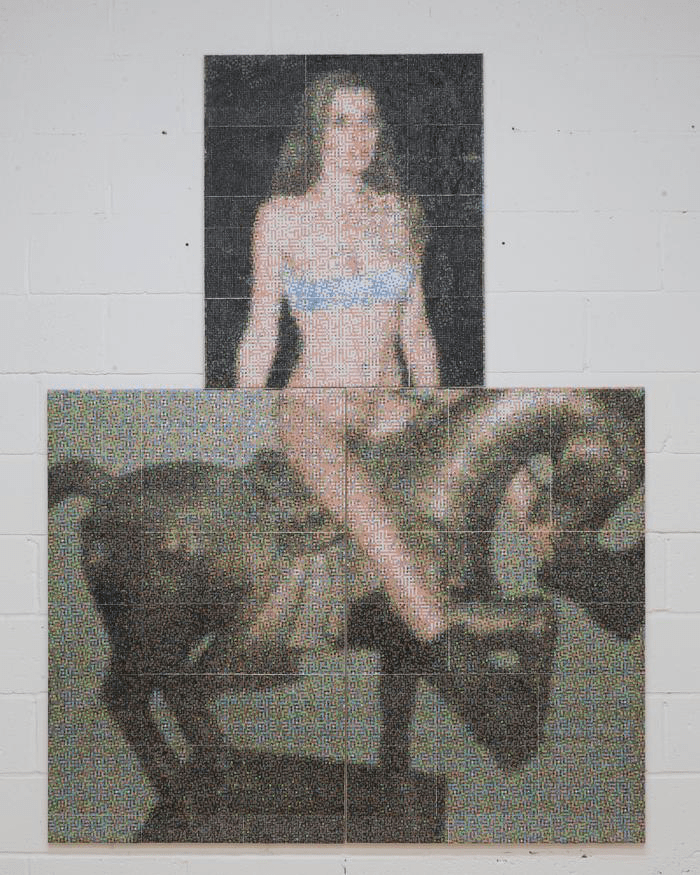
Watercolour paper on canvas. 95cm x 80cm, 130cm x 170cm
MD: I really like that you have mentioned feeling vulnerable. In your previous interviews you’ve also spoken about shame and the idea of making something embarrasses you, so you have to punch yourself to make it. When was that principle most tested?
LB: This idea came out of a conversation with my therapist. I find the action of creating to be quite embarrassing. I love art and I’d be making it no matter what, but showing something and saying, “I made this, it’s worth seeing,” is incredibly hard. It’s also easy to take yourself way too seriously, to feel that your work has to be conceptually driven in a specific academic way, which isn’t always the case. I would say it’s more of a general feeling, there is no particular piece that encapsulates it, but I never feel completely confident walking into a show. So, I keep pushing into it. The sense of embarrassment is often less about the creative processes and more about how people will perceive the work. I crave reaction but also find it really stressful and challenging. If someone gave me a negative reaction, as an artist I would be happy, but on the personal level I want to be liked.
MD: Your Instagram bio says, “lifelong obsession with laptops,” and you’ve said you want your work to be about what your digital obsessions say about you, not what you observe in others. What have you learned about yourself through that?
LB: A lot. I am a really emotional person, I feel a lot and sometimes it makes me ashamed and the way I work gives me time alone to move through them. So, the work becomes almost a way of self-soothing. I’m also not really a fan of things, but I’m very interested in people who are fans. Maybe I’m a fan of fans. I love watching people form identity around a shared interest. I am definitely not a celebrity worshipper; I am interested in how people feel about things more than in being seen as a fan myself. I have a friend who makes work about Beyoncé. Personally, I am not interested in Beyoncé, but I’m interested in why she is. The celebrities and online figures I’m drawn to are usually the ones impersonating my worst impulses, not by hurting anyone, but through expressing extreme emotions. I was really into Trisha Paytas as a teenager. I was watching her cry hysterically on her kitchen floor, because that’s how I felt but I was too English to do it myself. There is something cathartic about watching someone else feel what you feel, in a way I felt validated because someone had the same feeling as I did. I feel like a lot of success on the internet is built from that dynamic.
Edited by Alison Grace Zheng
Cover image: Lily Bunney in Her Studio, sent to the author from her archive



Leave a Reply