Recently, I visited the Hayward Gallery and spent a few hours losing myself in the Chiharu Shiota exhibition. Best known for her large-scale installations of intensely interwoven red or black thread that fills exhibition rooms in twisted webs, I was instead drawn to one of her more subtle works. Tucked away on a wall most people ignored to see one of her infamous string works, I noticed what at first appeared to be an unassuming series of photographs. Taking a closer look, I was fascinated by what I saw: various shots of Shiota’s nude body smeared with mud, crawling across the filthy earth and trying to submerge herself in a cavernous gap in the ground: this was Try and Go Home (1997/8). This attempt to fuse one’s body with the earth immediately reminded me of Ana Mendieta’s earth-body art, namely her Silueta Series (1973-80), in which, over the course of seven years, she documented her body immersed in the earth, and later merely physical imprints of her form on the land.
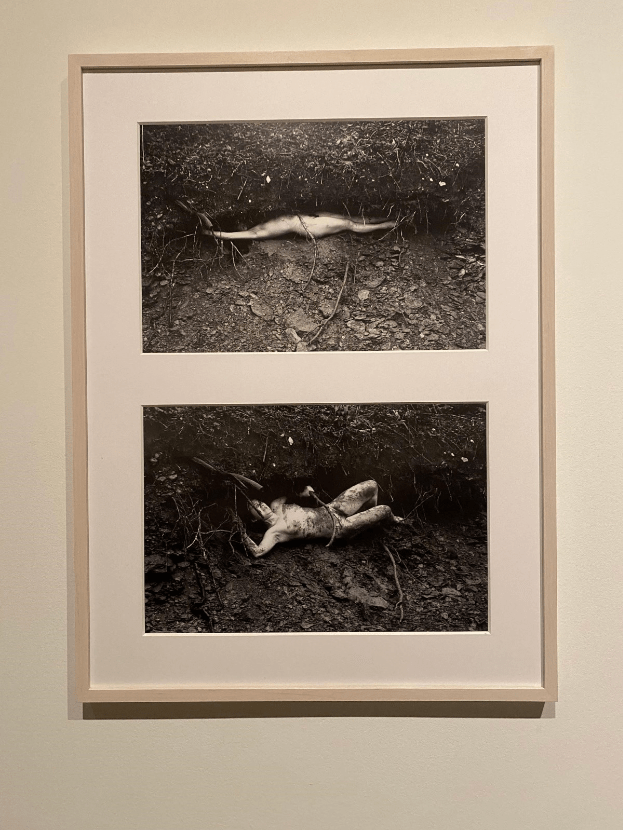
Shiota fasted for four days before undertaking this performance work, in which her struggle to climb up the sloping wall of the cavern recalled the complex “push-and-pull” feelings she experienced over her displacement from Japan, after moving to Berlin in 1996 to study at the University of the Arts. Longing to return to her home country, Shiota struggled to come to terms with her newfound identity as an immigrant and the void she felt upon leaving, yet she often felt out of place even when she did return to Japan. The act of covering her entire body in soil both connected her to the aliveness of the earth, and thus her homeland, whilst its difficulty to wash off reflected her ineffaceable desire to return home. The merging of the female body with land to combat the wounds of displacement is also at the centre of Mendieta’s land art, too. In Arbol de La Vida (Tree of Life) (1976), Mendieta’s naked body is plastered with mud, blending her form in with the surrounding trees, whilst in the 1972 precursor to her Silueta Series, Untitled (Grass on Woman), she lies face-down in her friends’ back garden, instructing them to glue grass on top of her nude body so that she blended in with the freshly cut lawn. Both works reflect her desire to connect deeply with the earth in an attempt to heal the psychological toll of being displaced from Cuba. In 1961, as part of Operation Peter Pan, Mendieta, aged 12, and her older sister were relocated to Iowa, where they spent 5 years in orphanages without their mother and were not reunited with their father until 1979. Not only was Mendieta taken away from her family, but she was also stripped of her national identity, a painful subject she continually grappled with in her art. Imprinting her body into the earth was a powerful way to reconnect with her homeland.
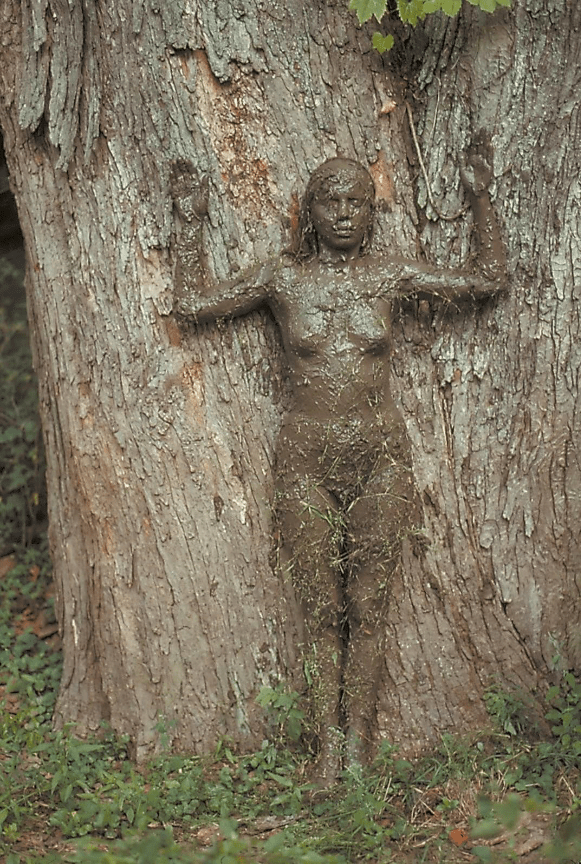
50.8 x 33 cm. Image: The Estate of Ana Mendieta Collection.
Both artists chose to transition away from more traditional media like painting, finding it to be too restrictive, as, according to Mendieta, it lacked a sense of “magic”. Instead, they turned to the possibilities of the human body. Taking inspiration from the self-proclaimed “grandmother of performance art,” Marina Abramović, Shiota realised the power of using and testing the limits of the body, with one experience of fasting in class for five days whilst reflecting on her true self — leaving her with a single thought: Japan; as a result, Try and Go Home was born. Similarly, Mendieta, who undertook formal artistic training at the University of Iowa, was deeply frustrated by the limitations of painting, so she joined the university’s experimental Intermedia programme, which promoted collaboration, hybrid media and site-specific works, catalysing her shift towards body-based performance art.
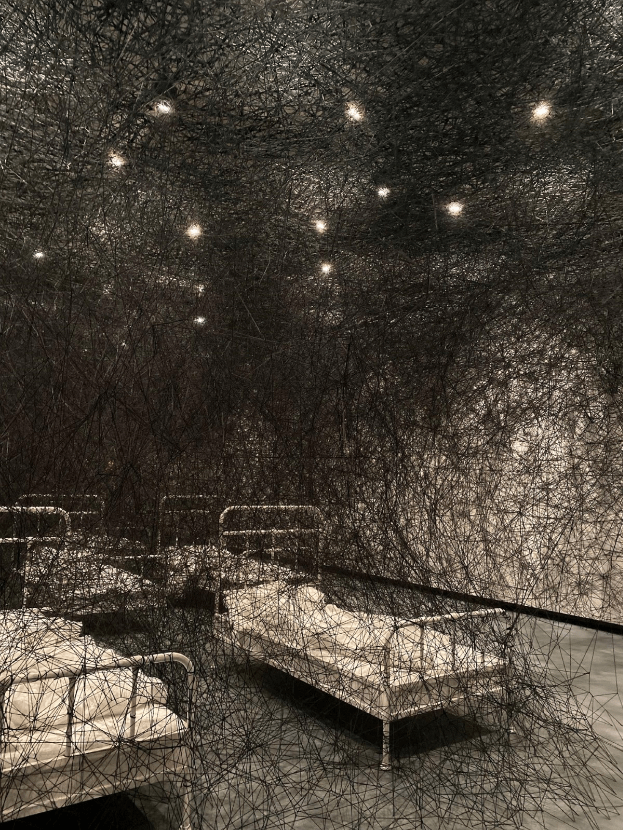
London. Image: Author, Roshy Orr.
As a child, Shiota was equally fascinated and disturbed by ideas about death, having spent summers in a mountain village in Kochi Prefecture helping weed her grandmother’s grave, which exposed her to the grave as a site of mortality that was also strangely alive. This dichotomy of life and death is ever present in her work, from the cavernous gap in the ground of Try and Go Home, which evokes a tomb with the liveliness of the nature, to the rich symbolism Shiota ascribed to a series of beds cocooned in a black entanglement of thread in her 2026 installation, During Sleep. The symbolism of the hospital-esque beds, which occasionally have performers sleep in them, and the densely structured network of string alludes to the concept of the ‘womb-tomb;’ a baby is both held, safe and contained but the very walls which protect the foetus can be the cause of its death if it cannot get out in time, lending the womb a dual sense of protection and entrapment. The dense entanglement of string can seem claustrophobic, dark, and to some — oppressive; but for Shiota it began as a source of comfort. Having relocated nine times in just three years when she lived in Germany, she wove yarn around her bed to create a sense of safety and containment that combatted her feelings of disorientation and displacement.
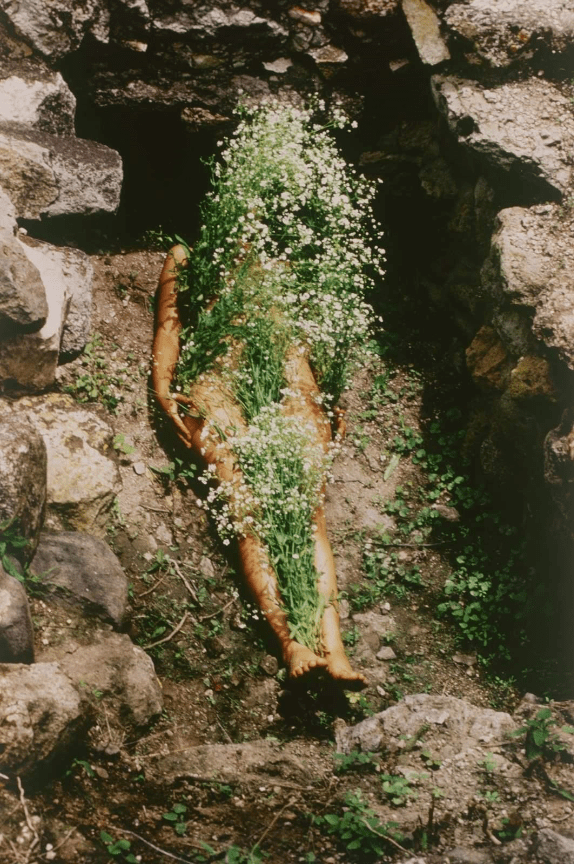
Mendieta explored the complex facets of tomb imagery in her art, particularly in Imágen de Yágul (1973), where her reclining nude form lies within a rocky tomb; her upper body obscured by plumes of fresh green and frothy white flowers that seemingly grow from her flesh. Located in a grave at the Zapotec archaeological site of Yágul in Oaxaca, Mexico, this complete submersion within nature was described by Mendieta as a “return to the maternal source…the original shelter within the womb”, aligning the womb and nature with tomb imagery. Like Shiota, Mendieta was influenced by childhood memories, especially of crawling across sandy beaches in Cuba — speaking to the significance of bodily interaction with the earth to her life and art. Her identification with nature is clearly characterised by ideas of both life and death, mirroring the complexity of her longing for her homeland during her exile. The tomb, which was covered in sprouting weeds, was a site of renewal, working in conjunction with the work’s allusion to Mexican funerary rituals to centre the cycle of life.
Both Shiota and Mendieta explore similar themes through their use of the body, creating work that is highly unique to their lives and experiences. Whilst Shiota’s exhibition Threads of Life recently closed, you can see Ana Mendieta’s work on display in a blockbuster retrospective at Tate Modern from 15 July.
Edited by Jayden Jin
Cover image: Ana Mendieta, Imágen de Yágul, from the Silueta series, 1973, chromogenic print, 50.8 x 35.3 cm, San Francisco Museum of Modern Art, California. Image: The Estate of Ana Mendieta Collection.




Leave a Reply