Perhaps the most famous work of the British-born contemporary artist known professionally (and formally) as Stuart Semple, is a small jar listed on his website as PINK (multiple), 2016. In contemporary culture, however, this is not how the work is known. Claiming to be the world’s ‘pinkest pink’, the container of pigment is available to purchase on Semple’s website through his commercial venture, CultureHustle.com. Yet curiously, despite being described as a ‘super bright high pigment fluorescent pink powder paint’ in Semple’s online store – seemingly implying that this is a paint, and therefore a purchasable art material rather than a piece in its own right – the pink is also listed amongst his artistic works.
Semple does not restrict his oeuvre to single instances of works. The fact that it is listed as PINK (multiple) rather than simply PINK suggests that it is the idea of the pigment in general that constitutes the work, rather than any specific portion of the pigment. The choice to list the pink as a work seems bizarre; it stands out as incongruous with the rest of Semple’s portfolio, none of which are commercial products. Yet, at the same time, the logic behind it is evident: PINK (multiple), despite its status as a commercial art material that comes into tension with its classification as a work of art in its own right, is Semple’s most infamous piece.
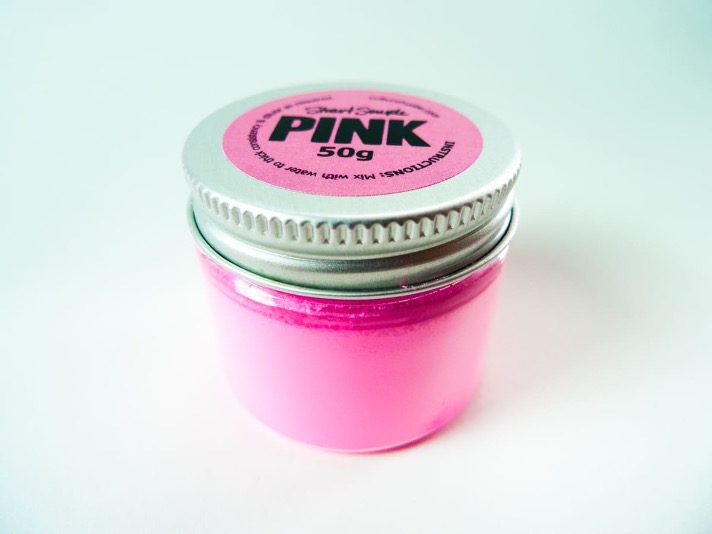
4.5 x 6 x 4.5 cm. 2016 onwards. Image Credits: Stuart Semple via <https://stuartsemple.com/>.
The story of the world’s self-proclaimed ‘pinkest pink’ – which is celebrating, as Semple’s website advertises, its tenth anniversary – starts not with Semple, but with the conceptual artist and sculptor Anish Kapoor. Kapoor, best-known for his Cloud Gate that stands in Chicago’s Millennium Park, explores matter and materiality throughout the construction of his practice. It is as part of this material-oriented corpus that Kapoor decided in 2014 to liaise with the engineering company Surrey NanoSystems, who were developing a chemical coating that would reflect less than 0.1 percent of visible light.
Composed of vertically aligned nanotube arrays, the compound – named Vantablack – was intended initially for use in the engineering sector. Its absorption capabilities and relative stability made it a sought-after material, although it bore warnings that it may cause eye and respiratory irritation upon contact and while extensive contact with the Vantablack was not recommended, it was nonetheless not overtly life-threatening. Nonetheless, Vantablack was not, nor was it ever intended to be, released as a publicly available commercial product. Its application process was complex and ill-suited to being performed in studio (as opposed to laboratory) contexts. It was likely Kapoor’s existing portfolio of work, in combination with his renown as an artist, that prompted Surrey NanoSystems to grant him an exclusive license to apply Vantablack S-VIS, a sprayable Vantablack compound, in his artwork.
The debut of Kapoor’s Vantablack works would come at the 2022 Venice Biennale. The controversy surrounding their production needed not to be so patient. Kapoor’s exclusive license to use Vantablack as an artistic material sparked an outrage amongst the online art world: the idea that only one man in the world was legally allowed to utilise a very unique pigment was decidedly unpopular among artists. Christopher Furr and Stuart Semple were two of the most outspoken voices condemning the move to negotiate exclusive use on Kapoor’s part. However, whilst Furr was content merely to offer verbal criticism of the contract between Surrey NanoSystems and Kapoor, Semple chose instead to position himself against Kapoor in a materialistic sense; in an oblique reference to Vantablack’s laudation as the ‘blackest black’ ever made, he released a pigment titled the ‘pinkest pink’ and made it publicly available for purchase to anyone bar Anish Kapoor.
Semple’s foray into the world of commercial pigments constituted a radical shift in the dynamics of the Vantablack discourse. Vanishing the lopsided dichotomy between actor and critic, a new narrative emerged, painting a much more even-footed feud between Kapoor – epitomised as a prong of the establishment, wealthy and representative of the art world’s elites – and the scrappy, up-and-coming Semple, the people’s man who stood in for the working-class artist pushing to democratise access to art, whilst Kapoor aimed to hoard and restrict it. The release of the ‘pinkest pink’ provided the push for those following the controversy to, however ironically, ‘vote with their wallets’. A disclaimer on Semple’s website made it abundantly clear that the act of purchasing the ‘pinkest pink’ was an act of allegiance – a disclaimer on the online listing, present on the website to this day, reads a demand that the customer confirm that they are not Anish Kapoor, and to the best of their knowledge, will not aid Kapoor in accessing the pigment.
Semple’s underdog position catapulted him into the internet’s limelight; online outlets such as the Smithsonian Magazine ran headlines framing the controversy as a feud between the elite and the working creative. Briefly, among the outrage that Kapoor’s exclusive license sparked, Semple and his studio were championed as the voice of the common people. Supporting Semple’s business financially became a moral act in a loosely-defined ‘culture war’. Even Kapoor himself bought into the childish rivalry, acquiring a pot of the ‘pinkest pink’ despite Semple’s ban, and posting a photograph of his middle finger covered in pink to his Instagram, captioned ‘up yours’.
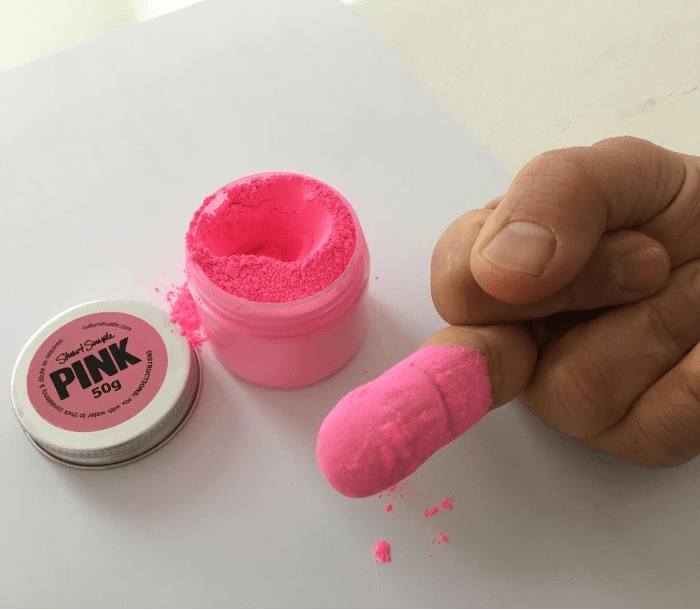
Image Credits: Anish Kapoor via <https://www.instagram.com/p/BOWz73wgj7R/>.
All this has come to create a picture that Semple was, in accordance with the general public’s consensus on the matter, financially rewarded for inserting himself into the Vantablack controversy and setting himself up as a heroic counterpoint to Anish Kapoor. Semple himself is far from the everyman he portrays himself to be, despite his working-class origins. By the time he released his ‘pinkest pink’, Semple was already a successful artist, and at 21, had his first solo exhibition in London at the A&D Gallery. In 2007, Semple’s exhibition ‘Fake Plastic Love’ at the Truman Brewery broke a million dollars in sales within the first five minutes of its opening. This career trajectory is immensely dissonant with the character that Semple played during the controversy – the very character that led to Culture Hustle’s financial success – and belies the marketing stunt that underpinned the production of the ‘pinkest pink’.
Almost paradoxically, the idea of Kapoor (at this point quite abstracted from the real-life personage) became a tool for Semple to command cultural relevance. In 2024, he legally changed his name by deed poll to “Anish Kapoor” and listed two limited runs of drawings signed ‘A. Kapoor’ for sale on his website, again galvanising reporters to remind the public of the eight-year-long ‘art feud’ that had long since died down. Having made his point, Semple claimed, he returned to using his own name professionally later that year; in 2026, his latest limited run of low-end drawings – prices at £70 each – capitalises instead on a different controversy featuring a disgraced TikTokker who met with Semple and asked for, but did not receive, a job offer at his studio.
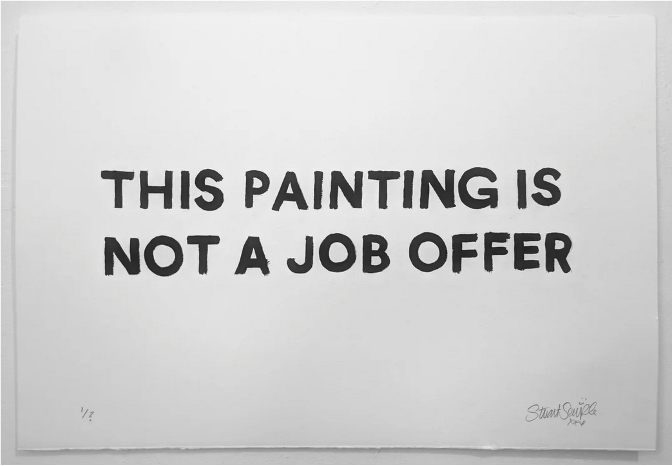
56 x 38 cm. Image Credits: Stuart Semple via <https://stuartsemple.com/>.
Semple was famous before he capitalised on his feud with Kapoor, with a 2012 article from the Standard describing him as an ‘art superstar’, but it was the controversy that drove him to infamy. In the late 2010s, the names Stuart Semple and Anish Kapoor became metonymic for the good and evil of an art world that the general public only tangentially understood, and Semple had come up on the right side of it. Looking at Semple retrospectively, the choice to enter the market at the specific time and place at which he did constitutes a calculated move to corner a new market outside of the elite circles of contemporary art commerce where he made his previous millions. Undoubtedly, Semple emerged from the controversy better off than Kapoor, having constructed a secondary consumer base and emerged with a far more flattering reputation. Culture Hustle has expanded beyond the ‘pinkest pink’, selling affordable art materials and culture-war relics to a general audience that would not have the means to buy into a market of high-end contemporary art.
All this is not to claim that Semple is a malicious figure. The public persona that Semple presents is understood to be inauthentic, and is considered by many to lie within the realm of performance art. Yet, Semple’s ongoing performance is somewhat clandestine, nestled in the peculiar disjuncture between subjectivity and identity that the public figure occupies – a domain where a degree of performativity is already to be expected. The role he plays is a sympathetic one; he embodies the guise of the free creative, the artist, the democratising advocate of art for the people and art for art’s sake. And yet, this performance, like so many of his works before it, is invariably a commercial act. Semple plays the artist, and the artist – as attested to by the financial returns on his investment in online controversy – is an advertiser.
Edited by Alison Grace Zheng
Cover Image: Anish Kapoor, Instagram post of Kapoor with Semple’s ‘Pinkest Pink’, 2016. Image Credits: Anish Kapoor via <https://www.instagram.com/p/BOWz73wgj7R/




Leave a Reply