Louisa Bermingham’s A Personal Ecology at the Masterworks Museum of Bermuda Art is an exhibition that resists the clean separation of painting, object, and environment. A Personal Ecology constructs a porous, sensorial field in which images and things circulate with an almost conversational ease. The exhibition feels less “installed” than gently grown into being. At first encounter, Bermingham’s paintings strike with immediacy. The flora portraits are saturated as though the color itself hydrated, and allowed to remain in a state of gentle suspension. A leaf, a stem, a vessel, a shadow: not asserted as fixed motifs, but as recurring presences that flicker in and out of clarity.
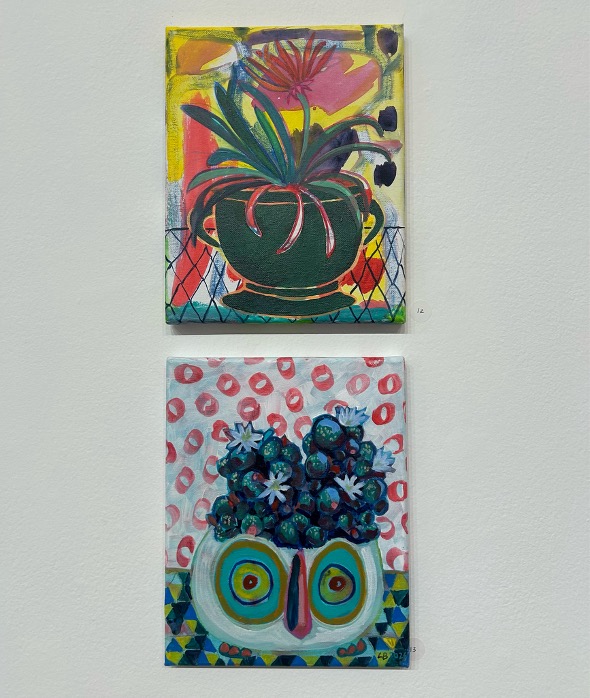
Walking through the Rick Faries Gallery at Masterworks Bermuda, you get a sense that these paintings are not just depictions of a world, but records of attention moving through it. Bermingham’s visual language is relational, colour generates and responds to the forms, rather than being purely descriptive. The viewer is drawn into a field where looking becomes an active, bodily experience: slow, receptive, and cumulative.
Yet, A Personal Ecology is not confined to the painted surface. One of its defining qualities is the way it extends painting into space through a curated constellation of objects: ceramic objects, branches, found materials, and small sculptural presences are arranged across wooden shelving. The relationship between these pieces creates a sense of play and a visual fluency, as if the paintings and objects come from the same lush, organic universe that the viewer becomes privy to through the exhibition.
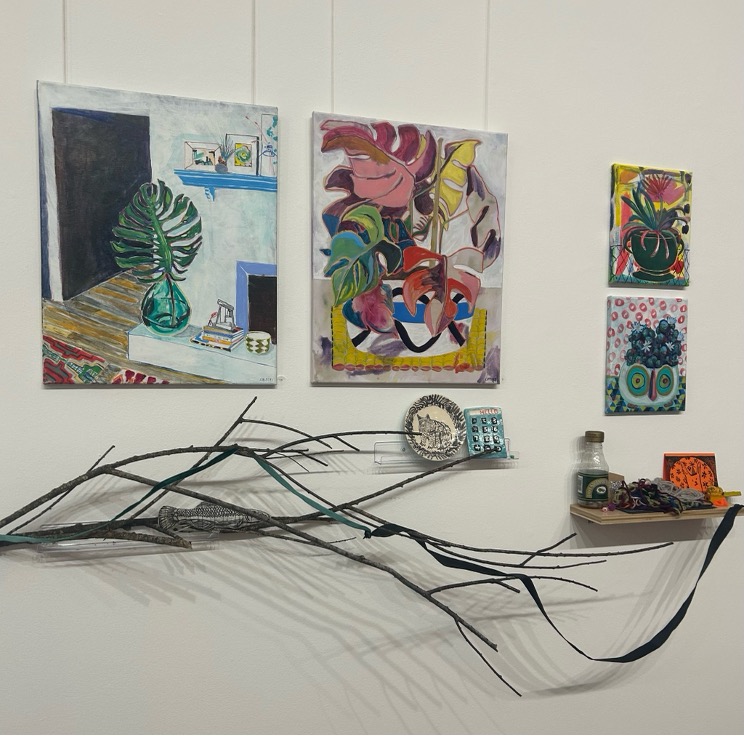
The ceramics, in particular, carry a striking sense of kinship with the painted works. Their glazed surfaces echo the chromatic intensity of Bermingham’s palette, catching light in ways that feel almost painterly. There is a subtle exchange between mediums: what is fluid in paint becomes solid in clay; what is reflective in glaze finds its counterpart in layered pigment. Across this exchange, one senses a consistent sensibility at work, an attentiveness to surface, to touch, and to the quiet expressiveness of material transformation.
The arrangement of these elements on simple wooden shelves reinforces the exhibition’s refusal of hierarchy. Nothing is elevated into overt preciousness. Instead, objects are allowed to accumulate in a way that feels organic, even provisional, as though they might be rearranged or re-seen at any moment. Branches lean, figurines rest, ceramic pieces sit with an unforced dignity. This staging frames the exhibition not as a fixed statement, but as a living arrangement, an ecology in the most literal sense, where entities coexist without dominance.
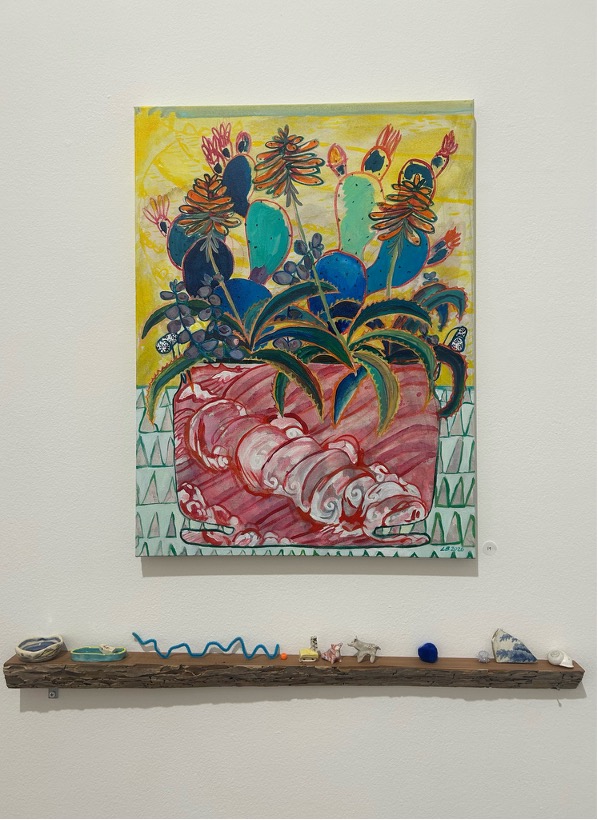
The curatorial voice, that being of Jasmine Lee, present, but soft. By placing disparate materials in dialogue, the exhibition encourages the viewer to notice correspondences that are not declared but discovered: a curve echoed between painted line and ceramic rim, a tonal harmony between bark and pigment, a shared fragility between object and image.
Importantly, Bermingham’s practice avoids sentimentality even as it embraces intimacy. The “personal” in A Personal Ecology is attentive, not confessional. It signals a mode of engagement with the world that privileges noticing over narrating. In this sense, the exhibition aligns itself with a broader tradition of artists who treat everyday materiality not as backdrop but as subject, where looking closely becomes an ethical act, a way of acknowledging the quiet significance of things that might otherwise be overlooked.
As one moves through the space, the experience becomes increasingly rhythmic. There is no singular focal point, no culminating image toward which everything builds. Instead, meaning accrues laterally, through repetition and echo. The viewer is invited to drift rather than proceed, to linger rather than resolve. This temporal openness is one of the exhibition’s greatest strengths: it refuses urgency and instead cultivates duration.
By the time one exits, what remains is less a collection of discrete impressions than a sustained tonal afterimage. The exhibition leaves behind a sense of continuity between seeing and being seen, between object and environment, between artist and world. Bermingham offers not resolution but relation, a practice rooted in attentiveness, where beauty arises not from isolation but from coexistence.
In its quiet confidence and material generosity, A Personal Ecology succeeds in doing something deceptively simple and deeply difficult: it makes looking feel like care.
Edited by Saffron Watkins
Cover Image: Left: Louisa Bermingham, Blue Shelf, 16” x 20”, 2024 — Right: Louisa Bermingham, Bruises, 16” x 20”, 2025. Image taken by author.

 Paper Galleries
Leave a comment