A woman lies flat on her back, legs extended, and a child draped face down over her torso. Both are dead. This is Käthe Kollwitz’s 1922 work, The Widow II, part of her famous woodcut series, War, which she began producing in 1919 in response to the horrors of World War I. Seized by desperation, the mother has taken both her life and that of the child’s, a last-ditch effort to protect them from any further pain that could be inflicted by the war. Unlike most war art, which focuses on front-line soldiers, Kollwitz’s art took the lives of ordinary people left behind, largely mothers and children, as its subject instead. Refusing to sensationalise the visceral acts of violence in combat, she painstakingly detailed the emotional burden of grief and loss, taking human suffering as her muse.
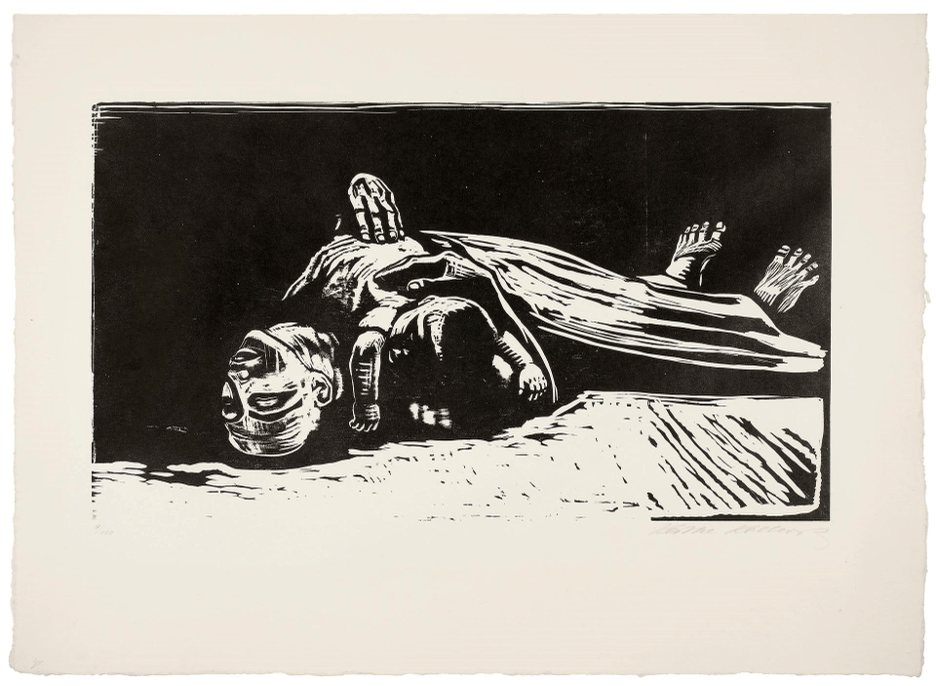
Kollwitz was motivated by a sense of duty to share the reality of war’s effects, which German propaganda grossly underplayed and even idealised as a source of national pride. She worked largely with woodcuts, which were affordable and could be easily reproduced, therefore exposing the public to a different perspective. Her works are honest. Through sharp lines, stark forms, and a largely black-and-white colour palette, she addresses the devastating emotional consequences of the war in a shockingly blunt and candid manner.
In contrast to the bold colour, fragmented abstraction and innovative materiality that characterised most Modernist art of the period, Kollwitz blazed her own trail. Tending to work with traditional media, from woodcut to bronze, her intense sympathy and own personal experiences of loss resulted in her figurative representations bearing the purest form of primal human emotions. Rage, loss and sadness pulsate through every line she draws and every shape she forms. Her ability to convey the emotions of grief in their purest forms stems from her own experience of mourning, having lost her younger son, Peter, at the frontline in 1914, aged only eighteen.
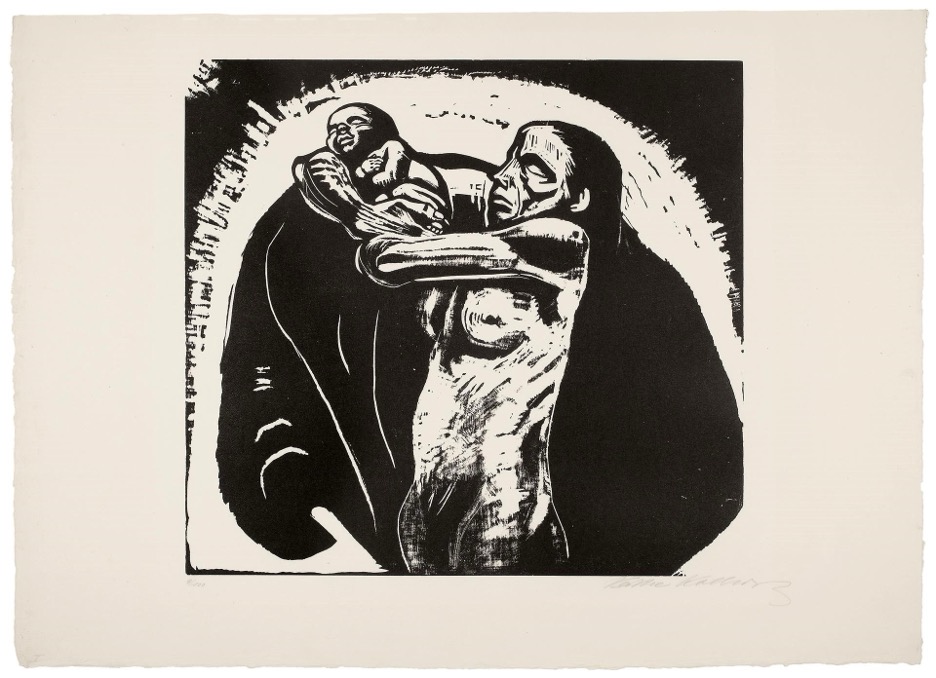
This likely feeds into her fascination with the relationship of the mother and child, a recurring theme in her oeuvre. Also part of the War series, The Mothers (1921-22) depicts a huddle of women in a defensive, impenetrable mass, shielding two children and a baby from being taken for future wars. Whilst the women are locked together in a display of solidarity and strength, the atmosphere is still charged with anxiety; the threat of losing another generation of men to the militaristic conflicts of their country is rife. This overwhelming sense of helplessness dominates The Sacrifice (1922), in which a woman offers up her baby to the war effort. She is nude and vulnerable, whilst her eyes are shut. Can she not face her own complicity in giving up her child? Or perhaps her closed eyes in fact hint at her blindness, unknowingly sending her child to his death, particularly since the consequences of signing young boys up for the war were minimised by governments, usually disguised as an act of patriotism. Infants were not recruited for military efforts, but the youthful innocence of the child is entirely intentional, emphasising the naivety of the boys who were taken advantage of by governments across the globe, forcing them to fight a war they did not start. Injustice permeates from the woodcut’s harsh lines.
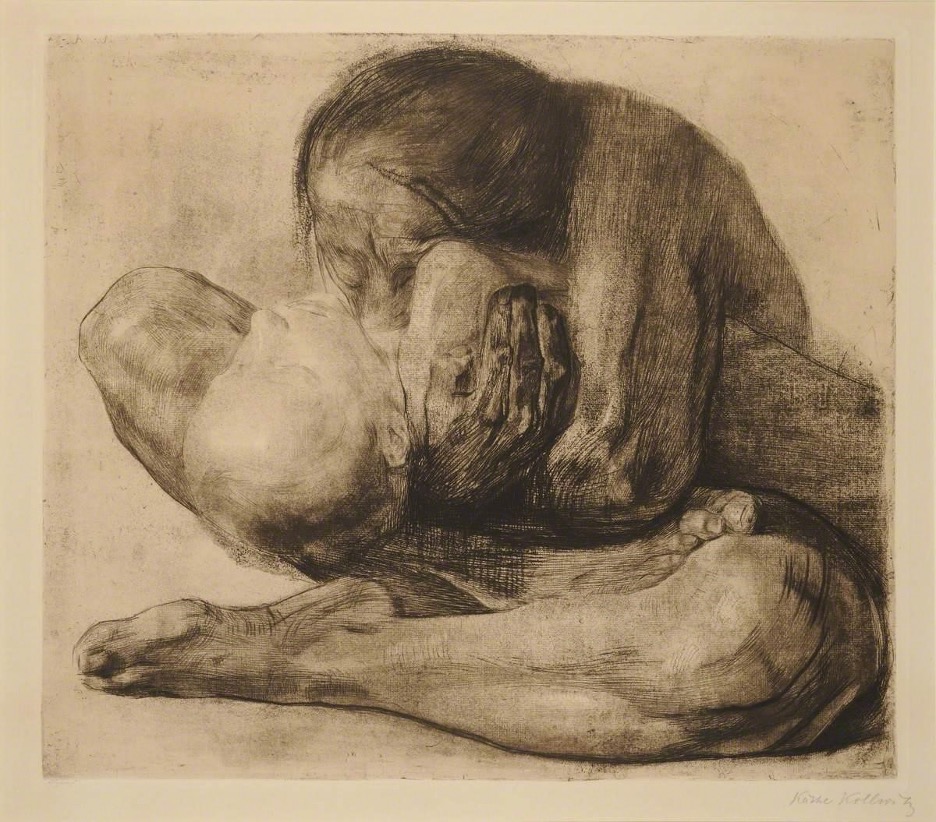
Kollwitz did not exclusively work with woodcuts. She is also known for her etchings, in which she builds up forms that are simultaneously naturalistic and distorted through a hatchwork of fine lines. An earlier piece, Woman with Dead Child (1903), provides a haunting illustration of loss. The image of a grieving mother holding her dead child alludes to the biblical icon of the Pietà, but unlike the gleaming beauty of its most renowned version, Michelangelo’s marble sculpture, Kollwitz strips the figures back to their most fundamental aspect: maternal anguish. Her nude body is in an animalistic contortion of agony that engulfs the ephemeral form of her son’s corpse in a display of the primal bond between a mother and child. It is lacking in the serenity and composure of Virgin Mary’s past. Modelled on Kollwitz and her seven-year-old son in 1903, there is a tragic, prophetic sense of knowing that in just over a decade he will pass — Kollwitz claimed she felt that Peter was destined to die young. Clearly haunted by his premature death, she returned to the subject decades later, this time working in bronze. Pietà (Mother with dead Son) (1937-39) is an intimate depiction of all-consuming maternal grief. Unlike traditional representations of the son’s body draped over the mother’s lap, here, his lifeless frame slumps to the ground between his mother’s legs, protectively encased in her voluminous drapery and almost taking on a foetal position, life and death connected in a single moment.
Edited by Jayden Jin
Cover Image:
Käthe Kollwitz, Woman with Dead Child, 1903, etching on paper, 42.5 x 49 cm, MoMA, New York. Image: https://artuk.org/discover/stories/write-on-art-kathe-kollwitzs-woman-with-dead-child




Leave a Reply