The painting Central Railway of Brazil (1924) by Tarsila do Amaral reflects the transformation of Brazilian culture during the early twentieth century. Created during a period of intense artistic experimentation, the dynamic piece exemplifies the principles of Brazilian modernism by combining simplified forms, vibrant colour, and symbolic references to modernization. Through her treatment of shape, line, space, and colour, Amaral constructs a visual narrative about Brazil’s developing national identity and the tension between rural traditions and industrial progress.
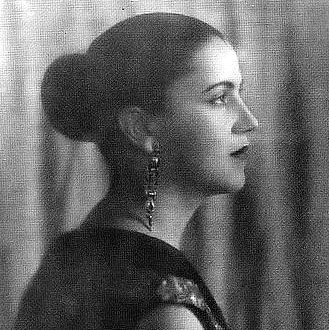
Amaral was a central figure in the Brazilian modernist movement, which emerged in the 1920s following the cultural shift sparked by the Semana de Arte Moderna. This movement sought to break away from European academic traditions and create a distinctly Brazilian artistic language. Although Amaral studied in Paris and was influenced by avant-garde movements such as Cubism and Purism, she adapted these stylistic elements to represent Brazilian landscapes, architecture, and social realities. Central Railway of Brazil illustrates this synthesis of European modernist techniques with local subject matter.
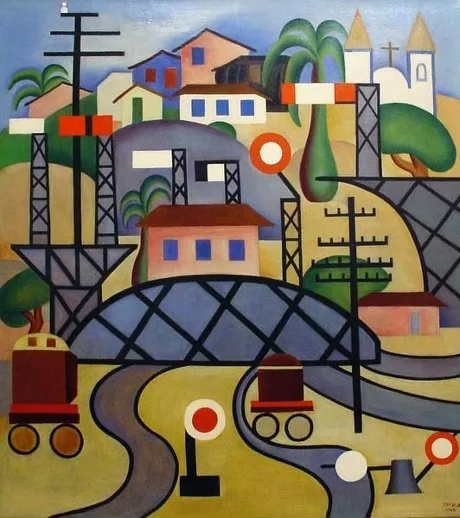
One of the most striking aspects of the painting is Amaral’s use of shape. The composition is constructed from simplified geometric forms that create a dynamic yet balanced visual structure. Buildings, trees, hills, and the church are rendered in rounded and stylised shapes rather than detailed naturalistic forms. These shapes give the painting a sense of vitality and youthfulness, which may be interpreted as reflecting Brazil itself as a nation undergoing cultural and industrial development. The simplified shapes also evoke the influence of Cubist formal reduction, yet Amaral transforms these forms into a uniquely Brazilian visual vocabulary by incorporating elements of rural architecture and tropical vegetation.
Line also plays a significant role in organizing the composition and emphasizing the theme of modernization. The railway track cuts sharply through the landscape, forming a strong linear element that contrasts with the softer curves of the surrounding hills and buildings. This contrast between rigid lines and organic shapes creates a visual tension within the scene. The railway functions not only as a compositional device but also as a symbol of industrial expansion and technological progress. Its direct, linear movement suggests the arrival of modern infrastructure into traditional rural environments, reinforcing the idea that Brazil was entering a new era of development.
Amaral’s treatment of space further contributes to the meaning of the work. The village, natural landscape, and railway are arranged in flattened planes that overlap rather than recede into deep perspective. This flattening of space reflects modernist experimentation with pictorial depth and emphasizes the decorative qualities of the composition. At the same time, the elements of nature, trees, hills, and sky are closely intertwined with the buildings of the village, suggesting a harmonious relationship between the natural environment and human settlement. However, the railway disrupts this balance by cutting through the landscape, visually dividing the scene and symbolizing the intrusion of industrialization into a previously unified environment.
Perhaps the most striking element of the painting is Amaral’s use of colour. The palette consists of bright, saturated tones including pinks, greens, blues, and yellows. These colours create a lively and optimistic atmosphere that celebrates the vibrancy of Brazilian culture and landscape. At the same time, the bold colour contrasts draw attention to specific elements within the composition, particularly the church and the railway structures. The church, rendered prominently within the village, may suggest the enduring influence of religion and colonial heritage in Brazilian society. By placing this traditional symbol within a modernized landscape intersected by a railway, Amaral highlights the coexistence of past and present in Brazil’s evolving identity.
Colour also reflects Amaral’s broader artistic rebellion against European naturalism. Rather than imitating realistic lighting or tonal gradation, she employs colour expressively and symbolically. This approach aligns with the goals of Brazilian modernists, who sought to reject academic conventions and embrace experimentation. Amaral’s vibrant palette contributes to the distinctive visual identity of her work and reinforces the idea that Brazilian modernism was not simply a derivative of European movements but a creative reinterpretation shaped by local culture.
Central Railway of Brazil demonstrates Amaral’s ability to merge modernist formal innovation with social and cultural commentary. The painting captures a moment in Brazil’s history when rapid industrialization and modernization were reshaping the nation. Through simplified shapes, contrasting lines, flattened space, and vivid colour, Amaral conveys both the excitement and the disruption associated with these changes. The railway becomes a powerful metaphor for progress, while the surrounding village and natural landscape remind viewers of the traditions and environments that modernization inevitably transforms.
Edited by Saffron Watkins
Cover image: Amaral, Tarsila do. Central Railway of Brazil (Estrada de Ferro Central do Brasil). 1924.





Leave a Reply