For this month’s edition of the Paper Galleries, I was graciously invited to speak with Tucker Drew and Tilde Fredholm at Lévy Gorvy Dayan about the gallery’s current exhibition on Juanita McNeely, organised in collaboration with James Fuentes Gallery in New York. Tucker and Tilde worked on the curation and research of the show alongside gallery director Victoria Gelfand-Magalhaes.
Juanita McNeely was a New York based artist whose work spanned from the 1960s to the early 2010s. She worked closely alongside other seminal women artists of the period, such as Louise Bourgeois, Joan Semmel, and Alice Neel, creating an expansive oeuvre reflecting a groundbreaking feminist approach. Her viscerally vivid large-scale paintings explore ideas of the female experience. She contorts and flays the human figure to prod at the innate physicality of subject matter like sexual intimacy, reproductive trauma, and living with disability. McNeely’s work, while often graphic and gut-wrenching, also contains elements which belong to the artist’s wider interest in performance, making evident the multitudinous nature of Juanita’s work and differentiating her within the canon of feminist art. Lévy Gorvy Dayan is proud to be hosting Juanita’s first ever solo presentation in the UK.
Vivien:
When did the gallery first become interested in this artist?
Lévy Gorvy Dayan:
McNeely’s work came to our attention in relation to an exhibition we did showing the work of Marcia Marcus, Alice Neel, and Sylvia Sleigh—The Human Situation, which took place in our New York gallery—which explored a particular field of painting in the context of 1970s and 80s New York, the strength of women artists at the time and their subject matters. The starting point for the McNeely exhibition then became the amazing and powerful oeuvre of paintings that she left behind, and oeuvre which, despite an active and impactful career, has
been, like many women of her generations, overlooked.
Vivien:
Why did you decide to host this exhibition now?
LGD:
This is the first time that McNeely has had a solo presentation in the UK, and it has been a great opportunity to show her works in Europe. Interesting connections have opened up during this time—we opened the exhibition in the same month as Crossing into Darkness at Carl Freedman Gallery in Margate, a show curated by Tracey Emin and for which she had selected a work by McNeely.
Vivien:
What can you tell me about the works on display?
LGD:
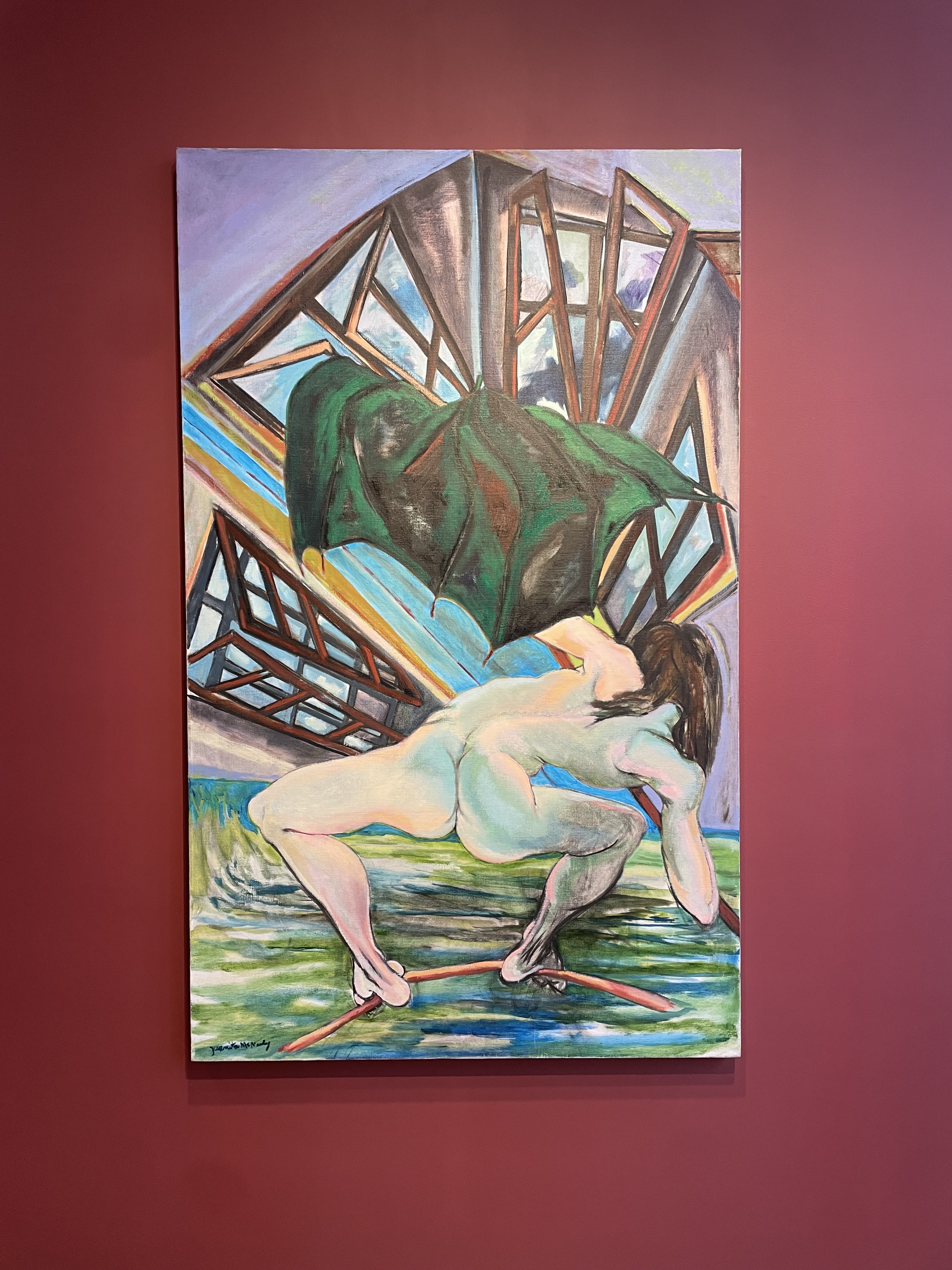
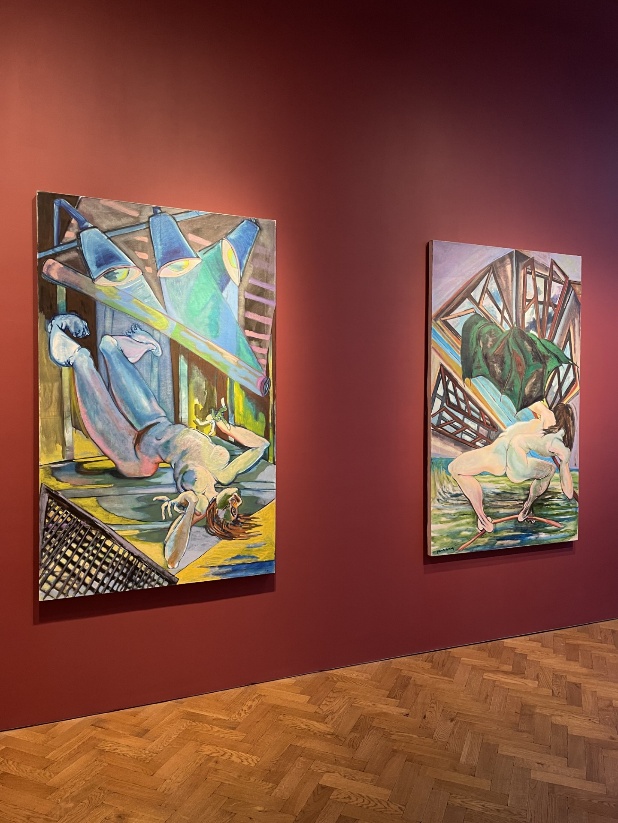
A number of the artworks on display are a part of the Windows series. These include windows and other types of architectural structures, which the artist used as a way to define her vision of space, and as elements that helped her achieve a complex and contorted sense of perspective. This perspective is rooted in her reality; she spent large parts of her life in a wheelchair, constrained within quite rigid structures. Another of these types of structures is the balancing bars of numerous paintings, alluding to, among other things, her experiences of physical therapy
LGD:
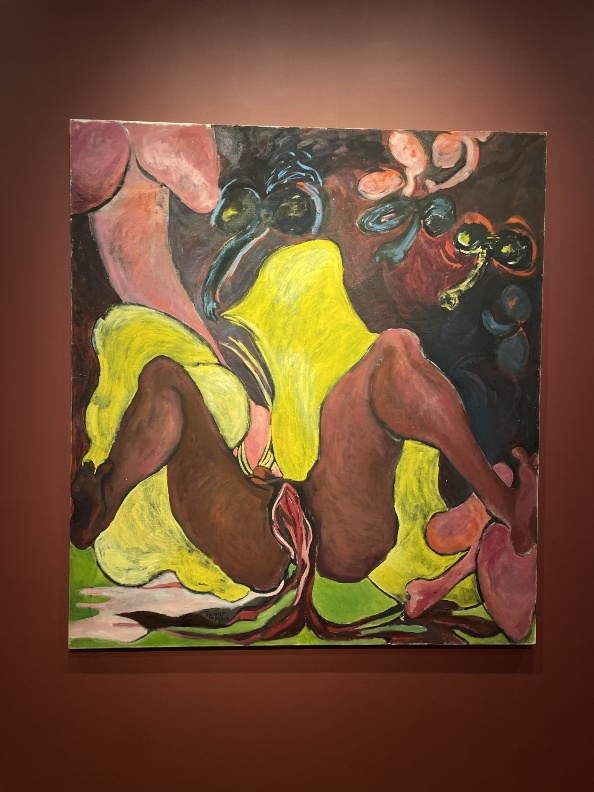
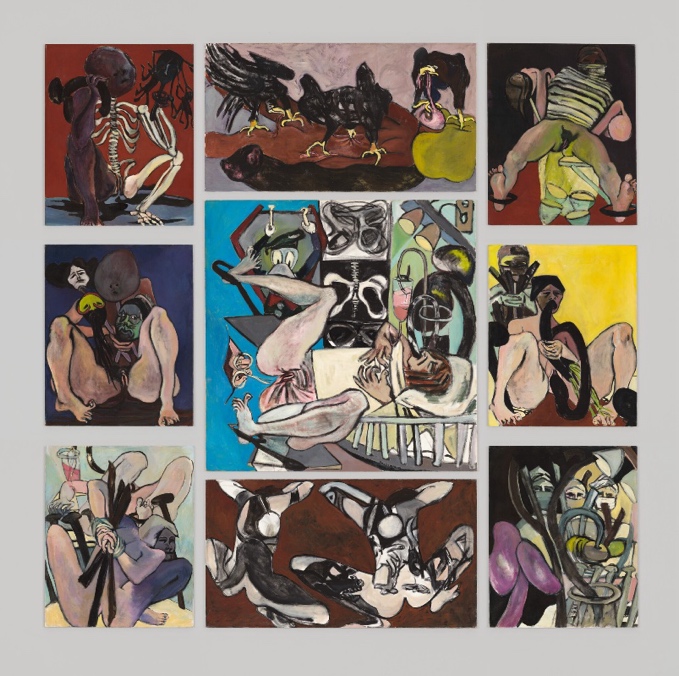
We also have two major paintings from the late 60s that show a more expressionistic, darker side of her painting. These predate the Windows series and relate to her struggles with medical treatment and the experience of an illegal abortion. Those are the very earliest works we have on display, and they were a very radical statement at the time. This was before the Roe v. Wade decision, which happened in 1973, and it depicts with incredible urgency the physical and psychological trauma relating to issues of abortion and reproduction rights.
These works show her experience in a very physical and direct way; nude female figures are laid on bare tables, very exposed and very raw. In 2022 when Roe v. Wade was overturned in the United States, the Whitney Museum in New York acquired a work that’s related to these paintings, and the paintings we have on display borrow very similar imagery, reinforcing that very powerful statement.
Vivien:
I think that’s why it’s so important to be doing this exhibition right now, especially in conjunction with the Emin show at the Tate Modern, which includes some of her most important works surrounding that theme. I’m sure that’s a huge part of the reason why you chose to exhibit this artist. Something that I notice is the sense of immediacy both artists use in depicting female anatomy during the experience of abortion; while Emin creates her sketchy monoprints, Juanita prefers to render her pain in paint. Apart from her own circumstances, what would you say are some of McNeely’s biggest influences?
LGD:
She was very influenced by expressionism, particularly German Expressionist painters, like Max Beckmann. He had a big presence in the St Louis Art Museum, where she grew up, and she would always go and look at his paintings when she first started working. From the 1960s onwards, a big source of inspiration were the artistic environments and communities she was part of in New York—including the Fight Censorship Group, founded by Anita Steckel. A shift occurred as the 70s proceeded which saw the artist open up her palette and begin to further explore the human body, and this part of McNeely oeuvre was nurtured by the communities of women artists and painters and collectives that she was part of.
Vivien:
How was her work initially received?
LGD:
There were strong reactions against McNeely’s and her contemporaries’ works. As part of the Fight Censorship Group, McNeely, Anita Steckel and others, protested the censorship of their explorations of sexuality and the nude body. McNeely had stories about both men and women coming up to her at exhibitions and saying, “what does this mean?”, “why are you painting this?”, “it’s too it’s too much blood!”, “it’s too much gore!”. Her response would have always been that these things are a part of everyone’s experience – especially women’s experience – you have the blood of giving birth, and menstruation, etc.
Vivien:
Are there any specific artworks from the exhibition that you’d like to speak on?
Tucker (LGD):
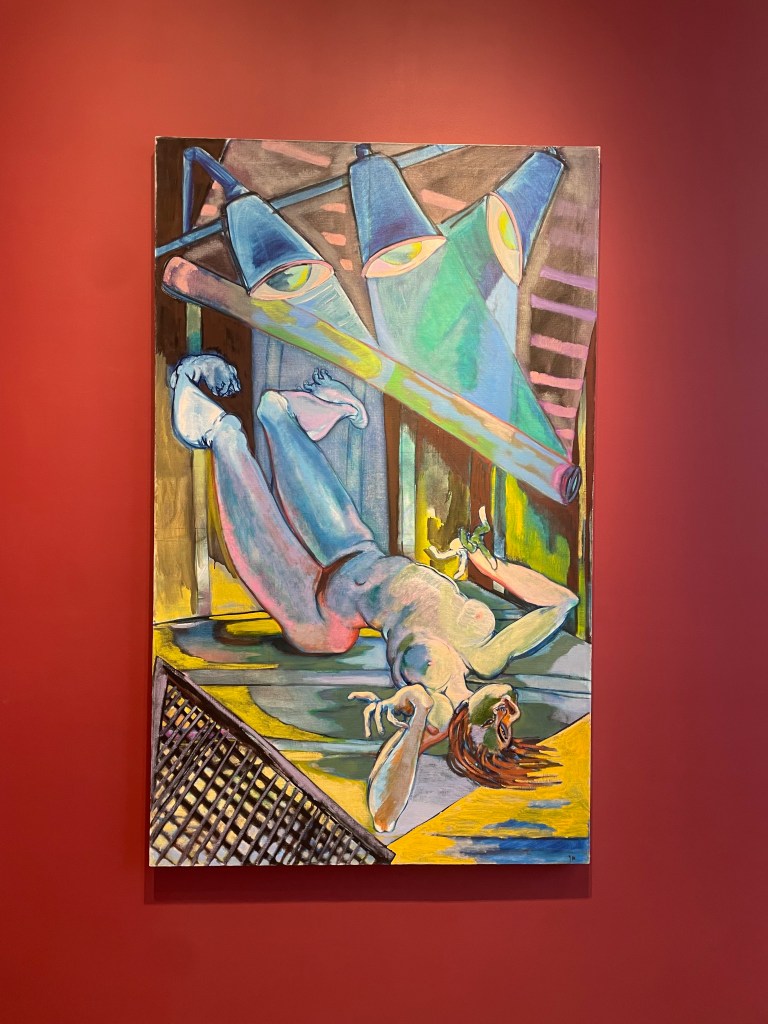
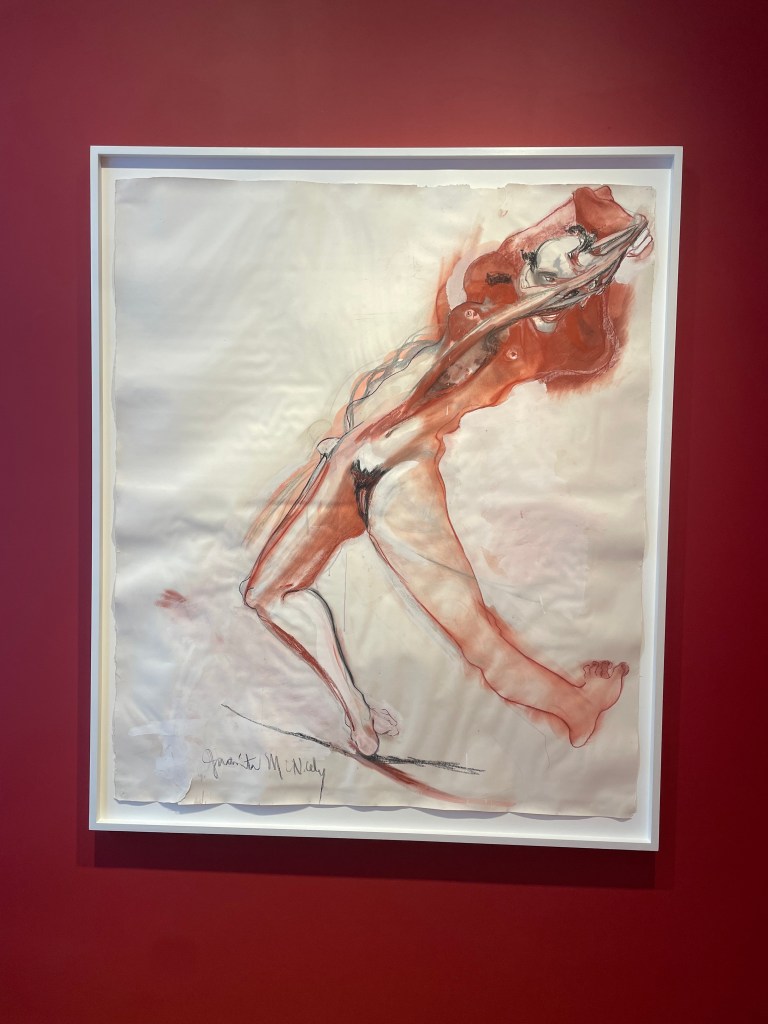
I love an Untitled work from the early 90s, depicting a contorted female body pinned under the strong light of three lamps. I think the lamps are great visual constraints, slightly different from the windows. I love the colours of that work, the blues and the greens are so vivid. If you get close to it and look at the texture, there’s this fascinating vitality to the paint which really excites me. Then also, another Untitled work, a large-scale work on paper from the 90s, shows a figure that seems to be in the process of changing form, pulling its own skin off in a very dramatic movement. The colour representing the flesh is deep and layered, really focusing the movement and composition.
.
Tilde (LGD):
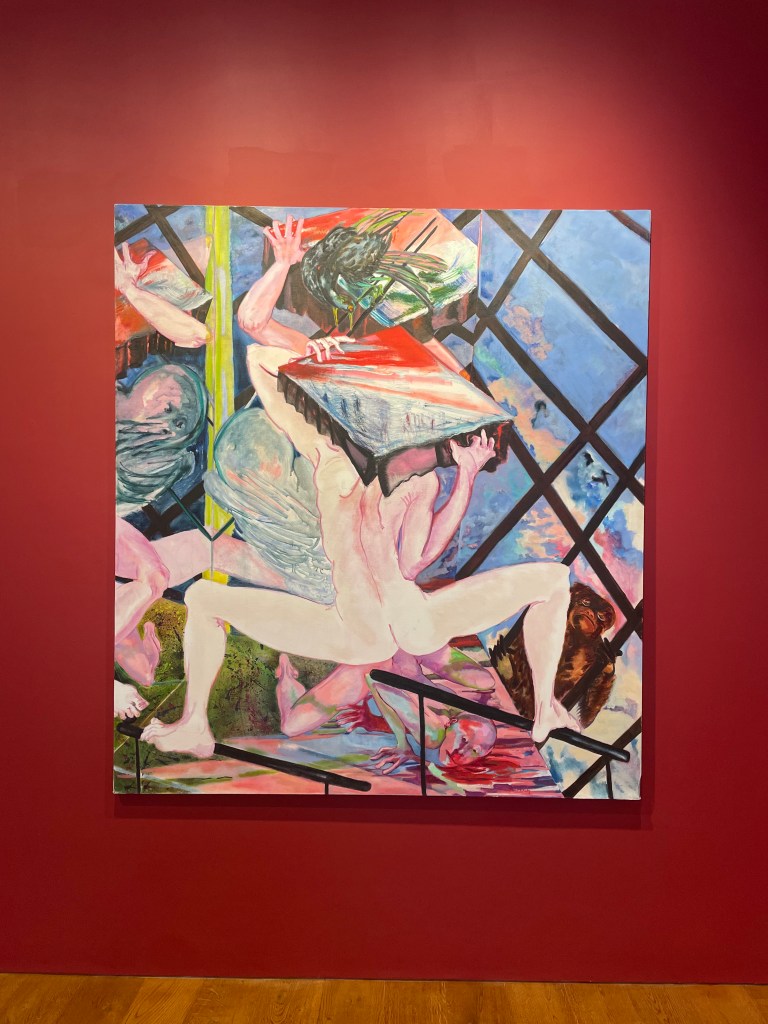
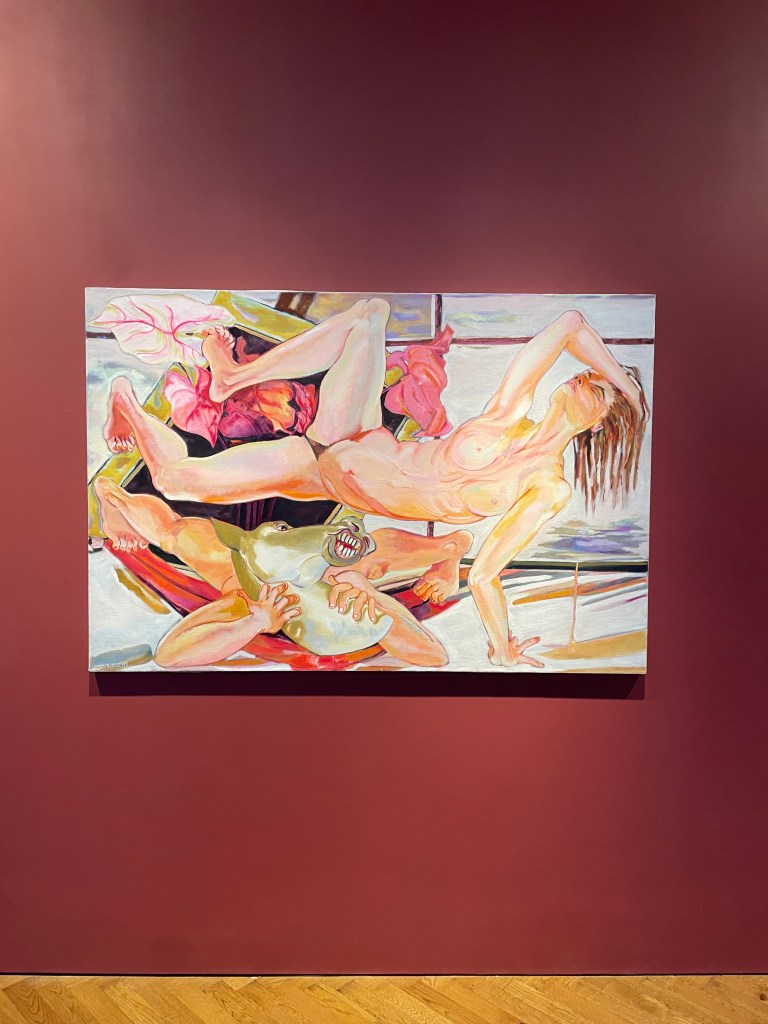
Box on Head from 1996 is a great work, showing McNeely’s ability to create imaginative and uncanny compositions. When we talk about McNeely, we often talk about her traumatic experiences, and we talk about pain and blood and anguish. But paintings like this demonstrate a very theatrical edge, reminiscent, for example, of the work of Paula Rego. A strange situation is created in this painting, from the omen-like black bird at the top through the fragmented reflections on the left and the crouching figure in the lower half.
Vivien:
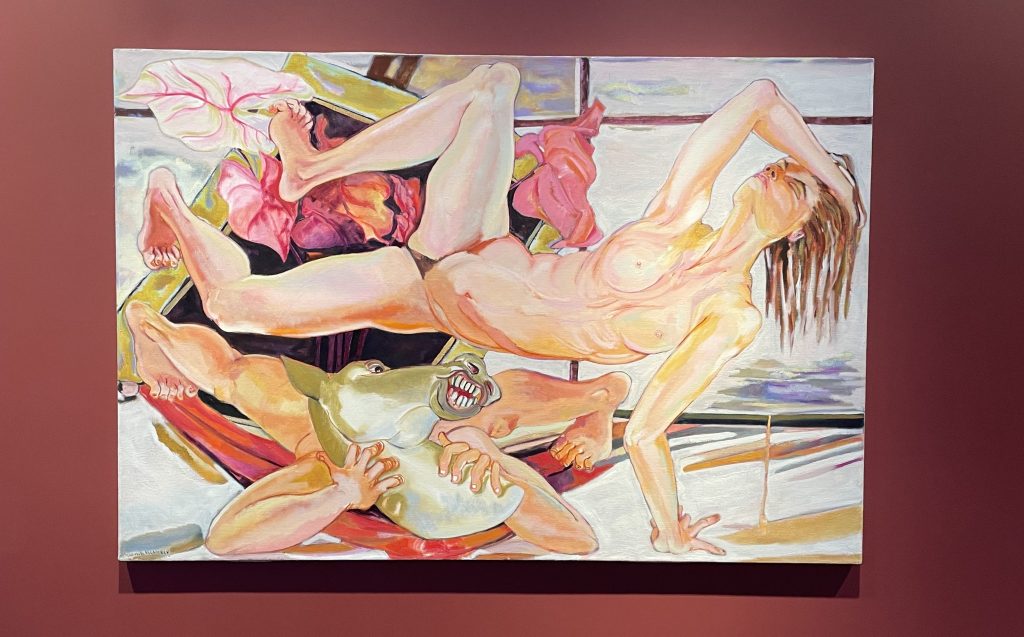
I noticed this in Caladium in Bloom as well – with the disembodied horse head and the warm, bright colours – she’s quite good at creating almost circus-like, carnivalesque scenes. I only discovered Juanita through this exhibition and this wonderful gallery space. When I first visited, one of your colleagues began to tell me about the history of this building. What do you know about the space?
LGD:
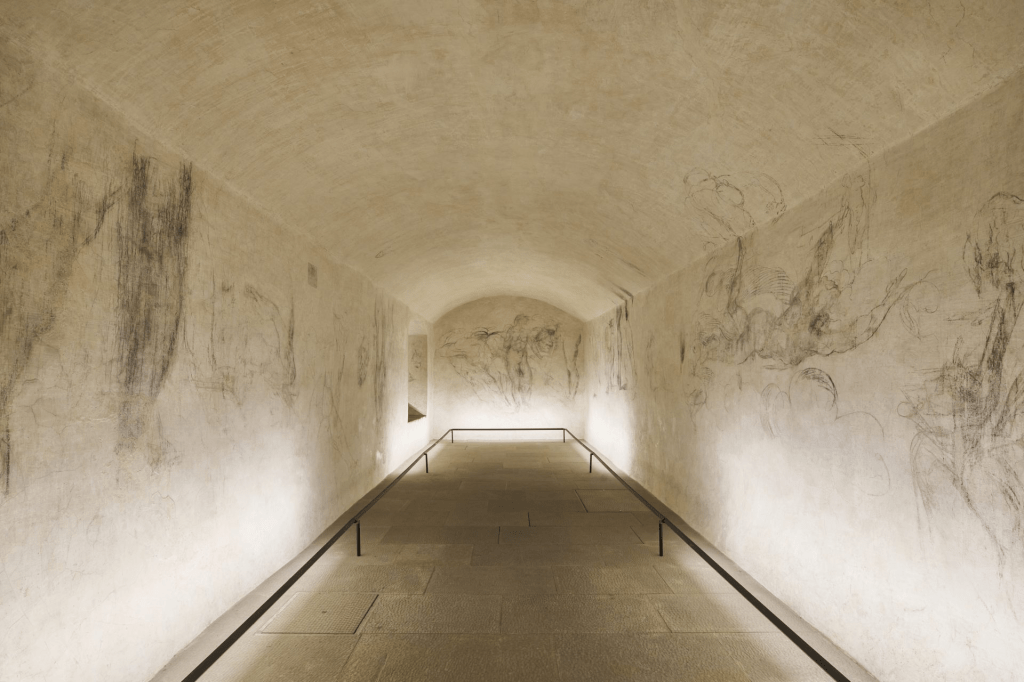
At the very end of the 1800s, this building was known as the Empress Club, and it was one of the first members clubs in London that catered exclusively to women. It became an important space, a space for women to meet and to form collectives—for example, there were many significant suffragettes coming through here. Our main exhibition room used to be the grand ballroom.
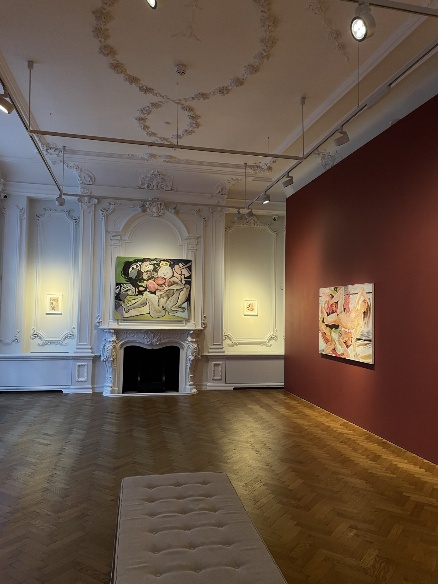
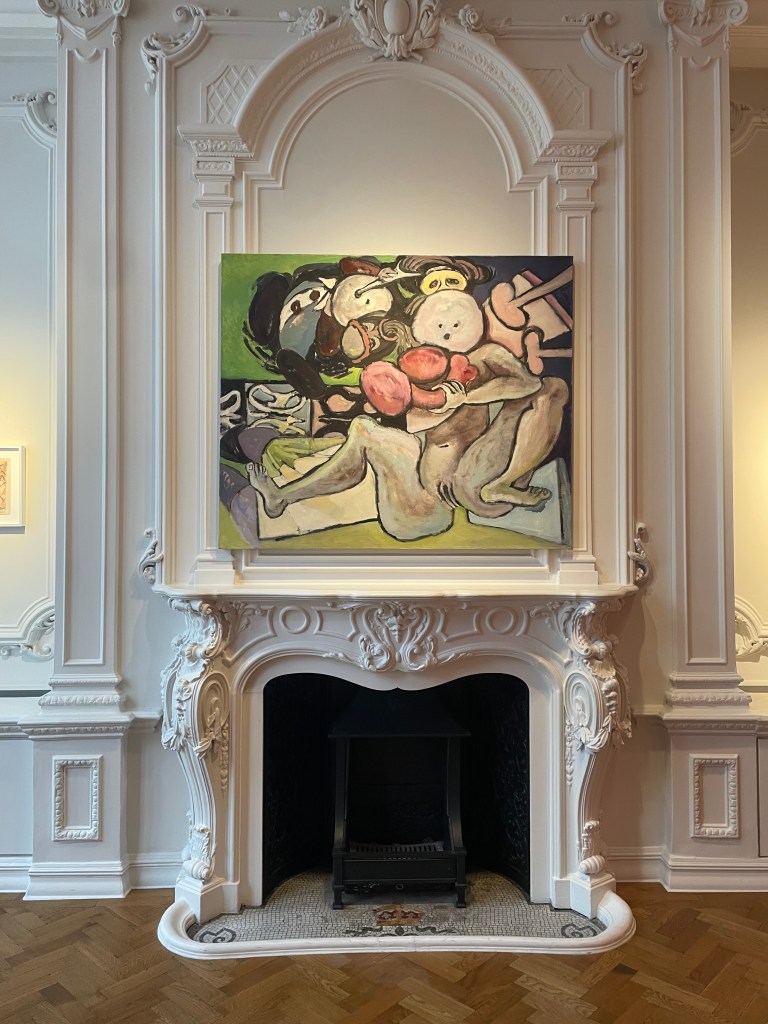
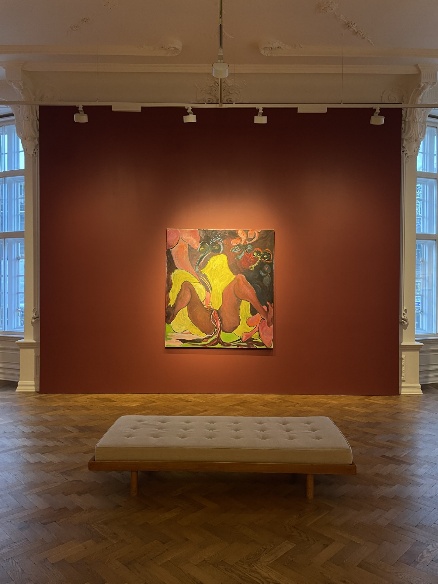
Images of the main exhibition space at Lévy Gorvy Dayan. Previously, the Grand Ballroom of the Empress Club. Photos by author.
Vivien:
It’s wonderful that you have that sense of dialogue between her as an artist, who was working with a myriad of other women artists in the 1960s, and now her works are being exhibited in this room that has such a history tied to dialogue between women around women’s rights and creating community. Thank you.
Edited by Isabel Hume
Cover Image: Juanita McNeely, Caladium in Bloom, early 1990s. Photo by author.



Leave a Reply