Collected by Budapest’s Ludwig Museum in 2013, the Transylvanian-Hungarian artist Károly Elekes’ 2011 painting Jó Katona (Good Soldier’) is currently exhibited in the museum’s celebratory ‘Big Bang’ exhibition. Functioning as a tour through how the museum’s collection has developed and evolved since its founding in 1989, Jó Katona stands in a room thematically designated as belonging to ‘Images of Destruction’ – a title that loses something of its vehemence in translation from the original Hungarian. The painting stands apart from those it is framed alongside primarily in the generic manner with which it describes its subject. The good soldier, uniformed and identifiable but himself anonymous, gazes past the viewer. He does not acknowledge the apparatus on his face – resembling horse blinders, but caving to the contours of the human skull – making literal his status as livestock to be shunted to the front line. He stands, perhaps, more for the idea of conflict in general than any particular image of destruction, setting him apart from his fellows, all snapshots into specific wars – these being mostly, given that this is a Hungarian collection, concerned with the contemporary war in neighbouring Ukraine.
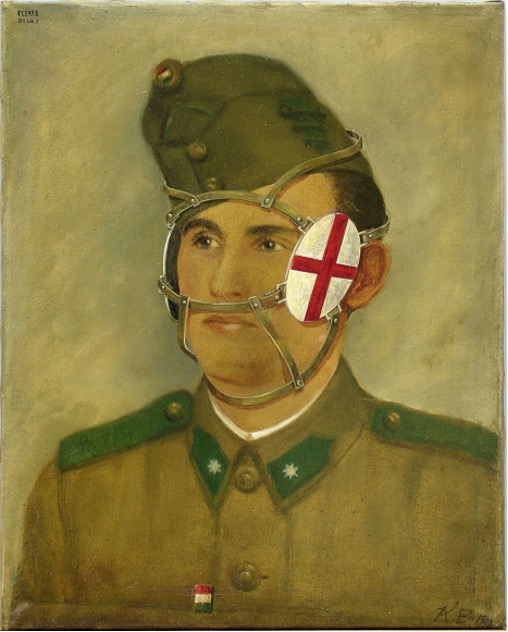
The reason for Elekes’ soldier’s odd thematic positionality comes to the fore upon closer examination. A particular clue lies in the signatures; Elekes’ signature can be found in the top left, yet in the bottom right, another one reads ‘K.E. 1903’. This is a subtle pulling back the curtain regarding the idiosyncrasies of Elekes’ artistic practice; he is known for selecting older, poorly-valued works of art and painting over them. The painting upon which Elekes is working is an honorific portrait of a Hungarian soldier; predating Hungary’s tumultuous legacy in the aftermath of the early twentieth century’s world wars, the solider comes to stand for patriotism, righteousness, and loyalty to the country. In this case, it is a loyalty to a lost homeland; this soldier serves the Kingdom of Hungary, which has not existed since the ratification of the Treaty of Trianon after the first World War.
Elekes’ remediation reinterprets this honorific (if, to use the Ludwig Museum’s own description of it, banal) portrait of an unknown man through the hindsight offered by his 21st-century vantage point. The blinders that he wears do not block his sight completely, but funnel his gaze forwards, locked onto a shameful and ruinous future that hangs forebodingly before him, and yet he can see no alternative. He cannot look away from the course that his nation and leaders have set for him. He carries the flame. The good solider is one that does not question, Elekes demonstrates, where he is going.
Beyond this reading, however, Jó Katona perhaps has more to say on the topics of surplus and remediation than it does about war. Elekes’ engagement with what he sees as ‘surplus paintings’ has a long history within his practice. This practice, which he refers to as ‘tunning,’ has been central to his oeuvre since 2003. The paintings that he selects for remediation all conform to a certain economic as well as aesthetic valuation – described by various museums as poor quality [‘szegényes’ and ‘rossz állapotú’], dilettante [‘műkedvelő vagy dilettáns’], and kitschy [‘giccses’]. The most scathing indictment of the pictorial value of the paintings that Elekes sees as candidates for ‘tunning’ comes from Székelyudvarhely’s Haáz Rezső Museum, whose description of Elekes’ 2012 ‘Tunning VIII.’ exhibition claims that Elekes works with ‘essentially, the re-utilised flea market pictures that bear aesthetic value only in traces, ‘tunning’ into contemporary high art, creating artworks from Barbie-doll or kitschy landscapes – design objects that serve only consumer perspectives’.
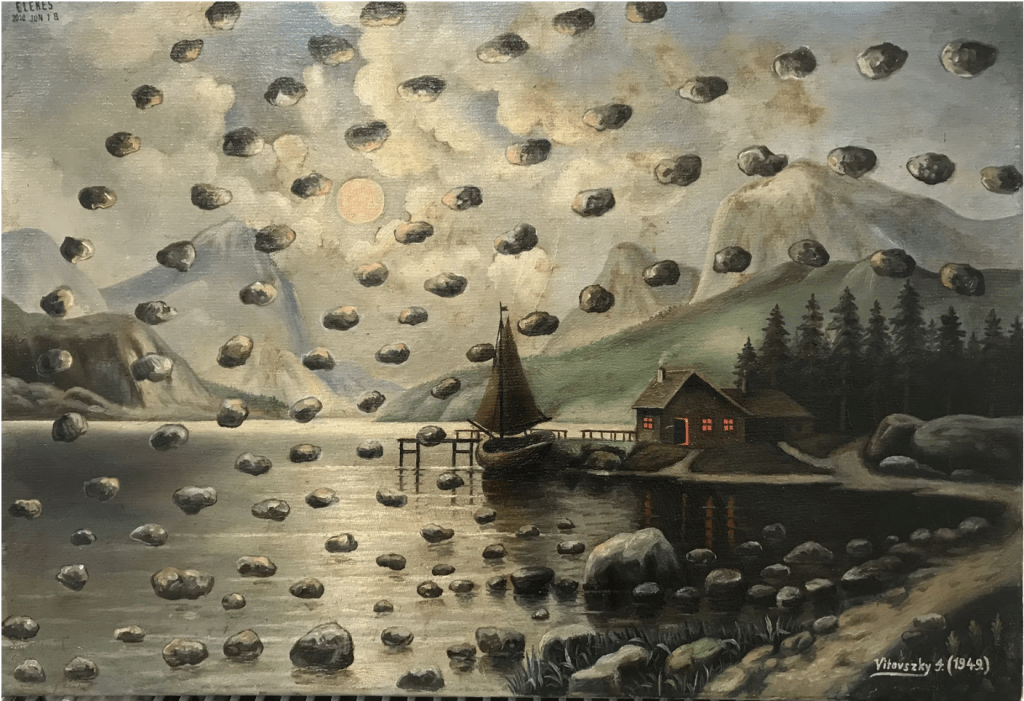
This description unambiguously relegates the images he works from to the realm of low arts; implicitly, Elekes’ artistic intervention is reified as belonging to a higher realm of artistic production than that which he designates as surplus. This distinction is reinforced by structure of the ‘tunning’ operation itself; the fact that he chooses to use them as materials in his own art relegates them to the realm of the material, with the superimposition of novel paint atop the original canvas amounting to a bestowal of meaning – in some cases styled as re-interpretation, but certainly considered to be an animation of some form. Elekes’ ‘tunning’ works do not necessarily hold to the style of Jó Katona; other works, such as Gördülő kövek – translated by Elekes as ‘Rolling Stones’ – take a more impetuous tone in remediating the work of the amateur painter, re-orienting the somewhat dully rendered landscape in the realm of the sarcastically surrealistic.
It thus emerges that the ‘tunning’ concept’s primary concern is with a typology of artwork that is derided as multitudinous, hackneyed, and interchangeable, and thereby, outside the purview of museums and galleries. Cynically, it might be argued that Elekes, as a member of the Hungarian Arts Academy and a recipient of the nationally prestigious Munkácsy Mihály award for excellence in the arts, elevates these works of low – or outsider art through the mere fact that it is a recognised member of the Hungarian high art sphere undertaking their remediation. The value of an artwork is oft-defined by its scarcity and unique instance in the world; despite being one-of-a-kind by virtue of their analogue physicality (a meaningful distinction to make in today’s digital age of infinitely replicable images), the paintings that find their way into flea markets and petit bourgeois interiors are made cheap by their overwhelming multitude – they become décor, rather than arts. If it is the intervention of a recognised artist which turns a picture into an artwork, therefore, this economy of scarcity is preserved; to borrow some terms from Walter Benjamin, the denouement of the ‘tunning’ process results in a work imbued with cultic value, bearing a surplus of aura.
Yet, it would be reductive to argue that socio-political status is the only thing that Elekes has to offer the artworks he remediates through ‘tunning’. To depart from qualitative descriptors and eschew notions of banality and dilettantism, the paintings he works from nonetheless have in common a starkly literal realism in the rendering of their subject matter. It is perhaps from this angle that the crux of Elekes’ practice can best be viewed – the conceptual playfulness present in his works of prescribe a novel vector for engagement with the work that did not previously exist. ‘Tunning’ as a practice places itself in opposition to the mundanity of the trend-following surplus; a 2025 exhibition of Elekes’ ‘tunning’ works as part of a series hosted by the Hungarian Arts Academy called ‘Natural Intelligence’ [Természetes intelligencia], draws an arch parallel between the dilettante works of 20th century amateur painters and the stochastically generated flood of AI images as modalities of image-making that create their own formally cohesive but entirely vacuous visual surplus. Elekes’ material concern with the surplus of poor-quality 20th century paintings is a practical manifestation of his concern with a dearth of meaning in the self-same corpus of works. The aim of ‘tunning’ might, then, be understood as the desire to make these surplus images speak with new voices that mark them as unique.
Edited by Saffron Watkins
Cover image: Károly Elekes, Gördülő kövek, 2010, oil on canvas, 30 × 40 cm, from https://www.artsy.net/artwork/karoly-elekes-rolling-stones-gordulo-kovek

 Paper Galleries
Leave a comment