The question of ‘immersion’ when facing an artwork is brought into a curious precarity through the emergent phenomenon of ‘immersive exhibitions’. These are typically understood as a digital spectacle, where visitors walk through altered projections of famous artworks, dramatically increasedin scale and rendered in such a way that viewing the whole image at once becomes an impossibility. The projectioncomes to encompass the entirety of one’s surroundings, and—so it goes—ultimately allows the viewer to pass through the work itself.
The luminous quality to the exhibit is as functional as it is quintessentially modern. By plunging everything but the image into darkness, it ensures the importance of the projection in forming the environment. The peripheral technologies—the wiring, scaffolding, and projectors that make the exhibit possible—are rendered invisible. The dynamics of the traditional gallery setting, where each visitor moves through a collection of artworks, is entirely inverted; there is one static location, presented to an audience as the medium through which its works will be mediated, and it insists on being experienced.
It is perhaps the unquestioned ubiquity of digital technology in the modern world that allows the mind to naturalise an abstract, luminous landscape as an environment that one can lose yourself in. In the ‘Imagine Van Gogh’ exhibition, which touts itself as the ‘original’ immersive exhibition and has been presented in multiple countries across the globe since its inception in 2017, the landscape of Van Gogh’s 1888 painting Starry Night Over the Rhone is reimagined as an environment.
Yet, the illusion is far from convincing. Unlike its structural predecessor, the panorama, the immersive exhibition does not pretend to an illusionary idyll. The paintings selected are typically already stylised as opposed to realistic; in order toextend the flat image into an all-subsuming surrounding, it must be cut up and repeated. The darkness required for the projections to be optimally presented creates a disjuncture between exhibit and attendees, as the viewers are unable to escape from the darkness that makes clear their inalienable separation from the environment they are here to be immersed in.
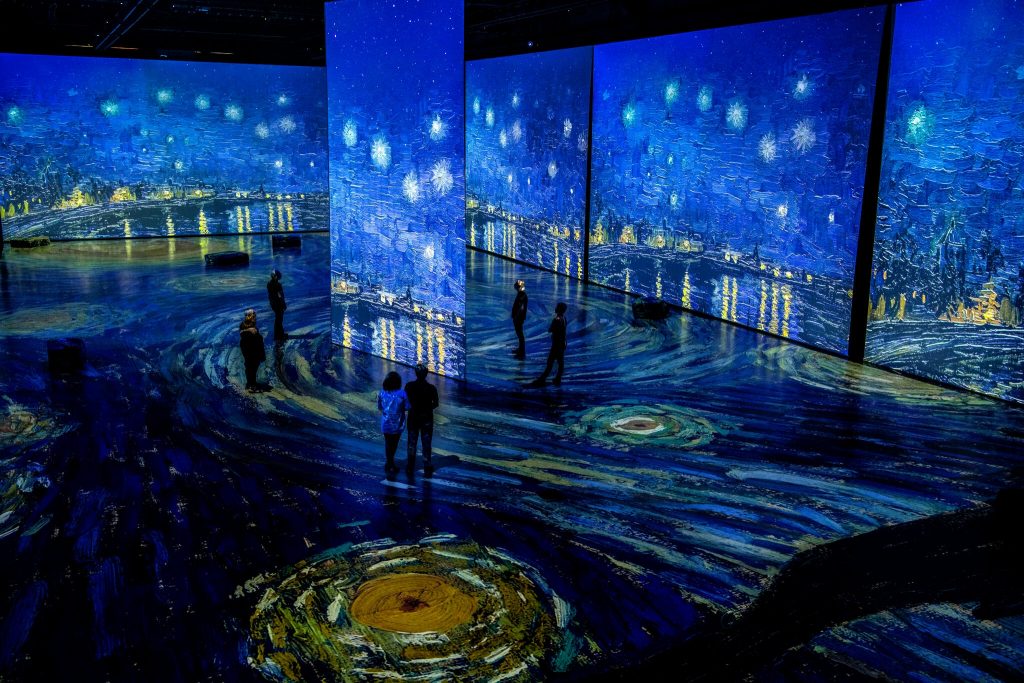
Image Credits: Laurence Labat via New York Times.
So speaking, the exhibit does not transport its viewer into the painting, nor does it simulate reality for them. The mechanisms of technology that form the exhibition do not successfully disguise themselves; the panels onto which the images are projected are disparate and disjointed. If they do fade into the background, it is only the ubiquity of the screen that allows us to take them for granted as a structural necessity rather than a breaking point of the illusion.
The categorisation of the ‘immersive exhibition’, however, carries an oppositional connotation. If this is an exhibition touted specifically as evoking immersion, does this imply that immersion is a special function that a typical exhibition might lack? At the very least, the emphasis on the ‘immersive’ qualities of the projected image must indicate that this format presents an experience that is in some way more intensive or engrossing in its situation of the viewer opposite the painting.The projection, the title argues, will bring the viewer closer to the painting’s subject that the painting itself can.
In his treatise, On Painting, Renaissance humanist Leon Battista Alberti likens the painting, encapsulated within its frame and possessed of its own constructed perspective, to being a ‘window’ into this created space. Alberti’s metaphor can be argued to position the painting itself as an already immersive environment—the frame already functions to give visual access to a space that one cannot literally walk through, and by framing it as a window, the artifice of the painting’s surface is obscured. This transcendence of materiality in mediating conceptual access to the painting’s subject—the avenue for the plausible deniability of the canvas’ surface and the position of the viewer that connotes a physical closeness to the painted scene—might itself be argued to provide an avenue for immersion.
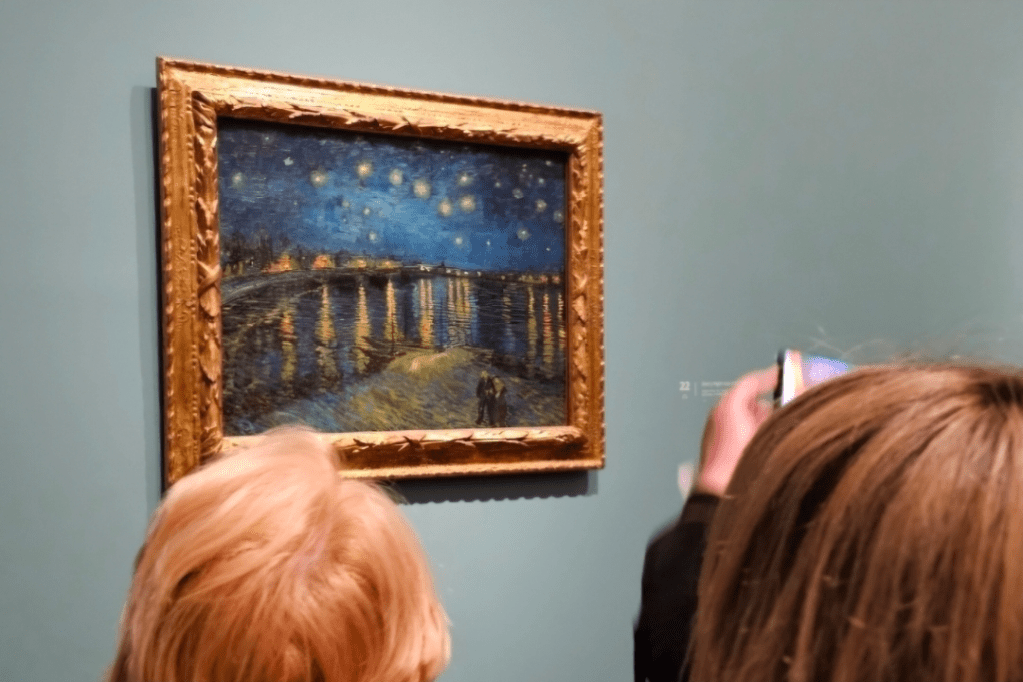
Is this connection to the scene through Alberti’s ‘window’ insufficient? The existence of a window necessarily implies a barrier between the viewer and the scene. Yet, the projected environment does not transcend this separation. In fact, in thissense, the immersive exhibition is more upfront about the material infrastructures that present the viewer with the art—and proclaims it loudly. The separation between viewer and work is not transcended; it cannot be. As the viewer closes the distance between themselves and the projection, the grand-scale work falls out of view, and the digital materiality becomes hyper-apparent.
Van Gogh’s Starry Night Over the Rhone might then be compared with the version presented to us in the 2021 ‘Imagine Van Gogh’ exhibition (which is incorrectly referred to on their website as The Starry Night). The iterated elements of the paintings destroy both the composition of the work and the specificity of the space that the painting encapsulates. As Van Gogh’s painting does not lend itself to a top-down view,the sky from the real The Starry Night—a separate painting to Starry Night Over the Rhone—is repurposed as a twisting path for the viewer to traverse. This splicing of images in service of the environmental simulacrum comes at the expense of the authentic representation of the original subject matter. The environment that visitors walk through is no longer quite the world that Van Gogh himself wanted to convey.
The transformative nature intent of the immersive exhibition is certainly intentional. The ‘Imagine Van Gogh’ website claims to allow visitors to ‘discover’ his works. This ‘discovery’ is perhaps more of a reference to the simulated physical journey through the projected images than a promiseto familiarise the viewer with novel works from an incredibly famous painter. The immersive exhibition is a novel medium that caters to a layman audience with easy access to visually precise reproductions of artworks. In considering the ease with which the scarcity of an authentic original might be circumvented in the digital age, ‘immersion’ might consist of forcing a cinematic, grandiose spectacle to recover a feeling of awe in those who might otherwise be desensitised to a work through repeated exposure to the same ‘picture’. If this is the case, then perhaps Alberti’s ‘window’ is truly an artefact destined for mainstream desuetude. Or perhaps, in the digital age, ‘immersion’ is better actualised through technological means, for a demographic for whom the digital is now ‘realer’ than the analogue.
Edited by Alison Grace Zheng
Cover image: Starry Night Over the Rhone from ‘Imagine Van Gogh’, 2021, North America, Laurence Labat via New York Times.

 Paper Galleries
Leave a comment