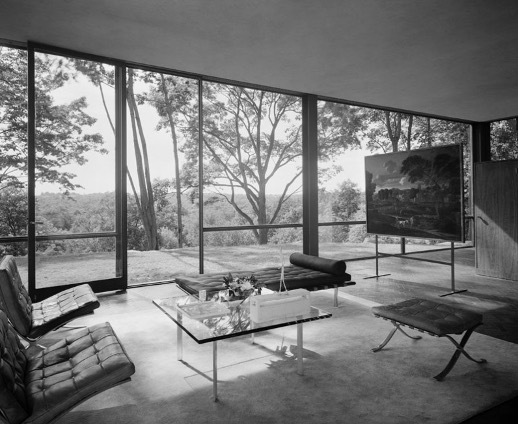
In 1965 article “A Home is Not a House” for Art in America magazine, Reynar Banham coined the concept of ‘un-house’ – one that radically deviated from the traditional idea of a house by being a mere shell to conceive services such as heating, cooling, and plumbing. Banham noted upon the society’s trend to seek reconnection with nature by virtue of ubiquitous portable technology – RVs and camper vans became the so-called ‘environmental bubbles’ that protected and entertained the inhabitants with climate control systems and radios, rendering them ‘mobile houses.’ For Banham, the closest conjunction of qualities to an un-house is found in Philip Johnson’s Glass House (1949). Situated among the vast 47-acre wooded area, this 1,815 square foot modernist masterpiece stands on the verge between the inside and the outside; tall floor to ceiling glass walls and sleek steel frames give the vista a dominant position within the interior, allowing the separation between the two worlds solely by means of the heating systems of the house. The open planning of the project – as the house simply lacks any conventional compartmentalised rooms, apart from the bathroom block, facilitates further a sense of spatial mobility and non-hierarchical thinking. For Banham this was the ultimate promise of un-house architecture – one that was stripped down of unnecessary decorations to bare essentials.
It is important to emphasise that Banham’s argument stems from his indignation with such modern thinking, for him it proves negligent and ignorant to build as to conceive the pipes and wires, and he fears architecture becoming simply technological, avid of the true exploration of the modernist styles and materials. Although, surprisingly, his very concept of ‘un-house’ in many ways coincided with what was about to come or perhaps was already being contemplated of by numerous young artists, architects and environmental thinkers.
The period of 1960-1970s was known for its socio-political contexts such as anti-Vietnam war movements, the rising counterculture and the deconstruction of nuclear family type, as well as various civil rights movements. This, in great quantity, influenced the emergence of the hippie culture, which expressed and promoted young people’s search for liberation, anti-consumerism, spirituality, and dreams of utopian communal living. The future proved unpredictable, and instead of trying to figure out how the world is going to be, the young generation saw it easier to adapt for when the time comes, which led this era’s fascination with “instant cities” and ephemeral structures that could be quickly erected, disassembled, and moved.
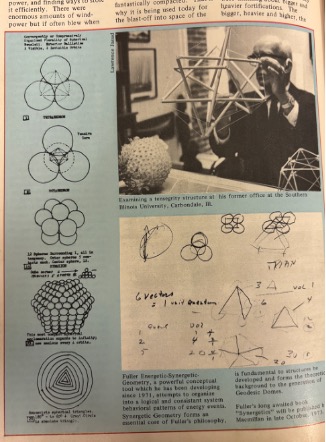
Furthermore, in his book Radical Environments of the Psychedelic Sixties (2009), Alastair Gordon points out the inherent influence of psychedelic experimentations on architecture calling it “a transformation of conventional space into vibrating space harmonies.” A writer Henri Michaux even coined a term ‘anopodokotolotopadnodrome’, describing the spatial experience of the drugs; the space which was born through such episodes was constantly moving, flowing, and most importantly non-hierarchal. One of the most prominent solutions to a quest for cheap, mobile, and ‘volatile’ structures for communal living became Buckminster Fuller’s spherical creation known as geodesic dome. Displayed for the first time in 1954 at Milan Triennale, it was a spherical structure made with a network of connecting lines, rather than from a singular curved surface. Made of polyvinyl chloride, it allowed various biophilic qualities such as natural sunlight, airiness, and lack of acute angularity. The very idea of the bubble fascinated Fuller for its “sphericity”, it was easily adaptable, as the number of cells could be easily increased. Fuller’s reasoning could also be considered spiritual, as the sequence of tetrahedron forms of the dome was seen by him as unveiling of scientific universal truths. In his book Synergetics: Explorations in the Geometry of Thinking (1975) Fuller wrote, “General systems science discloses the existence of minimum sets of variable factors that uniquely govern each and every system.” His words evoke a sense of micro and macrocosm, especially considering that Fuller praised geodesic spheres for their resemblance to carbon molecules, strengthening its connection to nature – which was noted upon by the Hippie communities.
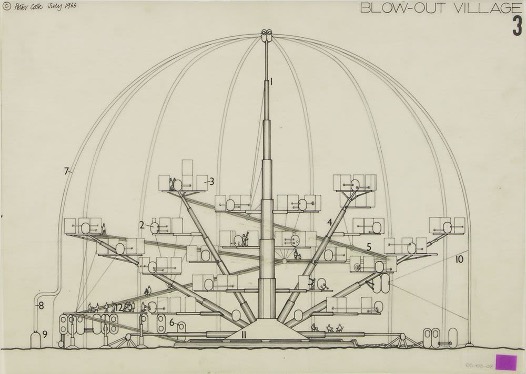
Overall, recalling the format of Tantric tents and possibility to assemble one from accessible materials such as vinyl sheeting, tape, and a pair of scissors or metal scraps as a practical DIY project, geodesic domes became recreated internationally with ardent. One of the earliest design examples was a conceptual project Blow-out Village by avant-garde British architectural group Archigram. Imagined as a metal structure supported by an inflated outside shell, it was theorising mentally and experimenting on paper with mobile dome-shaped structures.
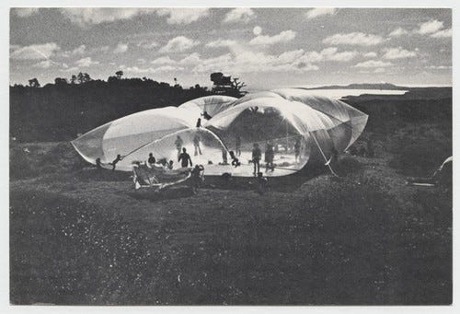
The realised examples came from Ant Farm – avant-garde group of artists who used blow-out as to explore the connection between the inside and the outside environments, mimicked by the homogenous surface of construction – bubble in interior and exterior. Ant Farm’s infamous Pillow structure consisted of 50 x 50ft inflated vinyl, when deflated it could simply be packed at the back of a truck and reassembled at the push of a button. Once inhabited, its pliable membrane visibly quivered in response to sound and movement, especially the amplified vibrations of music, turning concerts and gatherings into immersive spatial experiences. In this way, the inflatable did not merely contain countercultural performance but physically registered it, translating the era’s psychedelic soundscapes into architectural motion and reflecting a broader cultural “shift in psychic orientation.”
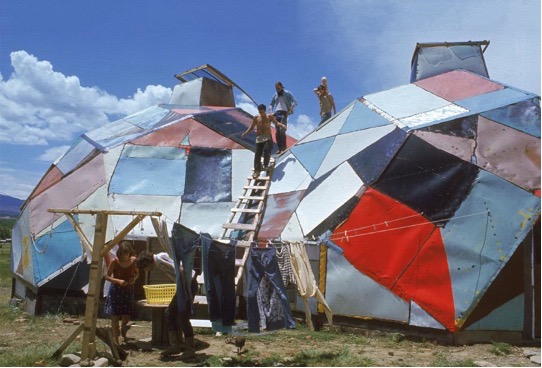
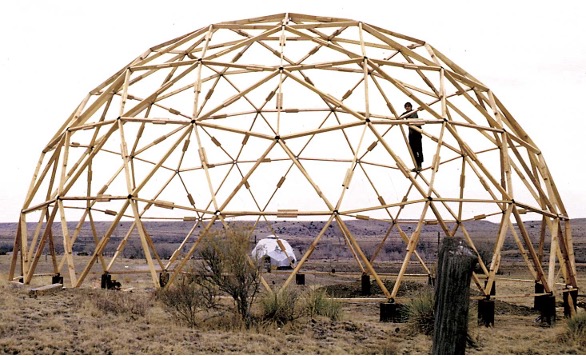
At Drop City, the Theatre Dome transformed the geodesic ideal into a hands-on countercultural statement. Constructed from 2 x 4-inch timber scraps, sewer-pipe hubs, and metal plates salvaged from old car tops-sometimes without additional structural supports-it demonstrated how discarded industrial materials could be reassembled into a stable communal space for under $1000. The dome thus became more than shelter, but a symbol of new mentality, as Bill Voyd (a founding member of the project) would say: the walls “blocking man from man, man from the universe, man from himself,” therefore creating through geometry and reuse, a model of sustainable and non-hierarchical communal living.
Banham’s ‘un-house,’ though meant as critique, anticipated a shift toward lightweight, mobile, and environmentally attuned architecture. From Philip Johnson’s Glass House to Buckminster Fuller’s geodesic domes and Ant Farm’s inflatables, these structures blurred boundaries between inside and outside, permanence and mobility, reflecting the era’s communal and ecological ideals. The “un-house” thus became a blueprint for adaptable, socially conscious architecture.
Edited by Isabel Hume
Cover Image: A sketch from Archigram’s Blow-out Village Project, 1966, by Peter Cook, image from https://www.mplus.org.hk/en/collection/objects/section-blow-out-village-ca36-t58/




Leave a Reply