In his seminal work, Art in the Age of Mechanical Reproduction, Walter Benjamin makes the argument that there is a quality to the work as a material object that is absent when the formal content alone is reproduced and circulated; this, he names the ‘aura’ of the work. The reproduced work is inherently non-auratic; ‘aura’ is lost when a work is mechanically reproduced, to be replaced, Benjamin argues, by a dimension of politics. In the case of today’s increasingly online world, the dominant mode of visual orientation is through the digital image, of which there can be no ‘original’.
Digital artworks become reproducible ad-infinitum, and no single instance of the image is more ‘authentic’ than any other, making it an inherently non-auratic medium. As contemporary life – and commerce – becomes increasingly entangled with the digital sphere, the boundless reproducibility of digital objects is increasingly framed an obstacle that stands in the way of economic models that relied on scarcity. The provenance and history of the work provide a unique value to an artwork; it is valuable because it is authentic, and this authentic instance of a work is ultimately scarce.
Launched in 2017, but not seeing widespread adoption or investment until 2021, NFTs – an acronym for ‘non-fungible token’ seemed to provide an avenue to enforce scarcity in the digital realm. NFTs were cryptocurrency assets, conceptualised and marketed as unique digital ‘tokens’ on a blockchain ledger. Their function, as touted by the Corporate Finance Institute (CFI) in a 2022 article, was to ‘prove ownership and authenticity for an underlying asset, digital or physical’. In effect, an NFT had the potential to enforce a sort of pseudo-‘aura’ when applied to a digital image; although the associated image might be saved and circulated, the associated token served as an authenticating mechanism to validate the ‘true’ owner and instances of an image.
Enforced scarcity lay at the heart of the NFT movement. Buzzwords such as ‘irreplaceable’, ‘unique’, and ‘authentic’ dominated the language of its proponents. It was therefore easy to see the medium as bridging the proverbial gap between the mechanics of digital reproduction and the modus operandi of the art market. Auction houses such as Christie’s and Sotheby’s moved into the NFT market – in 2021, Christie’s sold an NFT associated with the contemporary artist Beeple for over $69 million USD.
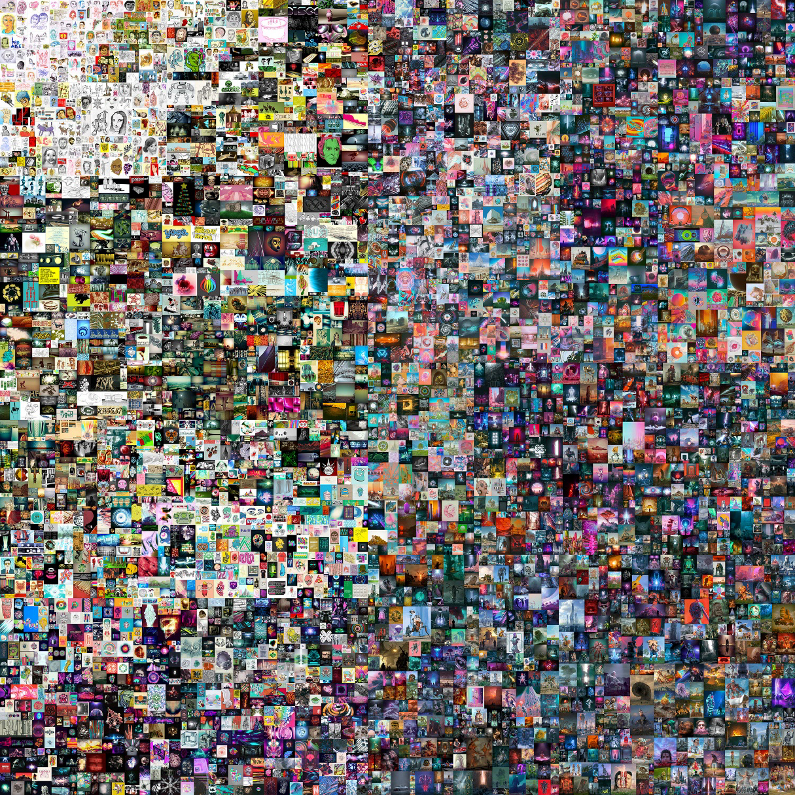
Image Credits: Beeple via <https://www.beeple-crap.com/viewing>
As a part of this embracement of NFTs as paving the way forward into digital art commerce, the art market turned to the blockchain not only as a way of minting ‘new’, all-digital artworks, but also as something that would subsume and replace traditional, analogue methods of art circulation and distribution. Shortly before the landmark Christie’s auction, a group of blockchain enthusiasts under the name ‘Burnt Banksy’ purchased an authentic instance of Banksy’s 2006 print Morons, which (perhaps ironically) depicts a Christie’s auctioneer stood next to a canvas reading, in block capitals, ‘I can’t believe you morons actually buy this shit’. In what was then termed an ‘authentic Banksy art burning ceremony’, Burnt Banksy proceeded to set the work alight for the purpose of then minting a subsequent NFT.
Whilst Burnt Banksy’s destruction of the piece might be read as a progressivist movement towards the digitalisation of art commerce, the statement underscoring their YouTube video archiving the livestream belies an alternative motive. Although proponents of NFTs as an authenticating record of ownership advertised that they were able to function as such even for physical assets, in practice, the non-digital instance of Morons was a threat to the unique and irreplaceable nature of the minted NFT. Burnt Banksy qualified their burning of the piece, stating that ‘as long as the physical piece exists, the value of that piece will remain with the physical’.
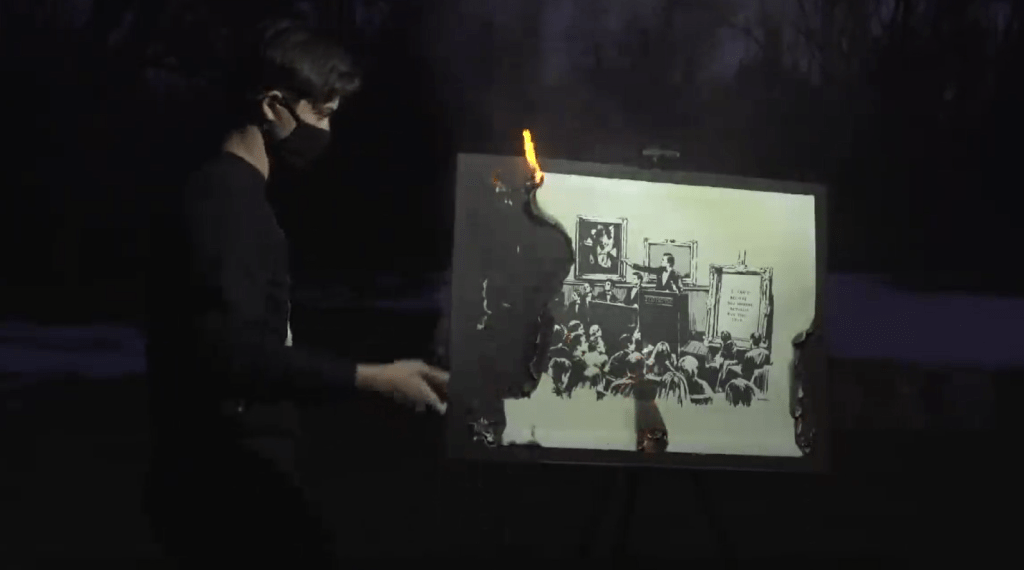
Image Credits: XION (formerly BurntBanksy) via <https://www.youtube.com/watch?v=C4wm-p_VFh0>
Burnt Banksy was not alone in taking this stance. In 2022, artist Damien Hirst launched a collection titled ‘The Currency’, wherein he minted approximately 10,000 NFTs with corresponding physical artworks, and offered buyers the choice of the physical artwork or the NFT. Over 4,000 buyers selected the NFT, and Hirst subsequently burnt the corresponding physical artworks in response.
The iconoclastic impulse towards the analogue ‘originals’ betrays a fear on the part of the NFT towards the authority of the physical instance of the work. The auratic, physical instance of the work still holds some implicit authority over the meticulously authenticated digital copy. Meanwhile, the non-auratic digital copy fails to escape the substitution of ‘aura’ with politics. NFTs, though conflated with the notion of ‘digital art’ in the high art realm of auction houses, were inextricably enmeshed with the mechanisms of speculative investment and the interests of cryptocurrency advocates.
In practice, the use of the blockchain to prove ownership was somewhat dubious; cryptocurrency is not subject to the regulations and oversight that bind fiat currencies. Furthermore, despite the central tenet of authenticity that defined NFT valuation, anyone was able to mint an NFT of any image, and , it was often difficult to tell what the relationship of the seller was to the asset they were selling a certificate of ownership for.
In a context where it was not an artwork but the right of its ownership that was being bought, this ambiguity was often crippling. A particularly callous consequence of this ambiguity was seen in the case of the digital artist Qing Han (better-known online as Qinni) who passed away in 2020 and whose art was subsequently taken and minted as an NFT by an unrelated third party, and listed online for profit as an NFT. Scammers were able to capitalise on the sale of ‘stolen’ artwork that they possessed no rights to, undercutting trust in the NFT marketplace.
Ultimately, the NFT project was a critical failure. After its boom in 2021 and 2022, valuations dropped sharply, and by 2023, 95% of NFTs were estimated to be utterly worthless. In practice, the use of the blockchain to prove ownership was somewhat dubious; cryptocurrency is not subject to the regulations and oversight that bind fiat currencies, and it was often difficult to authenticate the relationship between an artwork and its associated NFT. In 2025, Christie’s shut down its ‘digital art’ division – a platform previously focused on the sale of NFTs – marking the death knell of the NFT trend in the art world. Ultimately, the digital marketplace’s speculative investments in authentic digital assets was not able to replicate the dynamics of the auratic art object; the rise and fall of the NFT was, perhaps fittingly, catalysed by the modalities of capitalism.
Edit by Alison Grace Zheng
Cover Image: BurntBanksy, 2021, Still from the Burning of Banksy’s Morons (2006) Image Credits: XION (formerly BurntBanksy) via <https://www.youtube.com/watch?v=C4wm-p_VFh0>


 Paper Galleries
Leave a comment