’I’m not opaque. I’m so relevant I’m disappearing’ – Anaïs Duplan, ’One poem’
This line from One Poem by Anaïs Duplan was used by Legacy Russell in her theory of Glitch Feminism, which rejects categories through the abstraction of the body. When we embrace the error of a ‘glitch’, we reject a system of perfection that seeks to manipulate, rank, and exploit human bodies.
Russell posits that we are not opaque, but that the body is translucent, liminal, and immaterial. These descriptions are often used to describe modern technology (most often today, artificial intelligence) ideas, such as the “cloud” and “streaming” contribute to an ephemeral image, allowing us to remove the very real and very human consequences of technology from its popular association. Chinese American artist Hang Gao’s work flips the argument of glitch-feminism, showing technology as more tangible than metaphysical. His canvases display the aesthetic of 2000’s video game glitches, where we see the figures in a state that pre-empts their final conception, in their immateriality, they pose as perfect metaphors for our relationship with technology today.
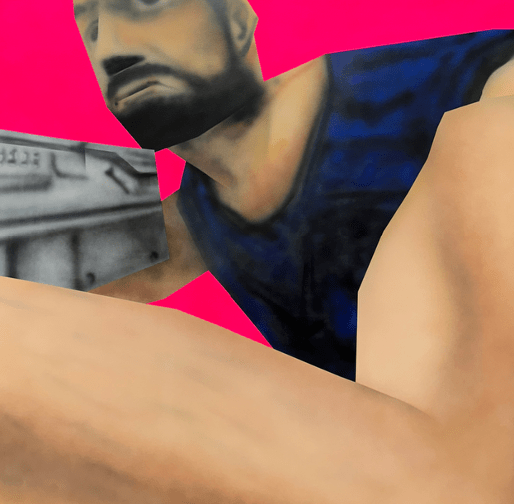
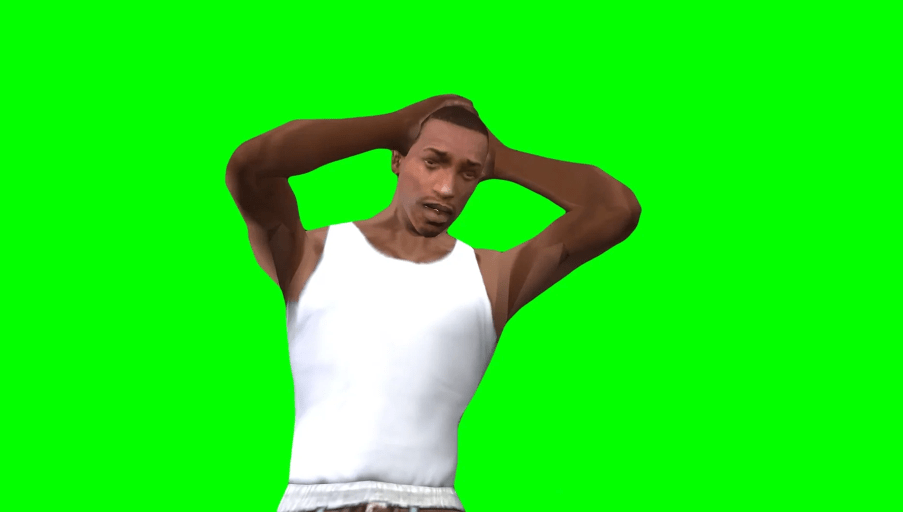
Upon seeing Gao’s work, the GTA memes immediately came to my mind. I’ve never played the games, but having a certain amount of screen time will likely lead you to recognise the image above. The ultra-fast circulation of images on social media has led to a culture based primarily on visual language. However, the unprecedented volume of bad news, which has worsened since the pandemic, has led many young people to use images as a form of relief from the stress of the outside world. Thus, one can remain informed in online spaces without confronting the accompanying geopolitical, economic, and social malaise. Memes allow us to blur the boundary between reality and entertainment, both visually and mentally. Gao’s interest in simulation theory and visual aesthetics (which resonates heavily with meme culture) shouldn’t go unnoticed. Simulation theory suggests that our reality is an artificial simulation (heavily influenced by The Matrix), which was itself inspired by the Ancient Chinese philosopher Zhuangzi, who woke up from a dream in which he was a butterfly. He was then unsure whether he himself was a butterfly dreaming of being a man, or a man dreaming of being a butterfly. Though these ideas seem cryptic, one can recognise the abstraction of reality in memetic warfare and a general lack of complicity afforded to social media users. When people’s pain and political reality are reduced to a short video, a piece of text, or an image we scroll through, we begin to sedate the world beyond our immediate reality. The faces of the people who are suffering become blurred; they are no more real than the characters we see in clips, and it is becoming harder to distinguish who is even real, as photo-generative AI develops. There is something ironic about an artist who makes work that looks digital working in a time when technology produces work that looks real. Both agents are trying to trick you.
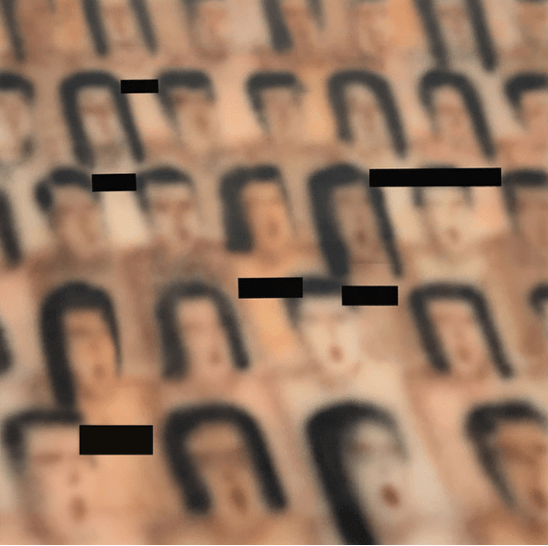
Gao’s work examines the very real diminishment of the human subject in an age of cyber-everything. It feels like the digital is consuming the physical world and disrupting it. The tangibility of the physical body becomes a danger and a possibility for exploitation. This danger, in relation to our growing reliance on technology, is evident in the racial bias of facial recognition technology. Studies (from the University of Sussex and the federal government in the USA) have shown technical inaccuracies in facial recognition that worsen on African and Asian faces. Here in the UK, the home secretary Shabana Mahmood was recently criticised for comparing the panopticon to her plans for the British criminal justice system; she even specified that AI will be the instrumental technology for this. Many associate the panopticon with a heavily dystopian form of surveillance. In truth, it is a design of in-built control used specifically for prisons. The way in which society treats prisoners is highly dehumanising, and the prison system itself is flawed, but to extend this dehumanisation to the British public is a great risk. Gao also dehumanises his subjects. As we look at his work, we can attempt to imagine the person behind it. In some of his works, he alludes to the very physical reality (which we cannot reach) through the cubist shapes beneath the blur. They are sharp, geometric and still abstracted, but they feel more tangible. In ‘Your Children Are Protected’, this 3D figure is no longer rendered. Instead, there is a mass of figures (whom we can assume are children) whose orderly position suggests almost a militaristic rigidity. They are also nude, which should make the viewer feel somewhat uncomfortable. Both choices by the artists convince the viewer of a sentiment that opposes the title: the children are not safe; they are instead positioned as products. Dehumanised, arranged and vulnerable, we, as the audience, become the surveyor; it is almost as though our viewership makes them unprotected.
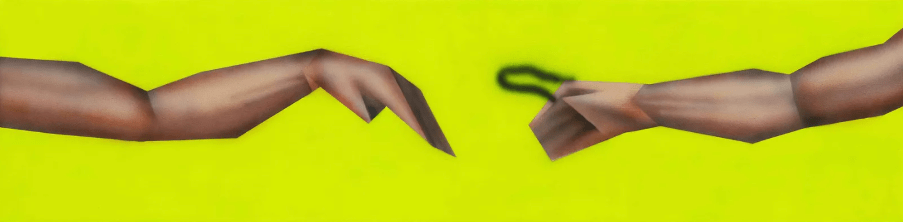
The movement towards cyber-surveillance seems overly trusting of AI; its replacement of humans in the justice system can be read as a form of veneration of technology, suggesting that AI itself isn’t heavily dependent on humans. When we see AI as a higher power through our ephemeral language, it becomes easier to separate technology from man. Yet this idea itself is a fallacy; there is a very physical reality to AI. The data centres that support AI have recently been revealed as very harsh on the environment, poisoning the water sources of surrounding areas (often of racialised communities). These centres and much of modern technology are all highly dependent on rare earth materials mined in China, which are often criticised for their highly exploitative treatment of workers and their harm to the environment. But there are also ‘ghost workers’ who consume the harmful images and videos created by AI to survey and moderate them. Women, specifically in Indian rural communities, are left traumatised after working to train AI, where they themselves must consume violent and pornographic content created by AI. This takes an incredible toll on their mental well-being, often leading to PTSD and insomnia. But when we ignore the physical reality of images created by AI, we also ignore those exploited and those it might later endanger.
Gao’s work reminds us of the human behind the digital; he is not trying to get us to believe in simulation theory, but by using it as a philosophical backdrop, he collapses the dichotomy between the human and the technological. These images are not made by robots; they are man-made, because everything is man-made, including climate change, computers, the panopticon, AI, art, porn and war. Like memes, a reliance on AI may allow us to escape blame and reality, but the dissonance between what happens on the screen and what happens to you is only geographic, not cosmic. Gao brings the reality of online images to the viewer’s immediate perception, whether in the gallery or on the screen, you are forced to see the human creation of technology.
Edited by Jayden Jin
Cover Image: Meme of CJ shocked with his hands on his head – Grand Theft Auto: San Andreas, screenshot with green screen

 Paper Galleries
Leave a comment