In the minds of many people, curatorship is associated with the ideas of selection, choice, and the power to decide what will be included and what will not be seen. However, during the recent Lucian Freud: Drawing Into Painting exhibition tour, organised by the Art Business Society in collaboration with the curatorial assistant involved in the show’s production, I found myself thinking more about what is not on show—and why it is not.
As we moved through the exhibition, we were told about the process and difficulties involved in securing the paintings of influential artists such as Lucian Freud, whose works are spread across the globe in public and private collections. Thanks to the National Portrait Gallery’s long-standing relationship with Freud during his lifetime, most of the works were successfully gathered in one space for what is considered the biggest retrospective of the artist. Yet it would be naive to assume that everything went smoothly. The gallery was unable to secure Large Interior, W11 (after Watteau), or more colloquially known as “Celia, Bella, Suzy and Kai: A Family Portrait,” which was sold at Christie’s to a private collection. In many cases, this painting would have been excluded from the exhibition, or, at best, described in the curatorial text. Typically, it would not have been included in the show’s narrative. However, the painting was actually there, but in the form of a reproduction, accompanied by text.
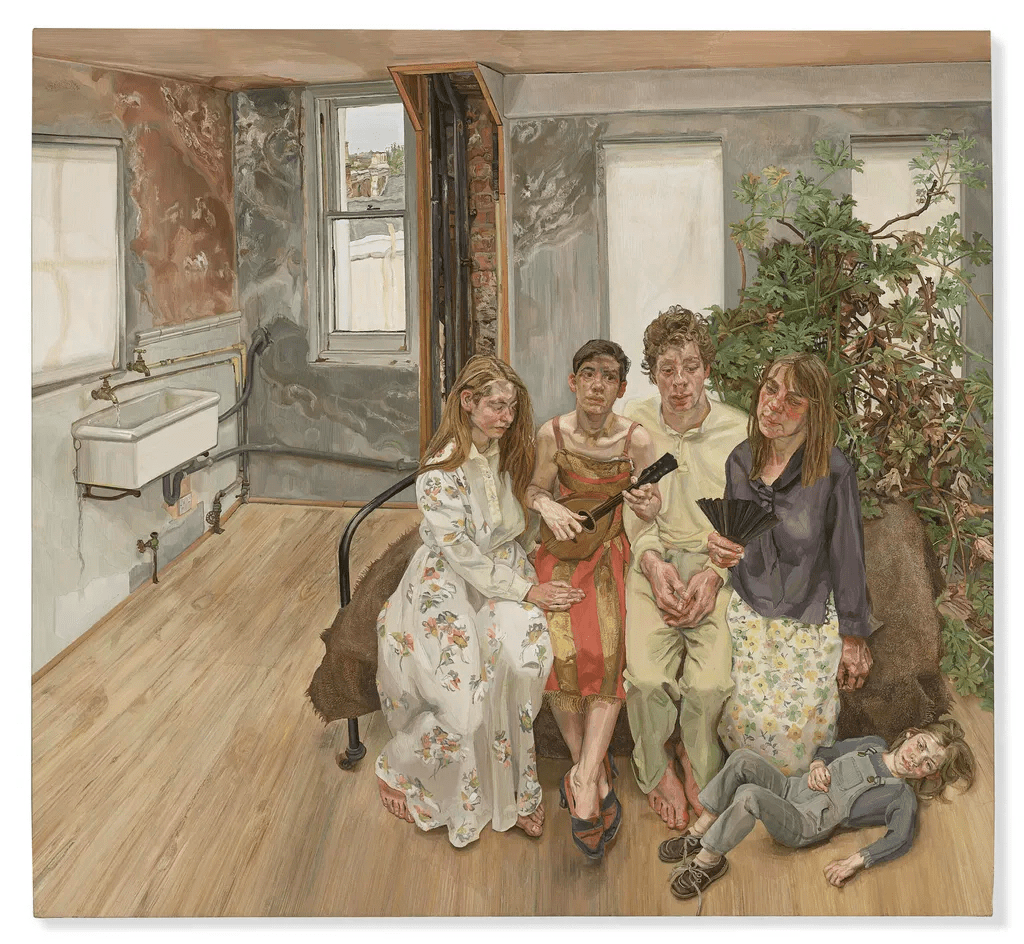
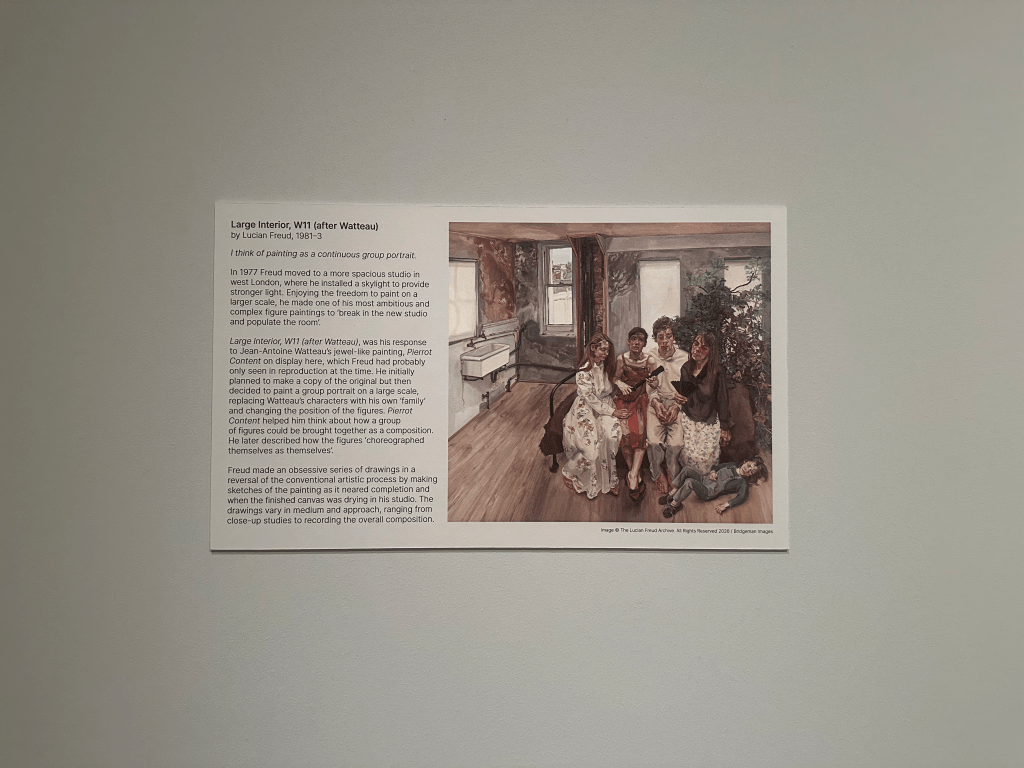
What distinguishes this exhibition from others is the team’s decision to not conceal the painting’s absence, but to point it out through its reproduction of modest size, placed within a vast space that could have accommodated the painting’s original size. In many cases, the exhibitions are designed to be experienced coherently and as a whole, with their gaps and constraints intentionally smoothed over. By contrast, the presence of reproduction makes the gap explicit. It invites viewers to consider the works excluded from the exhibition and challenges the retrospective’s authoritative voice, which promises a complete and comprehensive survey of the artist’s career. This small gesture of inclusion disrupts the exhibition’s authority, making the viewer aware of the limits and the internal organisation of the show.
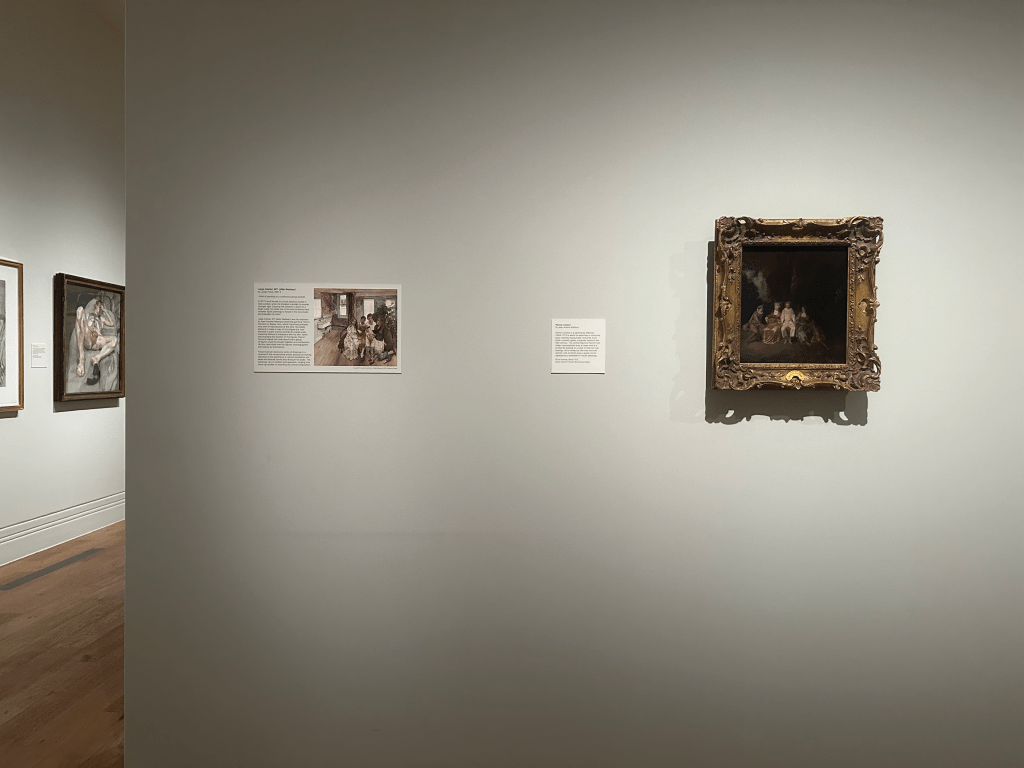
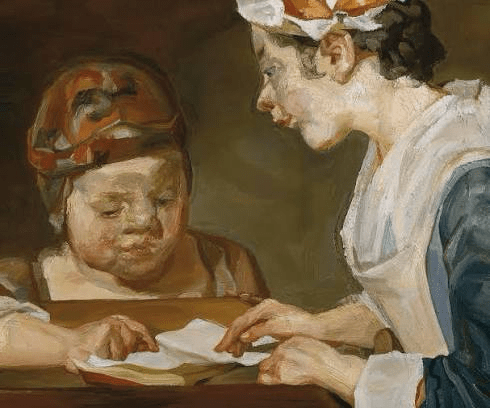
At the same time, this approach complicates the traditional distinction between original and reproduction. This idea could be seen as key for the whole section, where Large Interior, W11 (after Watteau) is placed, as it is dedicated to Freud’s ‘copies’ of the paintings from the National Gallery of artists such as Jean-Antoine Watteau. The contrast between those different types of reproductions is striking: while Freud’s paintings function like portraits of the paintings and bear distinctive features of Freud’s artistic style, such as thick layers of paint and dense brushwork (and therefore become independent artistic works, living a life separate from the original paintings), the reproduction of Large Interior, W11 (after Watteauseems to be closer to photography, as it depicts the objective fact of the painting’s existence. It does not argue or attempt to replace the original, instead, it highlights its absence and functions as a trace, highlighting the object’s physical inaccessibility and conceptual presence in the space, acting as an important element of the exposition.
The absence of the painting also makes visible the art market’s role in shaping public access to art, as well as in creating narratives in the viewer’s mind. As it happened with Large Interior, W11 (after Watteau), the acquisition of the work by a private collector removes it from public view, sometimes completely. The absence of this painting from Freud’s exhibition raises an important question: who has the right to see certain artworks and under which conditions?
In terms of the broader question of who is responsible for shaping art historical narratives, the obvious answer would be large institutions such as the National Portrait Gallery. However, this case shows that even large institutions have limited reach and often depend on the goodwill of private owners who lend works of art. Despite attempts to present the most inclusive and transparent narrative, curators are dependent on a system that allows key works to be withdrawn from public view, controlling the public’s access to the artist.
By making the art world’s struggles visible through reproduction, curators acknowledge the logistical challenges and incorporate them into the exhibition’s structure. The missing painting becomes another part of the story told to the visitor. Something that appears to be a failure at first glance turns out to be evidence of complex networks between institutions and individuals within the art economy. This way, a usually well-hidden process becomes visible, prompting the viewer to consider the forces beyond the exposition rooms.
In conclusion, the question “what is not on show?” helps us think critically about the art world. If the painting was there, the viewer would never compare it with the other Freud reproductions in the room, would never face the reality of the art market, and would never think about the challenges curators have to overcome to deliver a high-quality exhibition. The absence of the portrait, in fact, helps avoid overly focusing on what is represented, and instead emphasises the painting’s role within the exhibition’s larger context and what it can teach us about the art world. Considering that Lucian Freud’s art is often associated with intense scrutiny and psychological depth, it is particularly interesting how the exhibition invites us to consider what remains unseen and why.
Edited by Alison Grace Zheng
Cover Image: Large interior, W11 (after Watteau) by Lucian Freud, 1981-83 https://heni.com/news/article/lucian-freud-large-interior-w11-after-watteau-2022-11-09
 Paper Galleries
Leave a comment