Walking around in London, you can’t help but notice the amount of statues within our public parks, squares and streets. Although I don’t always take note of each individual being commemorated, I know that a largely singular narrative is being perpetuated in these sculptures: the seeming normalcy of white maleness. This is not just my experience; according to a 2021 audit by ART UK, of the 1500 sculptures in London, only 4% are dedicated to women — twice as many are dedicated to animals. What does this tell us about where value is placed in British society?
These works may not actively linger in our minds, but they are subtly embedded in everyday life with little scrutiny, with their symbolism subconsciously infiltrating and informing our ways of thinking. The art that shapes our visual landscape influences our perception of what is considered ‘normal’ and even impact our view of ‘objective’ truth and reality. Beyond this, the display of civic images in the public realm can also influence our perception of the beliefs central to our national identity in a far more insidious way than the works of art displayed within gallery walls, as they reside in plain sight.
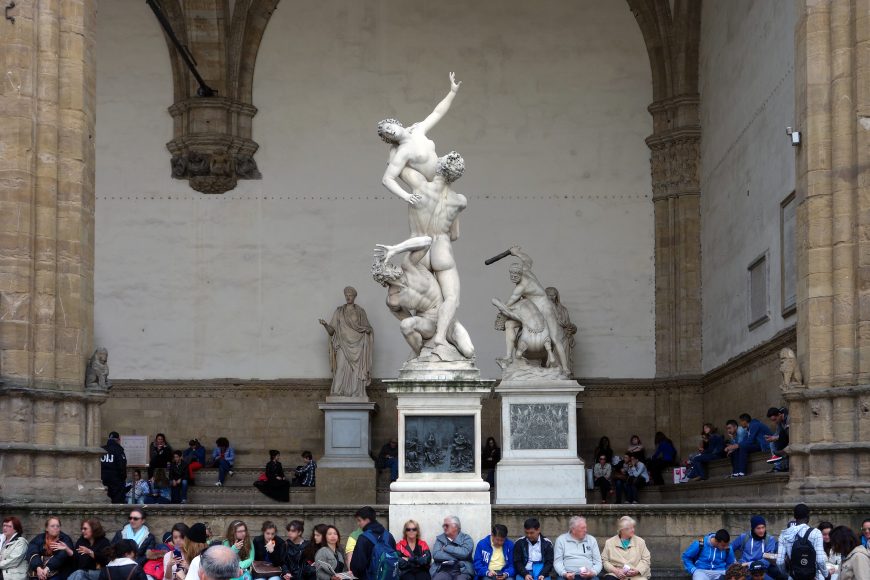
One striking example of this is Giambologna’s 1583 sculpture The Rape of the Sabine Woman located in the Piazza della Signoria in the heart of Florence, it dominates the Loggia dei Lanzi and is brimming with locals and tourists alike. This sculpture, which acts as a backdrop to the comings and goings of everyday life, depicts a screaming, nude woman desperately twisting in an attempt to escape from the clutches of the man who violently hoists her in the air. The assailant is Romulus, the 8th century BCE founder of Rome, who seized the Sabine women to bear children with the desire that generations of Romans would continue. The marble sculpture emphasises the maiden’s submission and lack of agency whilst maintaining an air of sexual attractiveness. The rape of the Sabine woman has been celebrated for centuries and forms the core of Rome’s national identity; this scene, and rape itself, is not perceived as one of suffering, but a symbol of political cooperation, harmony and pride. Violence against women in Italy has been at an all time high in recent years, and this calls into question what should be done about statues such as this one being put on public display.
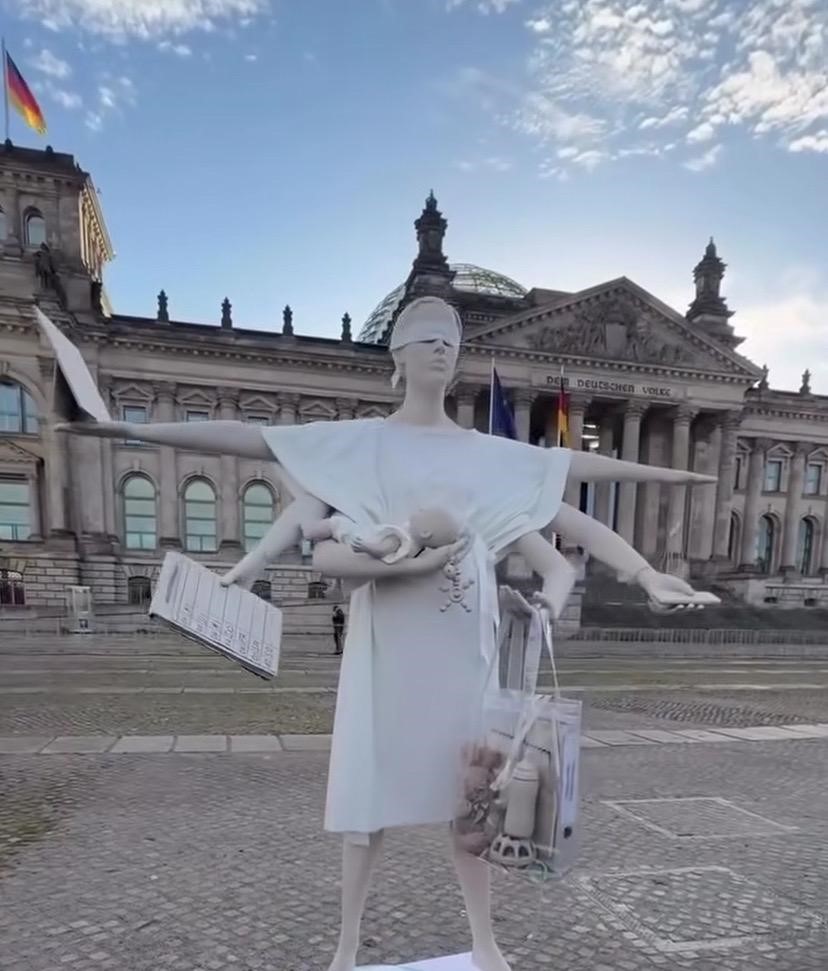
Works that celebrate women as empowered beings challenge this normalisation of misogyny. A powerful example is Stefanie Hidicki’s Pregnant Themis which was unveiled just a few weeks ago. The figure, being the Greek Goddess of Justice, holds a baby, laptop, calendar, bag, phone, and scales — stands in prime position outside the German parliament, Bundestag. Supported by the Mutterschutz für Alle! (Maternity Leave for All) initiative, it represents the silenced burden faced by working mothers in a society with inadequate infrastructures to help them. It makes a potent political statement that, whilst women are strong and independent, society has a responsibility to support them, starting with the fact that maternity leave should not just be a privilege but a basic right. Its location at the political epicentre of Berlin functions as a subversion of what we expect to see in the public sphere, and roots ideas of maternity as central to national identity and social and political discourse.
In recent years, public sculpture has come under the microscope for its role in continuing to normalise and idolise figures in Britain’s colonial, imperial history. Particularly since the Black Lives Matter movement in 2020, these works have been called into question and subject to much debate, protest and controversy. As recently as February 2026, a sculpture of Sir Winston Churchill located in Parliament Square, Westminster was vandalised, with red graffiti defacing the monument with “Zionist war criminal,” “Stop the Genocide,” and “Free Palestine. ”
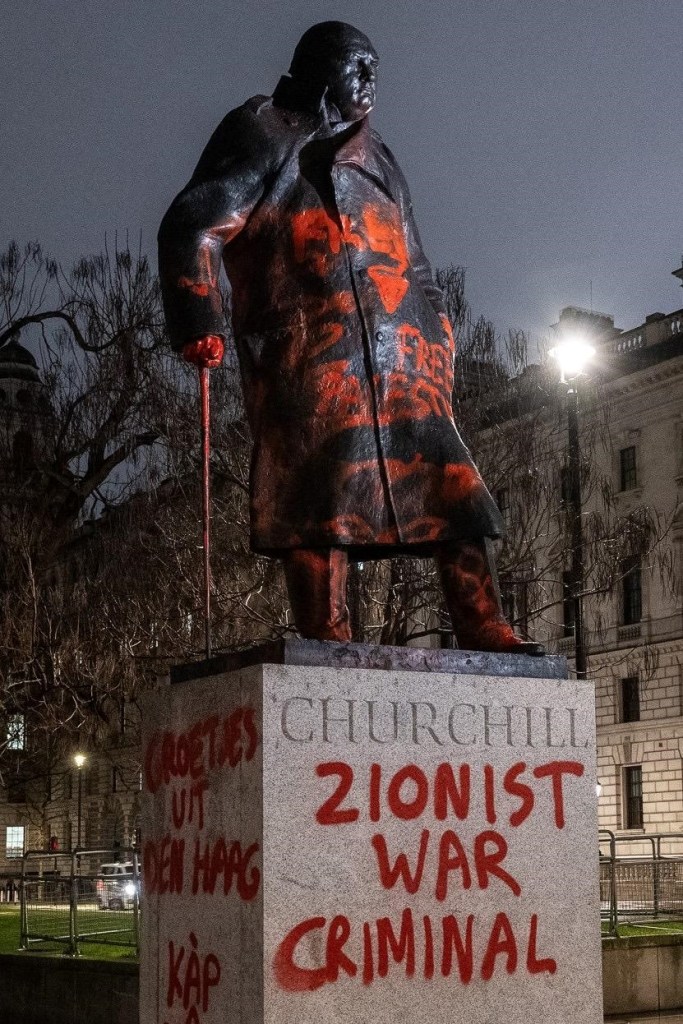
The statue was likely targeted for a variety of reasons; its prime location in a public, and politically charged space, immediately captures media attention to give this act of protest a wide audience, whilst the choice of targeting the increasingly controversial figure of Churchill leads us to question whether he should continue to be revered in spite of his racist role in maintaining the British Empire.
This reinforces how central public art is to our political, social and cultural belief systems and values, which is why it can no longer continue to tell such a one-sided narrative. It has become increasingly critical to acknowledge Britain’s racist past and active role in perpetuating epistemological violence, however the ways in which to do so still remain unclear. Politicians and heritage workers alike have been trying to tread the fine line between allowing works commemorating this era to continue to stand, so as not to censor our problematic past, whilst making clear that such ideologies and behaviour are not to be tolerated any longer, and to instead give a platform to the voices of the victims of such generational exploitation and damage.
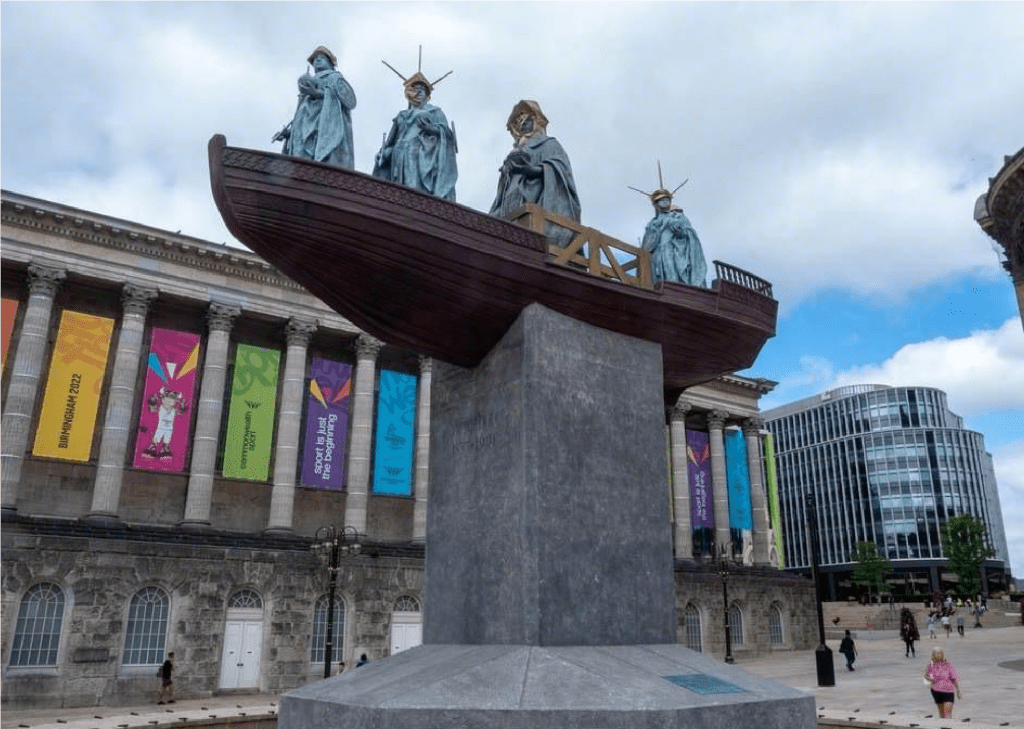
New works are being commissioned to tackle this dichotomy. Contemporary artist Hew Locke took a unique approach to this in his 2022 temporary installation at Victoria Square in Birmingham. Commissioned for the Commonwealth Games, it reimagined an existing sculpture of Queen Victoria by Sir Thomas Brock and William Boyle, by surrounding it with a boat and five
replica models of the queen. Each one carries a replica medal indicative of significant battles for the foundation of the British Empire, thus drawing attention to the implicit violence and exploitation inherent in the Empire. Through this work, he was able to shed a new light on our challenging history as a country, allowing a different set of perspectives to take space in the public realm and be interpreted by the population.
Clearly, public art does more than just decorate our shared spaces. It quietly tells us whose stories matter, who gets to be seen, and perhaps more importantly, who does not. If the figures we see, cast in bronze and stone, only reflect a narrow history, they will inevitably shape a narrow collective consciousness of who belongs. Reconsidering what we place in our public spaces is therefore not about erasing the past, but about expanding the story society chooses to honour in plain sight.
Edited by Milly Howes
Cover image: Giambologna, Abduction of a Sabine Woman, 1581-83, marble, 410 cm high (Loggia dei Lanzi, Florence
 Paper Galleries
Leave a comment