Egyptian Architect Abdelwahed El-Wakil said ‘We die and our buildings die with us’ in response to the temporal nature of modern buildings. He saw modern architecture as a space of dissonance between the world of nature and the world of the human. But what about the space beyond nature? What about buildings devoted to faith?
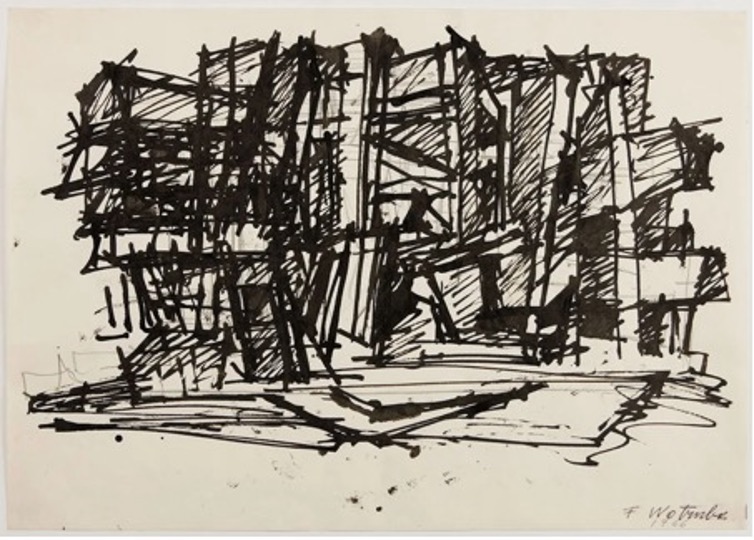
“I dream of a sculpture in which landscape, architecture, and city are one.” – Fritz Wotruba
An architectural style which encapsulates the cold modernity that El-Wakil spoke of is Brutalism. Originating from French architect Le Corbusier use of ‘Béton brut’ translating to raw concrete, the style is defined by its rejection of ornamentation and its adoption of functionalism. Brutalism is often seen as a highly secular architectural style, rising from the embers of spiritual doubt in a post-war era; the brutalist churches exist in a space which many would assume they do not belong. Some may think the holiness and glory of faith cannot be captured in the grim aesthetic of concrete. Its rigidity of form and emphasis on convenience go against the frivolity of the Gothic cathedrals of Medieval Europe and the High Renaissance buildings of the Vatican. Concrete itself feels anti-faith; the architecture of brutalism is the effect of a culture shifting from spirituality into reality. It is, in effect, brutal.
Yet the New Testament and the orthopraxic practice of faith also attempt to understand the brutality of life. Obedience to faith is often a consequence of the brutality of human life. From assumed atheists and agnostics clasping their hands in prayer during plane turbulence to the rows of sick believers waiting to be healed on pilgrimages, we often revisit our faith when we encounter death or hardship, as religion reminds believers that their hardship has a purpose and that it will be rewarded in heaven.
To Marx, this ideology was ‘the opiate of the masses’
However, concrete cannot possibly function as an opiate; frankly, it’s too dull and uninspiring. By adopting brutalist design, the Church can counter one of its most prominent attacks: Marxism. The brutalist philosophy somewhat mimics that of Marxism. The post-war reconstruction of industrial architecture enabled an egalitarian effort to build affordable, functional housing. It rejected the overt ornamentation that visually epitomised the exploitative bourgeoisie. The acceptance of Marxist principles in Christian rhetoric is reflected in Liberation Theology. A stream of Christian thought that began in the 1950-60s in South America, as a response to the suffering of the working class amid rampant class disparity exacerbated by capitalism, juxtaposed against the deep Catholic devotion of most of the working-class population. Liberation Theologians sought to socially liberate the poor and engaged in a Marxist critique of capitalism that was grounded in Christianity. Their ideology is almost perfectly encapsulated in these concrete cathedrals.
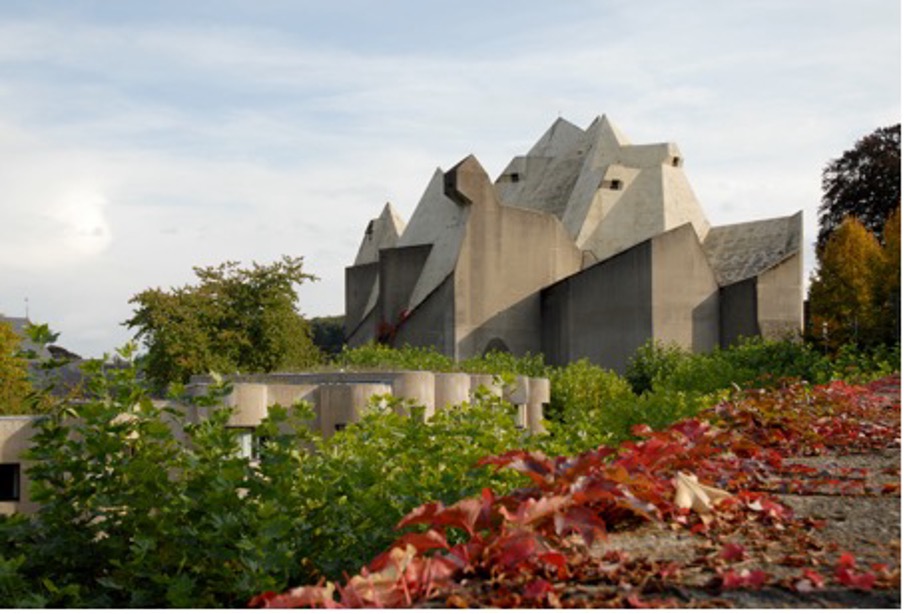
Is this assertion entirely true? When faith ignores the present for the sake of the future, focusing only on their eventual ascension, they seek to emulate it in the real world. The gilded domes of churches from the High Renaissance or Baroque, the rose windows of Gothic cathedrals, all emphasise the light of the heavens. They aim to imbue the church with a sense of weightlessness, suggesting that if they praise hard enough, the congregation can rise within that very building. It feels impossible to rise in concrete; it’s heavy and opaque, and the common concrete domestic building feels as though it is crashing into its residents, rather than uplifting them. But, materials of modernity, though dense, feel more grounded in the now through time and association. Thus, it abides by the practical faith of the Liberation Theologians.
However, Marx’s quote can be applied again as the simplicity of brutalist architecture asserts humility and submission, which Marx rejected for the working class. The obedient do not fight for their own wealth or rights; instead, they wait for the riches of heaven. This quote was a major issue for the Liberation Theologians, who sought to combine their faith with a political ideology they saw as oppressive. There is still something oppressive about the use of concrete, its mass is imposing whilst it does not intend to intimidate through splendour, its very form is often oppressive to nature. Concrete itself is harmful to the environment, with cement production significantly contributing to CO2 emissions and consuming substantial amounts of industrial water.
It’s important to know that political theories are often too abstract to apply to architecture, as any idea can be associated with any building, depending on the viewer’s socialisation and imagination. Interestingly, one of the most culturally celebrated Catholic churches built in South America during the period of Liberation Theology was the Church Atlántida. Created in 1960 and now a UNESCO World Heritage Site, is made of brick. It’s not colourless like concrete but not as marvellous as marble or stone, thus its association is subjective.
Overall, the biggest fallacy of the Liberation Theologian was their inability to fully modernise the church; this issue also appears in architecture. They were criticised for removing the necessary faith and devotion from Christian practices, focusing instead on acts of faith. In the same way, we can argue that these “modern churches” lack character.
Even though there is the moral issue of propaganda and abuse within the Catholic church, we still go to visit their cathedrals and monuments, because they hold cultural relevance. This is what El-Wakil couldn’t see in the architecture of modernity. He claimed, ‘Modern architecture will not pass the test of time’ and he is possibly right. I recently visited Florence and Rome, and on almost every day of the trip, I saw some sort of religious building. Each felt that they held a certain significance, which I don’t think is captured in modern churches.
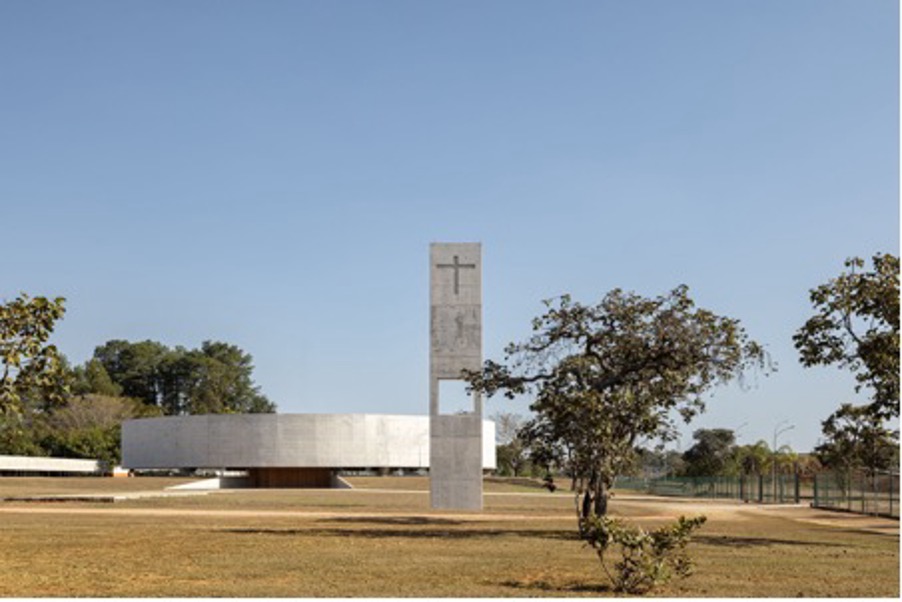
The image above is a more recent church from Brazil, completed in 2022. The Church of the Holy Family is vacant, isolated, and, quite frankly, a cultural void. It is no longer Brutalist; it does not espouse an ideology or philosophy. It is an object from a culture which does not particularly favour the traditions of the church, and so it has rejected them entirely. Author Bill Muehlenberg stated:
“What the church was for medieval Christians, the Machine is for most of us today.“
In this building, we see the church try to fit into modernity, and in doing so, it becomes a machine. But again, it is a rejection of the natural world around it and of the human world of culture, faith, and celebration. It is an emblem of technology. It almost functions again as an ‘opiate for the masses’, imposing the dominance of technology onto faith. We are obedient again to this promised future (sometimes described as a technological paradise), technical domination burdened by the mark of a cross, becomes a divine and inescapable promise.
Edited by Jayden Jin
Cover Image: Church of the Holy Family, Brazil. Image credits: Joanna França

 Paper Galleries
Leave a comment