Art has almost always been a political battleground. It has been harnessed by rulers, suppressed by dictators and controlled by states, all of whom understood it to be a vital source of power. Despite being a mode of expression, artistic production can be easily exploited as a tool for societal repression through both censorship and its use as a medium for propaganda. This censorship of both our visual world and our ability to freely express ourselves not only suppresses dissent and legitimises despotism, but more importantly, shapes a very particular collective consciousness.
Paintings, sculptures, and even architecture can be harnessed as potent tools for encoding ideologies, whose effects often outlive their originators and become an integral part of history. Such methods are certainly not new. They can be traced back over millennia, most famously seen in the iconic 20th century B.C.E imperial image of the first Roman emperor, Augustus of Prima Porta, which cemented his triadic status as leader, military commander, and high priest; profoundly shaping all later depictions of rulers with its new iconographic style. Interestingly, in 1937, Italian fascist politician Mussolini issued the Prima Porta Stamp, tactically employing Augustan iconography to legitimise his fascist politics.
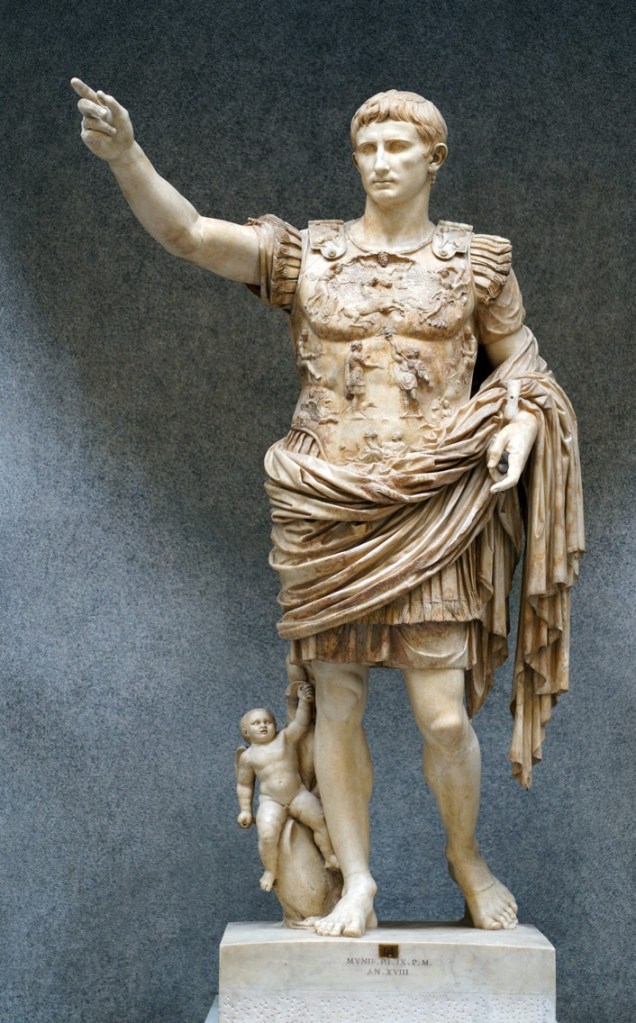
These deeply symbiotic methods were exploited fervently by other 20th century dictators too. The Communist cult of personalities employed by Stalin and Mao in the Soviet Union and China, respectively were maintained by strict control of artistic output so that a singular ideology could be communicated without challenge. Stalin suppressed avant-garde, abstract, or nonconformist art styles that did not befit state-sanctioned Socialist Realist art, which glorified the regime by depicting a simple, optimistic Communist working life. This was coupled with Stalin’s omnipresent image; an endless proliferation of posters portraying him in a paternalistic role and as the successor to Lenin, a series of idealised, classically inspired military portraits and monumental sculptures are found in cities across the USSR.
Dictators do not just use art to subjugate, but to also manipulate the past, present and future. This can be seen in Nazi lootings. From the 1930s onward, there was a purge of supposedly “degenerate art” from German public institutions. This eradicated aspects of the past which did not conform to the Nazi agenda. It was largely Modernist works of art, including Cubism, Expressionism, and Impressionism, that were targeted, since they were abstract and resistant to command. Censorship was deployed to overcome this fear of uncertainty. Simultaneously, Hitler promoted a new, austere form of artistic creativity in Germany, seeking to construct a contemporary cultural identity that would shape what future generations would consider normal. We may think that we have left such practices behind, now merely an Orwellian trope, but this is not the case. Across the globe, artistic practices are being restricted and altered by governments, utilising many of the methods used by past dictators once again.
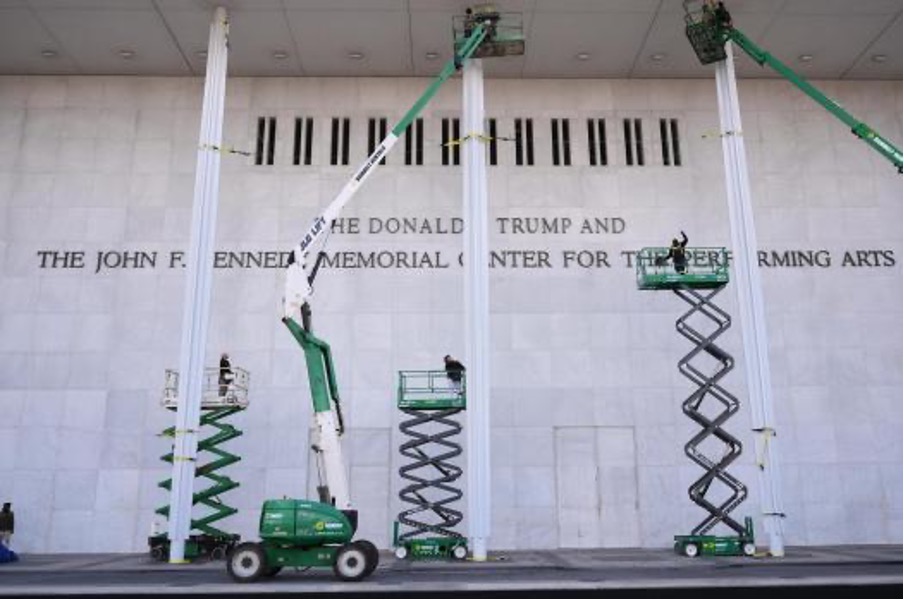
Most recently, in the wake of U.S President Donald Trump’s directive to abolish “corrosive ideology” from cultural heritage venues across the country, an exhibition at the Independence National Historical Park in Philadelphia was removed. Titled Freedom and Slavery in the Making of a New Nation, it explored the lives of nine people enslaved by George Washington, examining the paradox between slavery and freedom in America’s founding. This blatantly targeted erasure of history enables the Trump administration to dictate an alarmingly narrow view of America’s history and identity. Concurrently, Trump is exploiting the arts to promote himself in a remarkably similar way to dictators of the preceding centuries. There was an almost vindictive cruelty to his renaming of the John F. Kennedy Centre for the Performing Arts, a living memorial to J.F.K, as the Trump-Kennedy centre in December 2025, alongside promises to rebuild. Arguably, the quality of a democracy can be judged by the quality of its arts. Trump’s interventions suggest not mere indifference to this idea, but hostility towards it.
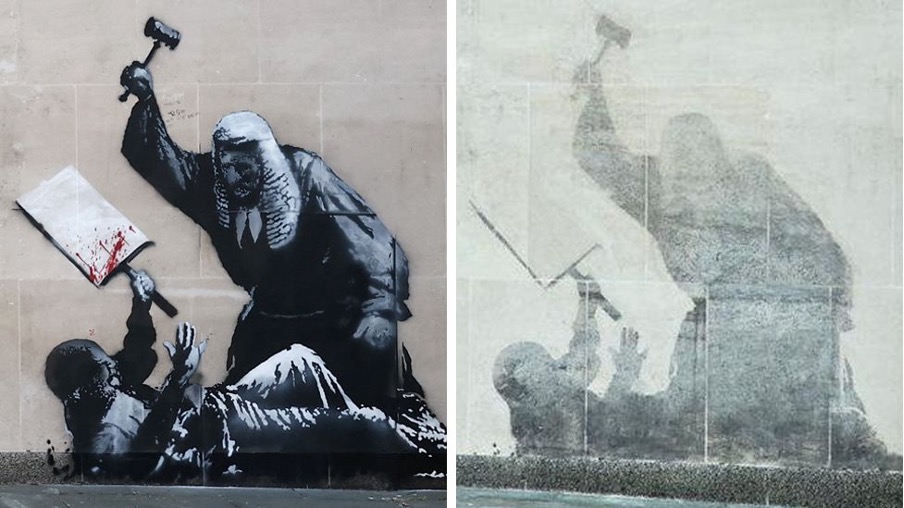
It is easy to think that such extremist, state-sanctioned actions are only occurring in countries poisoned by a politically fractious atmosphere; however, examples of state censorship are proliferating here in the U.K too. In September 2025, a Banksy mural on a wall of the Royal Courts of Justice complex was removed. It depicted a protester lying on the ground holding a blood-spattered placard as a judge, sporting a wig and gown and violently wielding a gavel, loomed above. It was thought to be a comment on the arrest of hundreds of people for supporting Palestine Action by holding up placards at protests. Its removal signals a shift in our country’s politics, one which does not endorse freedom of speech or the pursuit of artistic expression.
We are entering into an era of intensifying political extremism, making resistance to the growing control, suppression and manipulation of our visual and material culture more urgent than ever. To accept conformity is to surrender critical thought, and to tolerate censorship is to normalise the erosion of expressive freedom. When power converges with artistic production, vigilance becomes necessary, not optional. When culture is disciplined into obedience, society will soon follow.
Edited by Jayden Jin
Cover Image: The Banksy mural on the Royal Courts of Justice exterior wall before and after it was removed on 10 September 2025. Image credits: BBC website
 Paper Galleries
Leave a comment