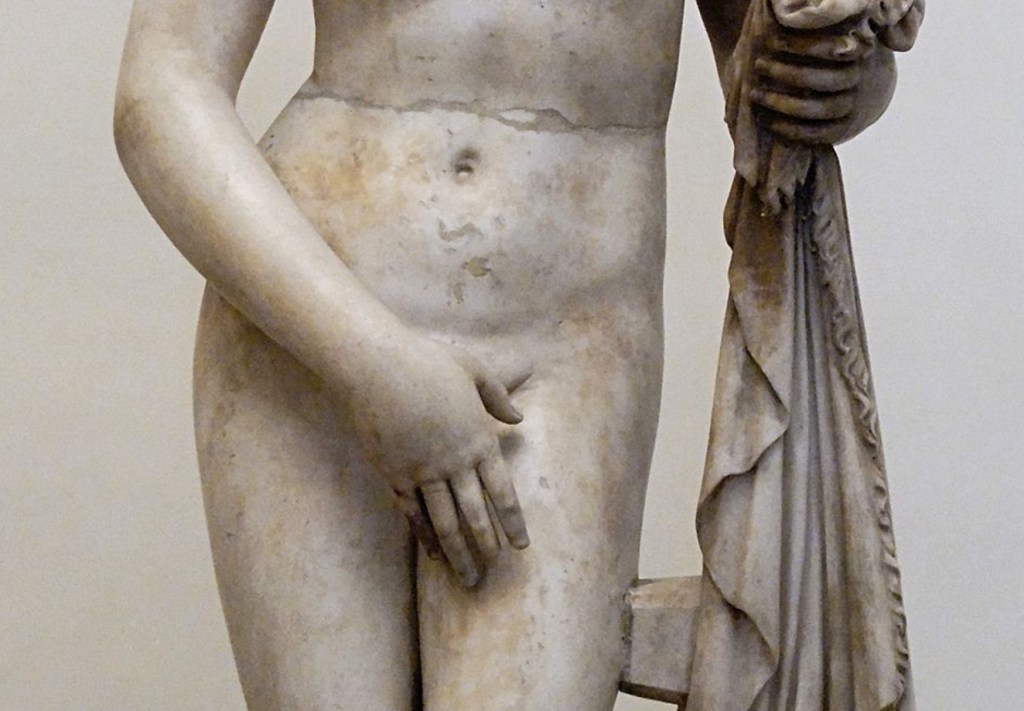
The reproduction of the female form in art history becomes as exploitative as its consumption. The female body must perform the function of Madonna or whore, the lustful or the shameful, the desired or undesirable. We seem to be controlled by a binary, where a woman must become the entire essence of something idyllic, lacking the nuance of a fully realised individual. Yet for most artworks depicting the imagined women, she is stripped of her individuality — instead performing a role within the fantasy of the artist. In the words of Margaret Atwood:
‘Male fantasies, male fantasies, is everything run by male fantasies? Up on a pedestal or down on your knees, it’s all a male fantasy’ [The Robber Bride]
Anecdotes from key figures and objects in the history of art show the danger of the male fantasy and how it pollutes the psychology of gender and desire. Since the fantasy of control is reinforced in the relationship between the artist and subject, the power to control image becomes another story of domination. The gender hierarchy is thereby reinforced through creation and imitation.
Writer John Ruksin, a companion of the Pre-Raphaelites, focused his work on the interconnection between the natural world and art, adoring the country-side and opposing the environmental impact of industrialisation. However, his ideas on natural beauty did not translate to the female figure; whilst the artists must become accustomed to the organicism of the natural world, the women must still remain polished, almost like a product. The very capitalism that Ruskin criticised could still be applied to women without any controversy. The female body was still something to be consumed, a service for his own pleasure. Effie Gray, a model for the Pre-Raphelites who would later go on to marry Millais, first married Ruskin. They were together for six years yet never consummated the marriage. According to Ruskin, ‘[Effie’s] person was not formed to excite passion.’ Some claim the real reason was that Ruskin was shocked to see her pubic hair—whilst this assumption may be untrue (a rumour formed in the 20th-century), Ruskin had still rejected the body of his young wife. Used to the delicate and idealised figures of Classical sculpture, Ruskin may have been astonished at the ‘imperfection’ of the true female figure. The natural formation of hair on the body disgusted Ruskin to a life of celibacy, and that the true nature of femininity was too far from the women he saw on the pedestals of mighty galleries and institutions. Ruskin’s disgust with the female body lies not in its actual visuality but in its function. When it cannot arouse, it must become ugly, and if it is ugly, it has no purpose. Ruskin’s use of the word ‘formed’ is reminiscent of a sculptor’s relationship to clay, rather than a man’s relationship to his wife. Even though Ruskin was never an artist, he still viewed himself as a creator, somewhat omnipotent to his wife. This could have been a consequence of his devout Christian ethics and beliefs, the idea that the body was formed by God. But his male desiredemanded more from God, it demanded perfection: the perfection his peers created in painting and sculptures, the perfection he saw in galleries and Classical ruins. A perfection he could not see in his very human wife.
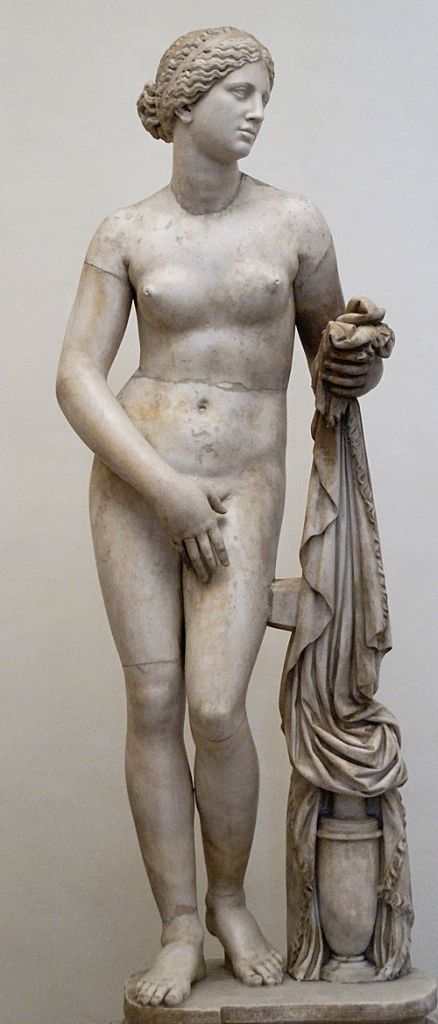
Possibly the most hyperbolic example of female perfection is the one of the very first nude female sculptures, Aphrodite of Knidos (Praxiteles 4BC). It is also a Venus pudica, where a nude goddess, usually in the form of Venus, covers her breast and pubic area each with one hand. As the etymology of the term suggests shame, pudico meaning ‘modest’ and pudendameaning ‘of which to be ashamed,’ this sculpture and the later versions of the Venus pudica oxymoronically highlight and hide the vulva, emphasising it to the viewer but playfully restricting it from the viewer’s gaze. The sculpture aims to taunt the male gaze and pursue the male libido. In both concealing and signalling her sexuality through the illicit imagery, the sculpture becomes heavily dependent on the male imagination. However, the name of this classical posesuggests that there is something to be hidden, that female sexuality is something to conceal. This is ironic as the goddess whom they portray is the goddess of sex, love, fertility and passion. Her sculpture functions as the embodiment of sexuality, however her form and position are dictated by a wish to conceal it. She is once again controlled by the male sculptors who have created her. Even after the sculpture’s creation its function is again dictated by male passion.
There is a tale from the Roman author Pliny the Elder about how the sculpture was once stained after a young man became so infatuated with the nude that he attempted to have sex with it. As comical as the story is, it also highlights a concerning truth about the predatory nature of the male gaze. I pose the question; can the female body exist in nude without the need for sexual arousal? Whether fat or thin, hairless or hairy, young or old, can men leave women alone? It seems, since the 4th century BC the answer has always been no.
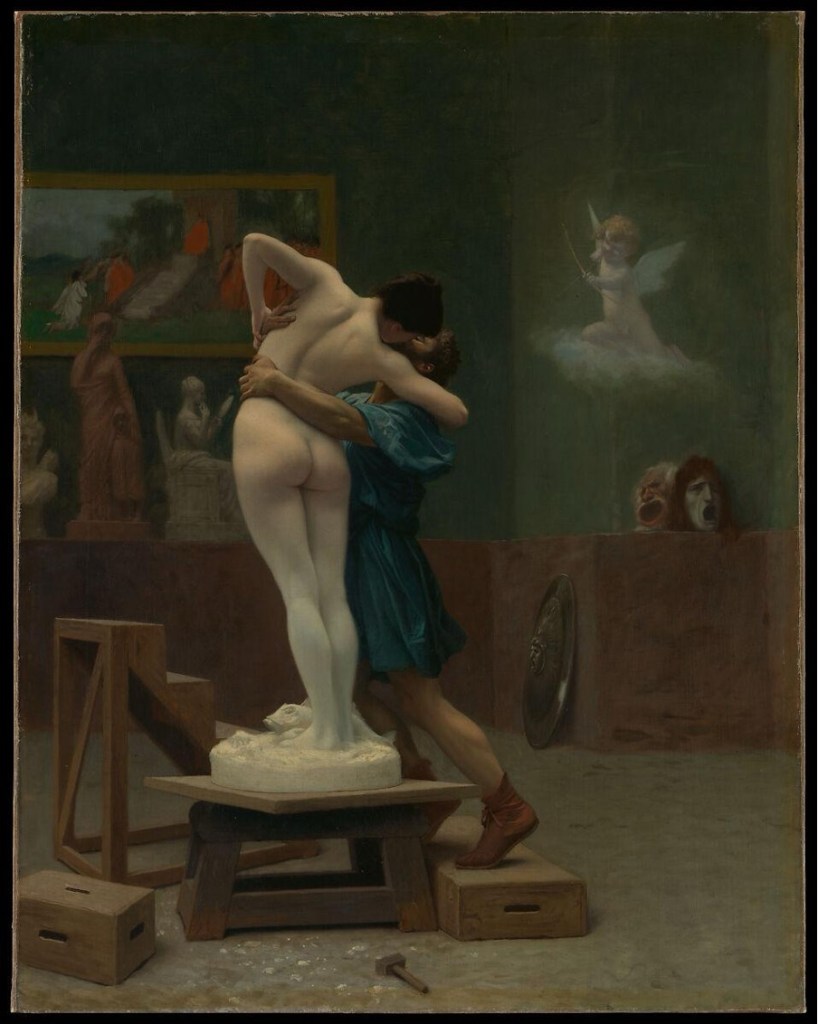
The relationship between a man of flesh and a woman of marble is also depicted in the myth of Pygmalion from Ovid’s Metamorphoses. The tale follows a Cypriot sculptor who wished for his future bride to be the very likeness of a sculpture he created, and on the day of Aphrodite’s festival his dream would come true; the Goddess brought the artwork to life, and the stone became flesh at the touch of her creator’s lips. It’s a fantasy of desire and mastery, mastery of both craft and wife, and desire for that which you can control and manipulate. Her form is dictated by the passions of the sculptor and her very being is the product of his own will. There is a pattern between the story of Pygmalion and the defilement of Aphrodite of Knidos. In both tales, men seek the company of that which is crafted for their own desire. But why does one ‘fall in love’ with the inanimate? It is not just an obsession with beauty, but beneath is also a desire for the infantile, the silent, and the submissive.
This begs the question: do men truly like women or do they like art? Pieces to place on pedestals, stone to sculpt into soft, hairless forms, paintings to gaze upon. They wish to dominate rather than to love. Robots are being created with the sole function of fulfilling sexual pleasure, stripping the interpersonal experience from romance.
In 2017 after the Arts Electronica Festival in Linz, Austria, the sex doll ‘Samantha’ was found ‘soiled’ according to its creator Sergi Santo, suffering from the hands of overly eagermale molesters. Yet he promised the BBC reporter that ‘she will pull through,’ with the BBC acknowledging that her career still looked ‘promising.’ This morbid response to the aggression against female anatomy reflects the abstraction that art can create from reality. When the body is seen as a robot/image/sculpture, it is produced only as a tool for the male fantasy. The current aesthetic of the sex-robot is blonde, with a full bust, thin waist, a smoky eye, and soft hairless skin. Whilst this does mirror the current beauty trends, it also portrays an image of the kind of ‘woman’ who can be treated in such a way, appealing to the societal disbelief towards female testimony — when victims present themselves in ways which we deem sexually promiscuous. Sex-robots and sculptures are not people. They have no emotions, no limits, no boundaries and most importantly, the inability to say no. As the dire consequences of pornography have shown us, we can no longer differentiate between the real and the dream that real women will be treated as though they too are made of plastic or paint. Whilst the function of sex-robots is to keep real women safer, the accommodation of male fantasies only increases the potential for ludicrous and dangerous desires. The stories of Ruskin, Aphrodite of Knidos, and Pygmalion only show that what men desire is for the dream to become tangible.

There is a pattern in the relationship between the male artist/viewer and the female subject—once she is conceived as something other than human it allows for the moralboundaries to be removed. Not only this, but the way in which we paint and sculpt women controls the way in which we assume women should act and behave. There is a common theme here of placing too much control into the hands of men. Women are always created to perform a function for male pleasure when the creative practice and intended audience is male dominated. Thus, the rhetoric should seek to change, through placing women in positions of creativity.
Edited by: Alison Grace Zheng
Cover image:
Close up of ‘Aphrodite of Knidos’ by Praxiteles, 4th century BC


 Paper Galleries
Leave a comment