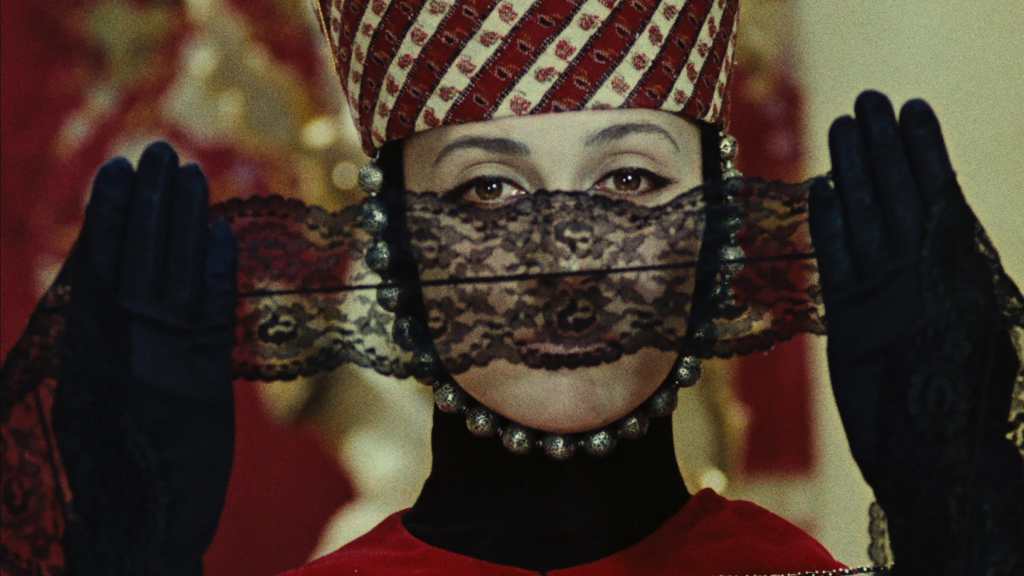
Watching Sergei Parajanov’s 1969 film The Colour of Pomegranates will make you feel as if you’re wandering through endless rows of a colourful market fair. The patterned rugs alongside antique vases, the rich textiles and archaic manuscripts, the nacreous shells, the candleholders, the flowers — all compete for your gaze with their allure. The same can be said of its narrative, with its elliptical, disjointed montages ingeniously weaved together by Parajanov to create a cinematic tapestry. Every detail is a metaphor, a symbol — disguised, yet hermeneutically intelligible when read with its content, history, and semiotics. Let’s unravel this masterpiece to understand how Parajanov explores and embraces this sense of entanglement both on a filmic and spiritual level.
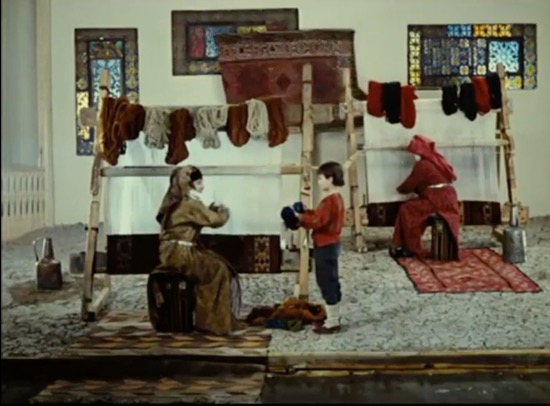
Unsurprisingly, the concept of ‘tapestry’ is central to the story, with the film following the life of an infamous Armenian troubadour, Sayat Nova, whose parents were weavers. We first encounter this craft during the poet’s childhood. In this initial scene (fig. 1) the perspective is flattened, the simple cream-coloured room is decorated only with a few stained-glass windows, under which two peg looms stand parallel to each other. Two adult figures are sat weaving, turning loose masses of yarn into organised geometric patterns, while little Nova brings the yarn to one of them. The carpets (shown to be complete later in the film) are only starting to emerge, suggesting the very beginning of Sayat Nova’s life.
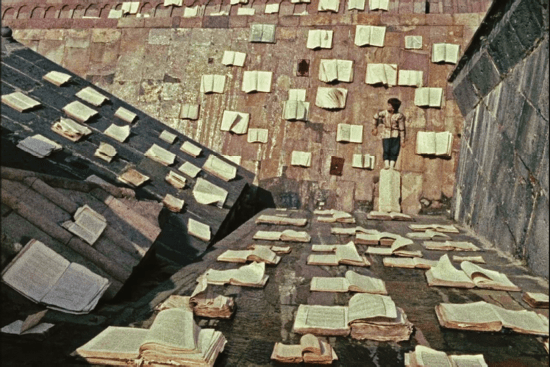
Another childhood scene depicts the poet at the top of a monastery; the roof is filled with rare manuscripts, and their old brittle pages are seen turning under a light breeze. While Nova is shown to be flipping through one book, he metaphorically studies all of them. The scene thus transcends traditional boundaries of time, capturing the boy’s adolescent experiences at the seminary. Observing both scenes, one may discern a semantic comparison between the word in the manuscripts and the thread of the loom; both are tied together with the rest to form a greater meaning, and both are continuous. In this way, language is like a carpet: weaved, formed and reformed throughout the poet’s life — it can be something that brings us closer to other people, even the ones who are separated from us by thousands of years. Parajanov highlights this by stating that “We are recounting the epoch, the people, their passions and thoughts through the conventional, but unusually precise language of things.”
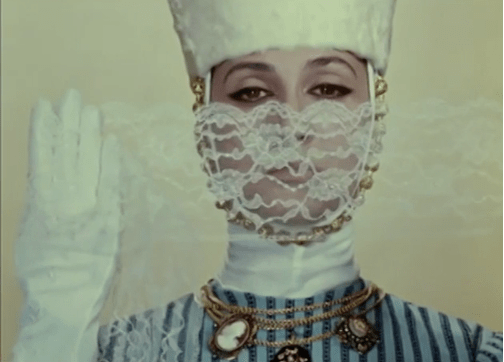
In the troubadour’s youth scenes, the lace and vibrant textiles help construct a medieval setting, this is especially evident in the choice of white lace held by Princess Anna in the courtship scene. Alluring, soft, pure, and feminine, it moves down her face to the lips, revealing her drooped eyelids and her sensuous yet morose gaze. This exacerbates the sexual tension between the two young lovers, and hints at the forbidden nature of their romance.
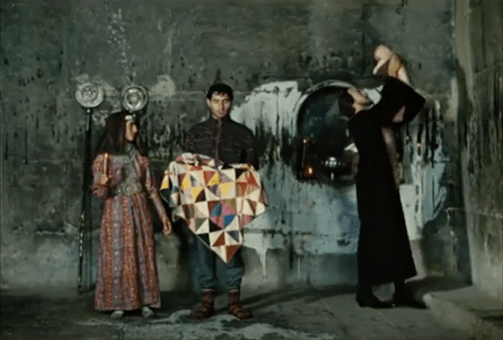
During Sayat Nova’s twilight years as a monk at the Haghpat Monastery, the idea of tapestry resurfaces in the religious context. In the baptism and marriage sequences, one may notice a vibrant padded duvet, which in the first scene covers the baby, and in the latter covers the newlyweds. Contrasted with the monk’s grim attire and the plain grey stone walls of the monastery, the brightness of the quilt stands out as a constant, reinforcing the sense of unification of the past and the present. Sewn together from different pieces, it becomes a symbol of connection, one that links human with God, and ultimately can join two human fates together.
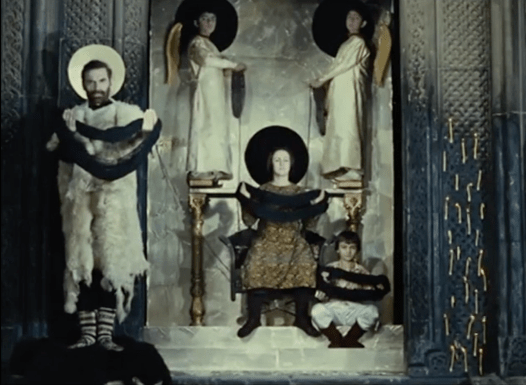
The connection between the act of weaving and religion is shown again in one of the final scenes, when Sayat reminisces about his parents. In a tableau vivant fashion, the figures are arranged to resemble Mary, Jesus and John the Baptist. Their hands are encircled with yarn, the threads of which stretch and form a knot under Mary’s chair. Historian James Steffen believes that through this composition Parajanov draws a conscious link between motherhood and the divine. Alternatively, this could also serve as a metaphor for Sayat’s life that is about to be finished by revealing the creators behind the tapestry that is his existence.
The film’s score also ardently embraces fragmentation of time and space, like a tapestry or an old manuscript. Armenian composer Tigran Mansurian constructed the soundtrack in the manner of musique concrète – a technique created in the 1940s and later favoured by film directors such as Jean Cocteau, Michelangelo Antonioni and Jacque Tati. Consisting of various tape recordings from Sayat Nova’s poetry reading, and according to James Steffen included “audio recorded both out in the field and in the studio, with the help of the film’s sound engineer Yuri Sayadyan.”
Finally, the story of Sayat Nova is, in itself, culturally entangled. He was born in Tiflis (modern day Tbilisi), then part of the eastern Georgian Kingdom of Katrli, which was a vassal of the Safavid Empire of Iran. Sayat’s father was from Aleppo (modern day Syria), and his mother was a Kartveli from Tiflis, while the poet was born and educated in Sanahin (modern day Armenia). The influences of various Transcaucasian nations — Armenians, Georgians, Azerbaijanis, and Kurds — and the religious practices of Islam, Christianity and Judaism were thus mingled together in the film. We see Persian rugs, biblical references such as the pomegranates representing the blood of Christ, ancient symbols of feathers, and shells as female and male principles respectively. Parajanov has attempted, and one may argue brilliantly achieved, portraying a complex relationship between people through love and anger, through loss and remembrance; connecting the language of Sayat Nova’s poetry to the poet himself, and the rest of the world.
Edited by Milly Howes & Ariel Yuan
Cover Image: Still from the film The Color of Pomegranates by Sergei Parajanov

 Paper Galleries
Leave a comment