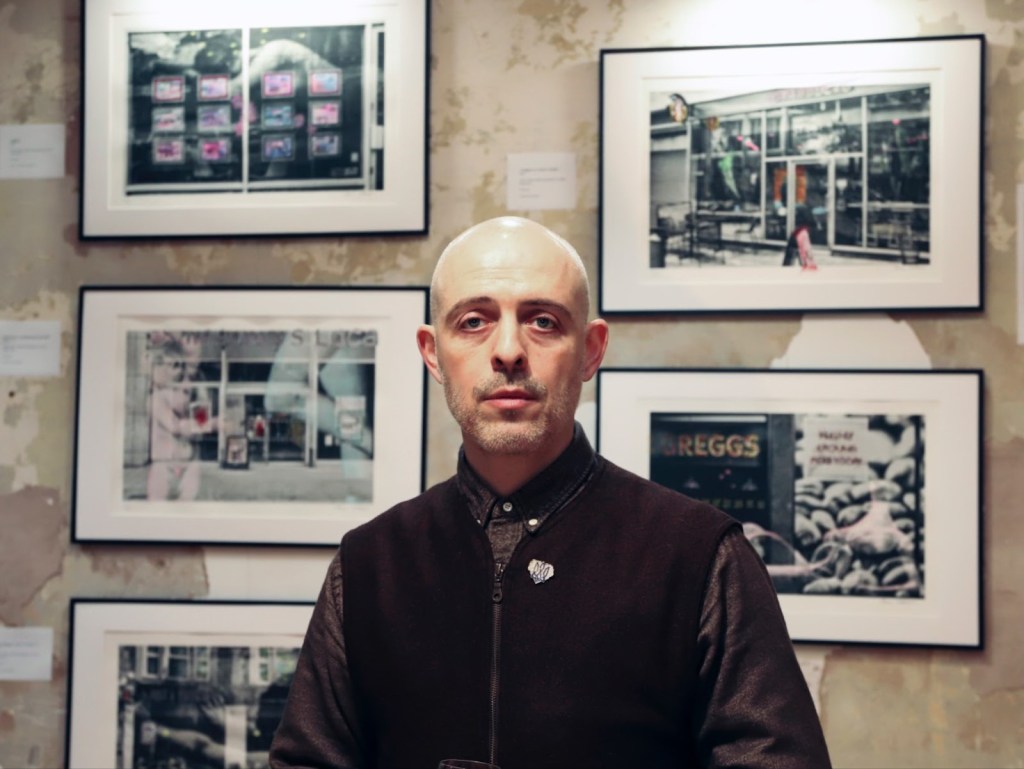
On 16 January, The Arc London in Fitzrovia opened Roma Liberov’s solo exhibition Reflections: “a poem is as real as a utility bill”, which I had the privilege to curate. The show brings together a series of mixed-media photographic works created over the past two years of the artist’s life in London. Liberov’s practice, long situated at the intersection of cinema, visual art, literature, music, and performance in Russia prior to 2021, has gradually evolved in response to life in England, the experience of emigration, displacement, and the loss of home. The central visual motif of the series emerges through double exposure. Commercial urban surfaces saturated with the city’s anxiety are layered with fragments cut from expressive painterly scenes.
After several months of close engagement with Roma’s works, I came to see some of them as a ready-made iconographic guide to the National Gallery, one of London’s most comprehensive public collections. I began to follow Liberov’s path through biblical and classical subjects, tracing it as one might follow a trail, in order to reconstruct the map of his artistic pilgrimage and to show how his distinctive method of exploring the city through the museum galleries, that might be repeated by our Paper Galleries readers.
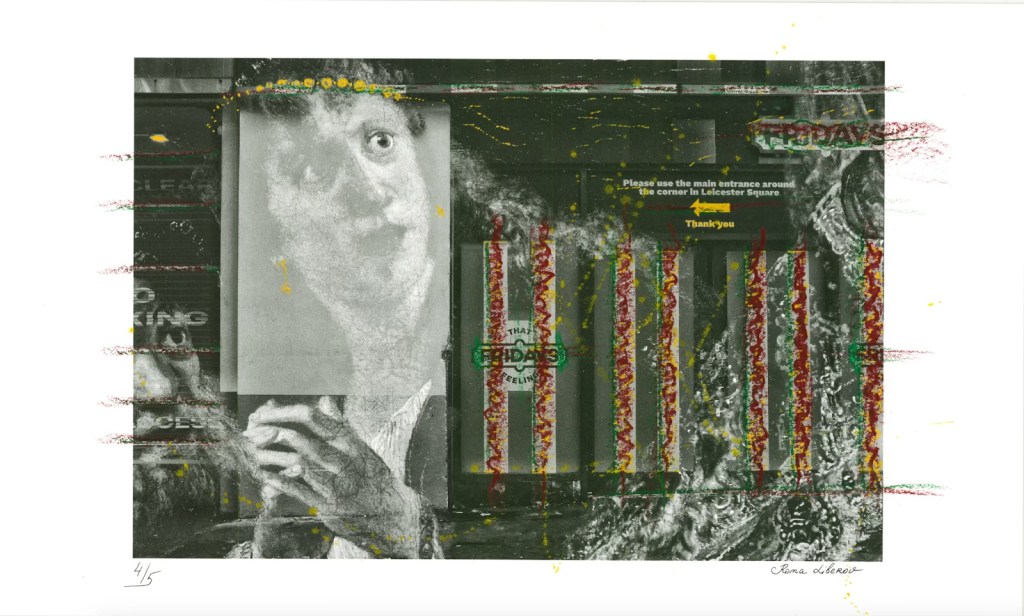
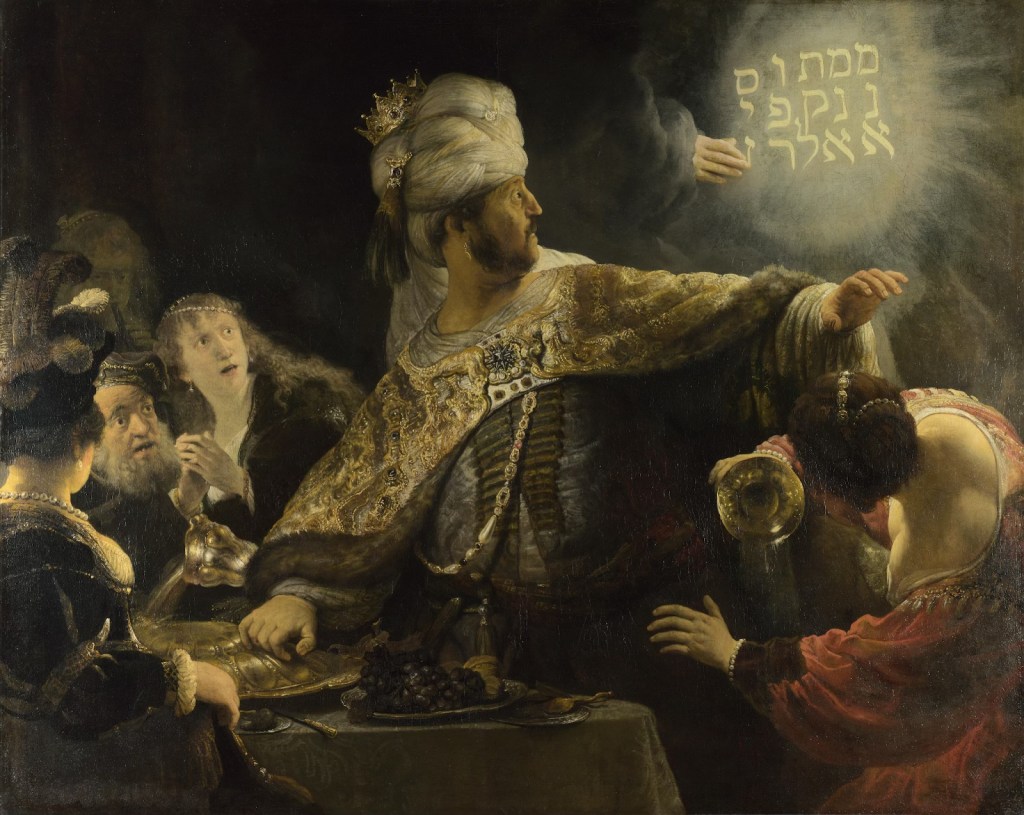
The point of departure set by Liberov’s viewfinder was Rembrandt’s Belshazzar’s Feast from 1638. The painting hanging in Room 22 on the second floor, depicts a biblical episode rarely favoured by artists of the Dutch Golden Age. Belshazzar, newly risen to power after the death of his father Nabonidus, hosts a lavish feast. When the guests run out of vessels, he orders the sacred golden cups taken from the First Temple of Jerusalem and kept in the treasury of his god to be brought in. The drama of the painting unfolds gradually. In the mese-en-scene, before the king and his court, a hand appears, inscribing glowing Arameic letters onto the wall, interpreted by a young noble prophet Daniel: “Mene, Mene” (“numbered, numbered”) – God has numbered your kingdom and brought it to an end, “Tekel” (“weighted”) – you have been weighed on the scales and found wanting, “Upharsin” (“divided”) – your kingdom has been divided and given to the Medes and Persians.
That same night the city falls to the Persians and the Medes, and the king is killed. Beneath the prophecy, water spills from a precious goblet, a quiet reminder that no amount of power can transform it into wine. However, Liberov’s attention in this work rests on a female figure crowned with pearls, the king’s wife, her face contorted by fear. Her expression sets the emotional tone of the entire composition, lending it both tension and gravity. And yet, within this terror, there remains a fragile clarity. The sense that the world has not been abandoned, that the divine continues to act within it, revealing itself to those who remain open.
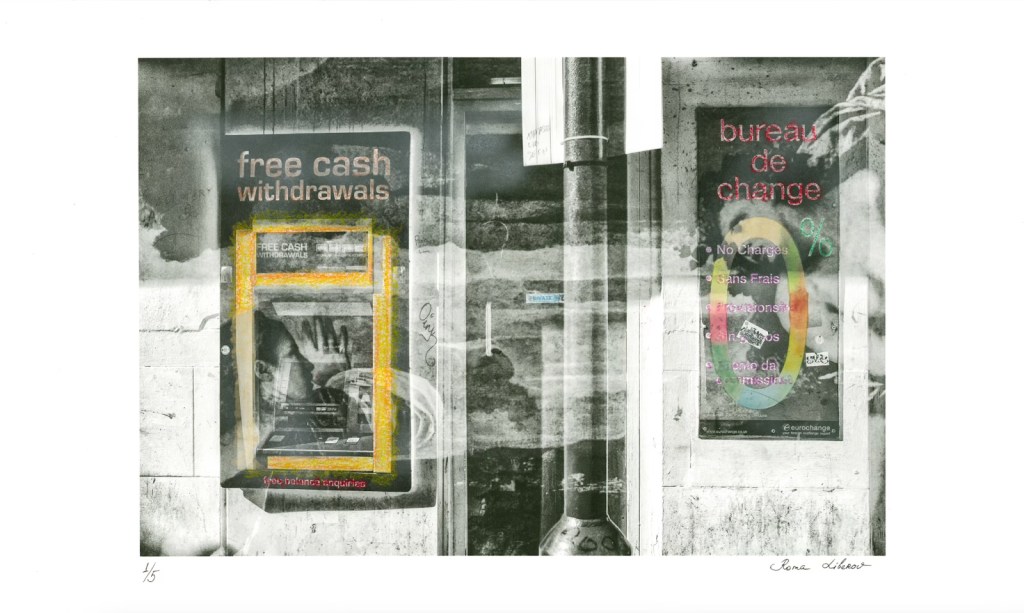
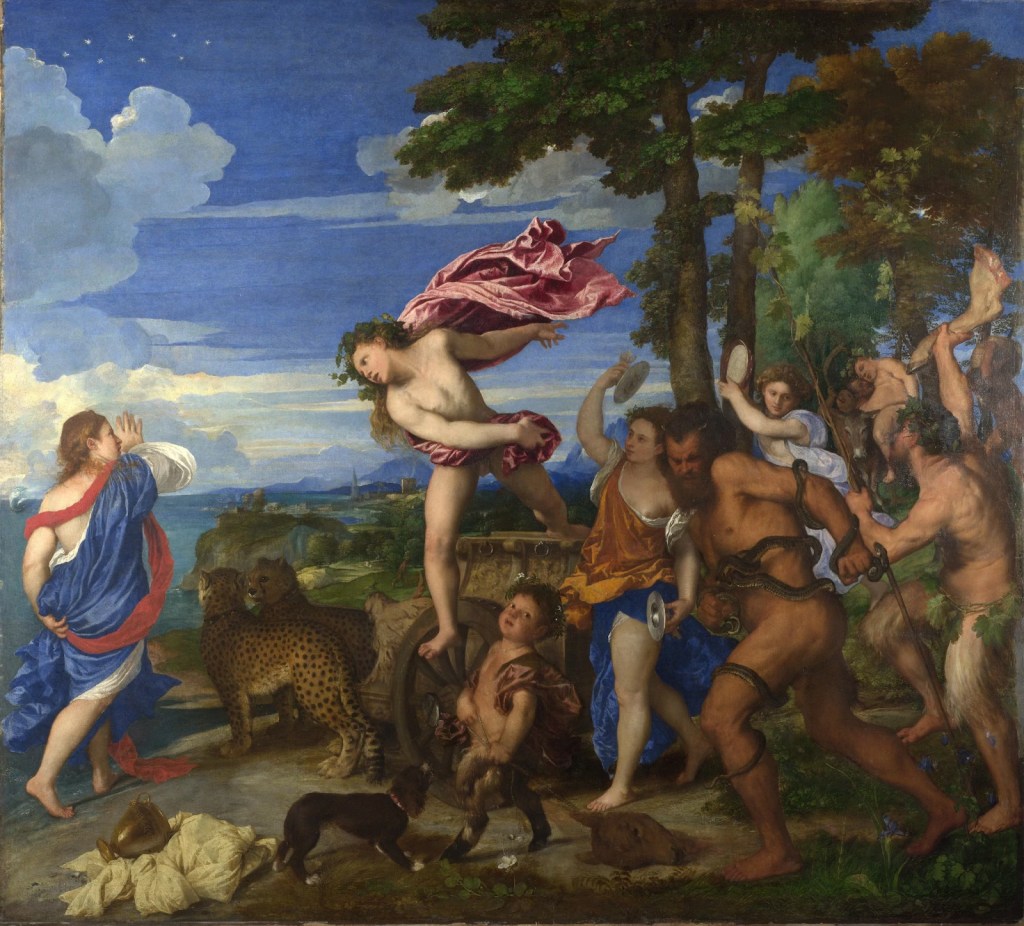
Like the heroine of the next painting, moving from despair toward immortality and divine love, I made my way to Room 8, following a cue from Liberov’s Bureau de 0%. In Bacchus and Ariadne, Titian builds the composition through a dynamic interplay of gesture and movement. Drawing on Ovid and Catullus, he depicts Bacchus, the god of wine, leaping forward in a dramatic rush to catch sight of Ariadne, who has just been abandoned by her lover Theseus. The moment is suspended between shock and recognition. Titian aligns their gazes along a single axis, allowing the tension between Ariadne’s vulnerability and Bacchus’s devotion to structure the entire scene. Liberov responds to this compositional logic by placing the scene in reduced opacity over a monochrome photograph of a currency exchange office. In the gallery the original painting asserts a different palette. Green-blue and earthen tones define the landscape. The figures’ bodies appear luminous, rendered in pearly flesh tones punctuated by flashes of white, lilac, and blue. Titian’s handling is both sensuous and controlled. The figures are modelled with remarkable sensitivity, yet the composition remains rigorously ordered. Emotional intensity is held in balance by structural clarity, a hallmark of the painter’s mature style.
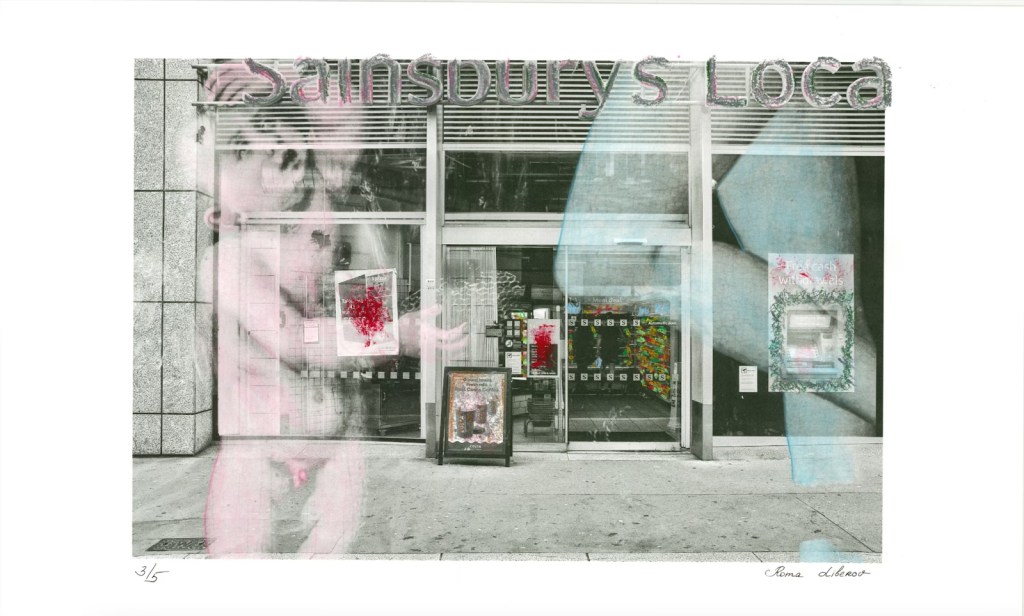
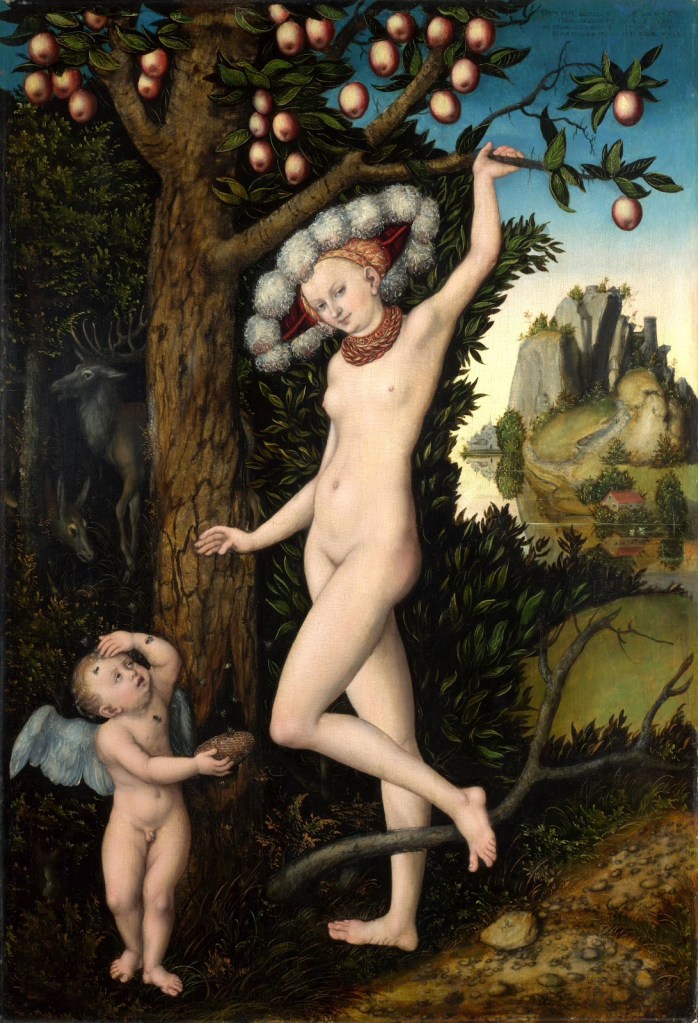
In Room 55, I am greeted by patrons of love, figures already familiar to me from Sainsbury’s Loca(l)/Cranach the Elder’s. The weary Cupid and Venus appear here in accordance with classical myth. Having attempted to steal honey from a beehive, the god of love is stung by bees and, in pain, turns to Venus for comfort. The episode echoes a passage by Theocritus, the father of ancient pastoral poetry. Cranach the Elder includes a quotation from the Greek poet in the painting itself, inscribed in dark paint and barely visible in the upper right corner. Venus directs her seductive gaze towards me. The elegant, flowing lines of her figure depart from the ideals of classical sculpture. Cranach renders a distinctly Northern vision of the body, carefully detailing every crack in the tree bark and each translucent, almost glass-like feather of Cupid’s wings. This work, which concludes my tour, becomes a moral counterpoint to the Titian seen moments earlier. Here, passion is fleeting and inevitably leads to pain. Like the small god of earthly love, stung while giving in to temptation, desire promises pleasure but delivers suffering. All-consuming passion, Cranach the Elder suggests, leads not to fulfillment but to loss.
As I left the museum, I decided to leave iconography and myth in their familiar setting and return to the present – to Roma’s works that observe London as it is today. They are on view at The Arc Space, where we welcome visitors from Monday to Friday, 12 to 5 pm, at 13 Tottenham Mews, until February 13.
Edited by Saffron Watkins
Cover Image: Roma Liberov at the opening of the exhibition Reflections at The Arc London, 16 January 2026. Photo: Valery Konkov/courtesy of The Arc Space.

 Paper Galleries
Leave a comment