Historically, the art market has been perceived as a closed sphere: a world concentrated between London and New York, where key positions are taken by blue chip galleries and major auction houses trading highly priced masterpieces. However, in recent years this landscape has begun to shift, driven by rapid technological advancements and an increasingly volatile global economic environment.
In 2026, we will see a growing decentralisation of the art market. This process will affect nearly every aspect of the art world: from the geographical expansion of established Western cultural institutions and the emergence of new ones in the Middle East, to the explosive growth of the sub-$50,000 ‘entry-tier’ investment. Traditional formats of trade are being increasingly complemented and transformed by digital, immersive and experience-based practice, reshaping both artistic production and audience engagement.
The Middle East’s Developing Creative Role
One of the most significant shifts in 2026 is unfolding in the Middle East. In the 2010s, the region was largely perceived as a consumer of primarily Western art. Over time, it has evolved into one of the world’s most influential patrons of contemporary culture. Cities such as Riyadh, Doha, and Abu Dhabi have become crucial cultural meeting points, where leading Western institutions meet local initiatives.
On an institutional level, 2026 will mark numerous major milestones for the region. Guggenheim Abu Dhabi, which is set to become the largest Guggenheim museum branch worldwide, is to be completed in 2026, signaling the scale of the region’s ambition in the cultural sector. At the same time, Centre Pompidou’s partnership with AlUla will reach a circular moment with the Arduna exhibition, which will juxtapose artists like Picasso and Kandinsky with contemporary artists, sparking a dialogue across historical periods. The art market will be expanding alongside these developments happening on the institutional level. Two of the world’s most influential art fairs are launching Middle Eastern editions: Art Basel Qatar will start in February 2026, and Frieze Abu Dhabi is set to launch in November. Together, these fairs introduce the region not only as a marketplace and a major consumer of modern art, but as a site for curatorial innovation.
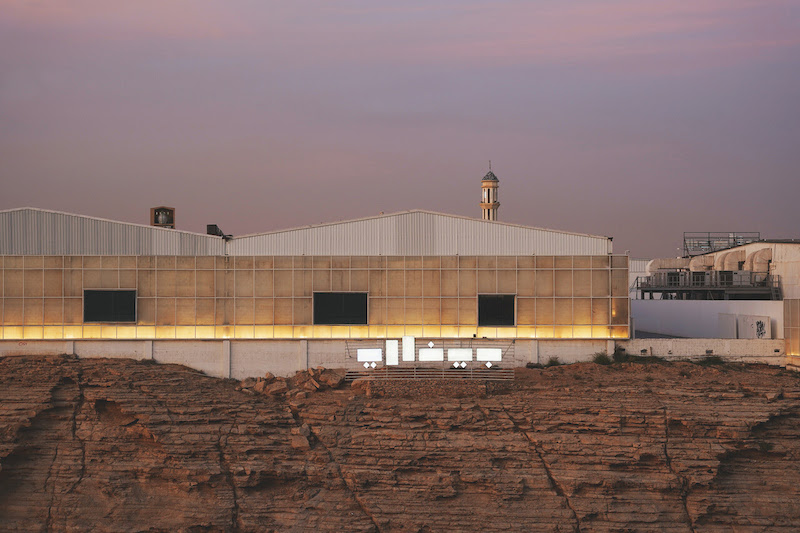
Equally visible and important is the rise of homegrown initiatives that challenge traditional approaches to the art exposition and notion of museums. Projects are becoming increasingly interested in experiments surrounding contemporary art. One of the most outstanding examples is TeamLab Phenomena Abu Dhabi on Saadiyat Island, a 17,000-square-meter venue dedicated to immersive digital environments. Its installations are exploring ‘environment phenomena,’ with artworks that exist through the intersection of space, light, and audience. At the same time, in Saudi Arabia, the 2026 edition of the Diriyah Contemporary Art Biennale will lead to opening of Riyadh’s JAX District, a repurposed industrial zone that is now home to more than a hundred creative studios that will support the development of contemporary artistic culture.
The Rise of the “Entry-Tier” Market
While big art market research publications such as Art Basel, Artsy, and UBS have mostly focused on the wealthiest percentile of collectors, 2026 might offer a different perspective. Works priced under $50,000 have seen an estimated 40% increase in transaction volume over the past two years, driven by a new generation of collectors who are more interested in the process of discovery, experiment, and cultural relevance over the financial security offered by successful and widely recognised artists.
This shift marks a democratisation of art and taste, echoing ideals of the Dutch Golden Age when art migrated from the limited environments of the church and aristocratic circle to the homes of merchants and professionals. Today, thanks to digitalisation, art has been democratised and has moved from blue-chip galleries to a wider public. The lower price bracket allows a more diverse range of artists to be presented, including those from the Global South and historically marginalised regions, allowing a wider and more inclusive artistic environment. As affordability increases, traditional big players will lose their authority over taste-making, showing that the 2026 market is being built from the bottom up rather than top down.
The Development of Digital Art
Another important development coming in 2026 is the transformation and maturation of digital art as a form of artistic expression. The early phase of NFTs has created a pathway to a more mature engagement with digital art. Collectors are no longer primarily interested in owning unique and discrete digital files – instead they have become increasingly interested in experiences related to digital art, as it increasingly converges with the broader idea of an ‘experience-based economy.’ Major acquisitions are now more focused on large-scale, immersive projects by collectives and artists such as TeamLab and Refik Anadol, who engage with technologies like artificial intelligence and real-time data streams in order to create living spaces that respond to the contact with the viewer. This shift might pose a challenge to provenance data. With the development of interactive installations and digital art in 2026 we may need to focus on how work is experienced and how it changes over time, instead of attempting to trace the physical life of the object.
Conclusion
All these changes directly concern the history of art as an academic discipline. 2026 is likely to become a year that will provoke further development and evolution of art historical approaches, as the art world rapidly moves from a defined set of monuments, masterpieces, key-players, and hierarchy to more of a decentralised network system. Art historians no longer only document the past, but actively engage with the current art market shaped by digital access, new markets, and immersive forms of art.
Edited by Alison Grace Zheng
Cover image: Diriyah Contemporary Art Biennale from https://biennialfoundation.org/2024/02/diriyah-2024-edition-after-rain/
 Paper Galleries
Leave a comment