During the cold winter days, we tend to spend time with our loved ones, enjoy the flicker of garlands, and quietly contemplate the year from the warmth of our home. Naturally, everyone has their own traditions and rituals – some private, some shared. Yet, it is especially in the winter that there seems to be a sharpened universal appreciation for peace and community and the steady flow of time.
Winter imagery was also explored in medieval Europe; where time was often imagined and organised through recurring seasonal duties and religious occasions. For example, the Book of Hours – an illustrated schedule for Christian life that combines sacred routines with secular labour, and that visualises the year through repeating scenes of work and celebration. Late November and December pages, for instance, depicted slaughtering animals in the barn, winter provisions and Christmas celebrations. January scenes were full of folk theatre and brushwood harvesting, while February featured carnivals and feasts prior to the beginning of Lent.
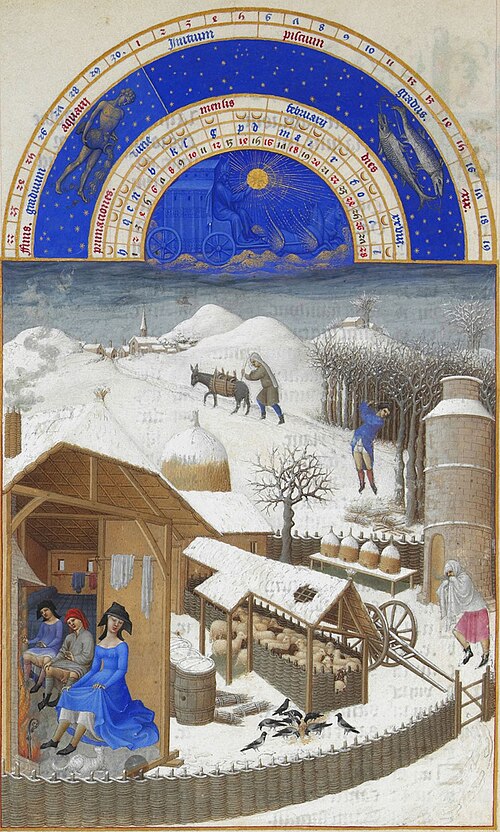
By the sixteenth and seventeenth centuries, this interest in seasonal life had taken on a new pictorial scale in Northern Europe; winter became a theme to be explored, both iconographically and iconologically, inhabiting landscapes with daily life that could be observed at length.
Across Flemish winter genre landscapes of the late-sixteenth and seventeenth centuries, a remarkably consistent visual ‘grammar’ emerged. The viewer is typically positioned at a high vantage point, which immediately turns the village into an observable community. The scene is structured into foreground, middle ground, and background. Roads, rivers, and banks as conduits that lead the eye deeper into the picture. Atmospheric (aerial) perspective often softens the far distance, while linear recession is frequently rendered through diminishing trees, paths, and rooflines. Trees also function as framing devices; dark trunks and bare branches form a kind of stage-wing that both anchors the composition whilst heightening contrast against the snow.
From the mid-sixteenth century, Western Europe, including Belgium, Austria and the Netherlands, experienced what modern scholars call a ‘Little Ice Age’, with ubiquitous drops in temperatures and especially harsh winters leading to the death of crops. Against this background, certain pictorial motifs become emotionally charged; gnarled black trees cutting into a pale sky, firelight and gathering that suggest warmth, even as scarcity is obvious. Gay winter festivities that, when contrasted with hardships, appear as a celebration of endurance. In this sense, it also suggests a strength of community when faced with dark times.
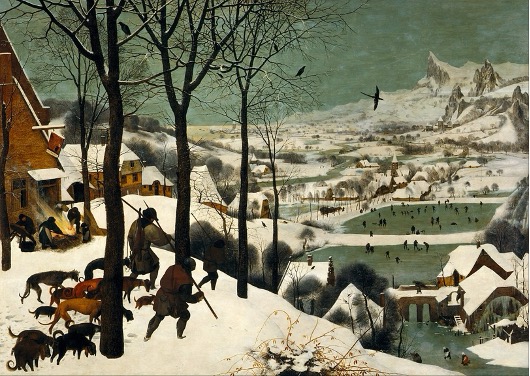
Bruegel’s Hunters in the Snow (1565) is a particularly influential work that shows how this balance can be staged. The composition leads in with a group of hunters and their dogs in the near foreground, then pulls the eye down into a wide valley where village life continues across ice and snow. The only food in the painting is the hunters’ scarce prey of a single fox and a pig cooked on an open fire – both highlight scarcity. The crows and magpies on the bald trees, too, become quiet reminders of death. By contrast, the skaters and onlookers in the distance animate the frozen surfaces and add festivity to the scene, providing the viewer with mental juxtapositions. Formally, Bruegel’s winter has a crisp, almost architectural feel; strong diagonals and high contrasts push the eye down into the valley, reflecting the cold through the structural rigidity of the composition.
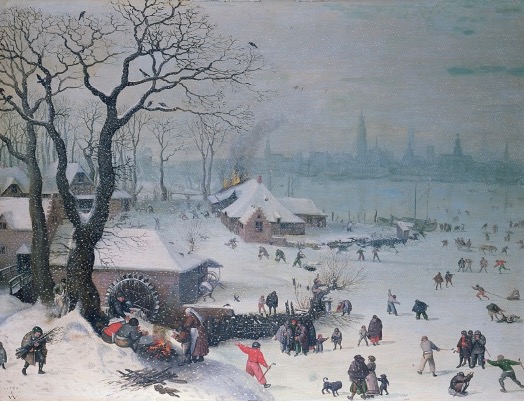
Valckenborch’s Winter Landscape (January or February) (1586) shares the elevated viewpoint and the pleasure of dispersed activity, but it shifts the tone through both motif and handling. It is the gathering and carrying home of brushwood and firewood that links household survival to communal life. Furthermore, the light snowflakes animate the scene, while adding a touch of magic, immediately lightening the perception of what must have been a challenging and cold day.
Visually, Valckenborch’s winter can feel softer than Bruegel’s. Rather than relying only on ‘lighter values’ of a hue, the snowlight often reads as though it has been pulled across darker layers. Such effect is often reached through the technique of scumbling, when a thin layer of paint is applied lighter than what lies beneath, used to soften, lighten, and create a veil-like effect. Such paint handling pushes the palette toward pastel and makes the overall atmosphere gentler, even when ominous notes remain, such as dark trees, watchful magpies, and smoke in the background are set against skating and communal enjoyment.
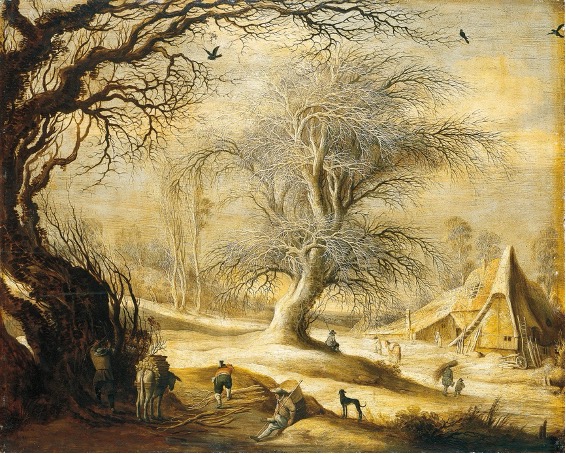
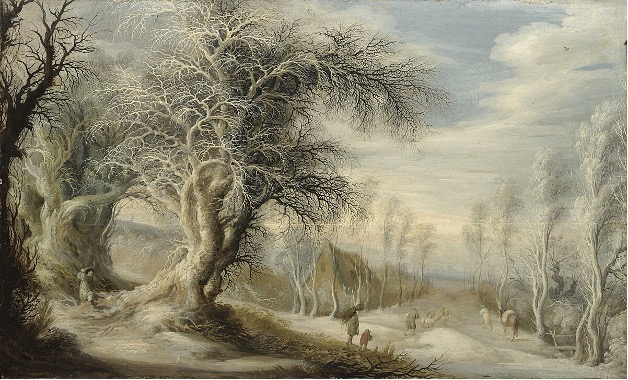
Gijsbrecht Leytens, a specialist in winter landscapes, offers yet another rendering of the season – one that often preserves sharpness through contrast. In Leytens’ winter scenes, the human presence can be relatively small against the dominating structure of trees and frozen paths. The forms of bark and branches often feel carefully built rather than dissolved into atmosphere. Even when whitening layers are used to suggest snowlight, Leytens frequently keeps edges crisp by placing light and dark tones beside one another, constructing volume through adjacent contrasts. The number of people in Leyten’s scenes seems to be the scarcest among all three artists. In his works it is the dominance of nature that is supposed to strike the viewer as the gigantic trees tower over the tiny labourers. They are not set in a developed city, like the previous works, but rather capture the liberty of the province. Especially poignant is Winter Landscape with Woodsmen (c.1657), where small, pale figures of the villagers and the thatched cottage blend in with the dancing of the hues, the trees and the skies, and the scene starts to appear uninhabited, prelapsarian even.
Seen together, these works demonstrate how a shared Flemish winter language can produce distinct emotional temperatures. Bruegel’s winter is angular, high-contrast, and frozen – its pleasures are not far from fatigue and need. Valckenborch’s winter softens under a veil of pale light and shimmering snowfall, drawing the viewer into a gentler atmosphere that nevertheless admits danger and unease. Leytens’ winter, by comparison, often feels sharper and more textural, with trees and branches carrying much of the scene’s intensity. However, human warmth is not simply about festivity, but the visibility of community. Just as nowadays, when we too send wishes, love and care for our significant ones, winter has been and still is the season that reveals, most clearly, how people endure the cold together.
Edited by Isabel Hume
Cover Image: Pieter Bruegel the Elder, The Hunters in the Snow, 1565, oil on wood, Kunsthistorisches Museum, Vienna.

 Paper Galleries
Leave a comment