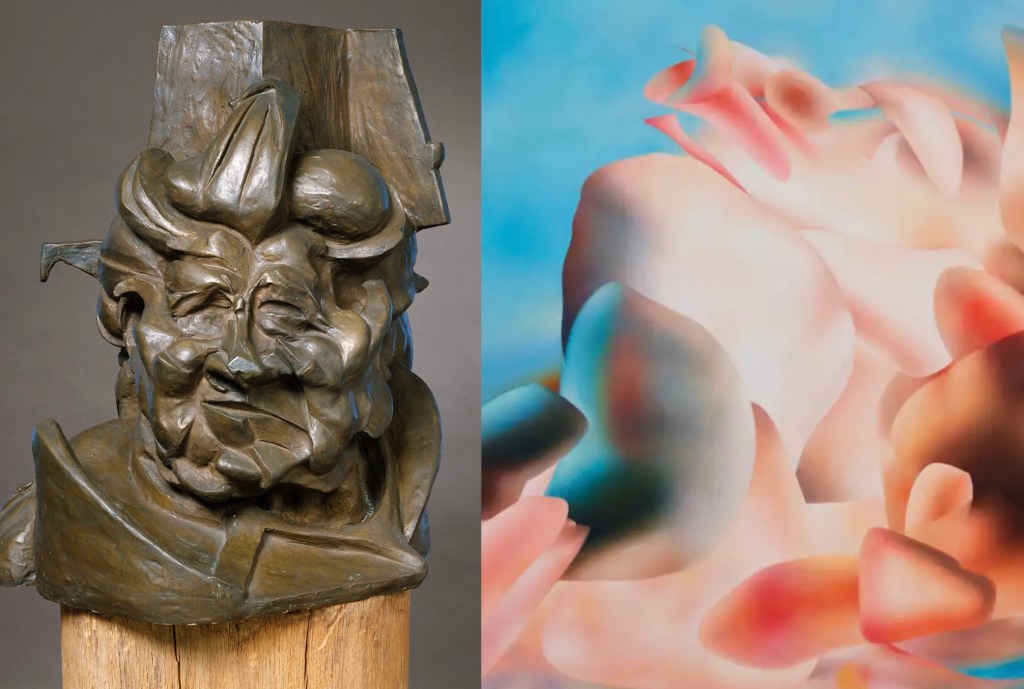
Technological progress has always had a profound impact on culture, shaping the ways people live and perceive the world. These shifts have often been reflected in art, as artists respond to changing conditions of everyday experience. In the early twentieth century, Italian Futurists were fascinated by the rapid development of modern technologies, particularly the automobile, which dramatically increased the speed of daily life and transformed society. A century later, another major technological development took place and changed human experience: the introduction of social media. In both cases, artists have been deeply interested in how new technologies affect the human body. This article aims to explore how technologies have influenced artists in different historical moments and how they use these technologies as a tool to transform the depiction of the human body and experience in art.
At the end of the nineteenth and the beginning of the twentieth century, Europe was experiencing rapid social, intellectual, and industrial change. The introduction of theautomobile in 1886 and the airplane in 1903 fundamentally altered the ways in which society functioned and how daily life was perceived. Artistic and intellectual circles were equally affected, as the emergence of modernism encouraged artists to depart from traditional representation to more experimental and abstract approaches. In Italy, these transformations contributed to the rise of the Futurist movement, led by poet and theorist Filippo Tommaso Marinetti, for whom a radical break with the classical Italy’s past was necessary. In his Futurist Manifesto, he celebrated speed, machine, and the energy of modern life, presenting the machines as a symbol of a new aesthetic shaped by movement and power.
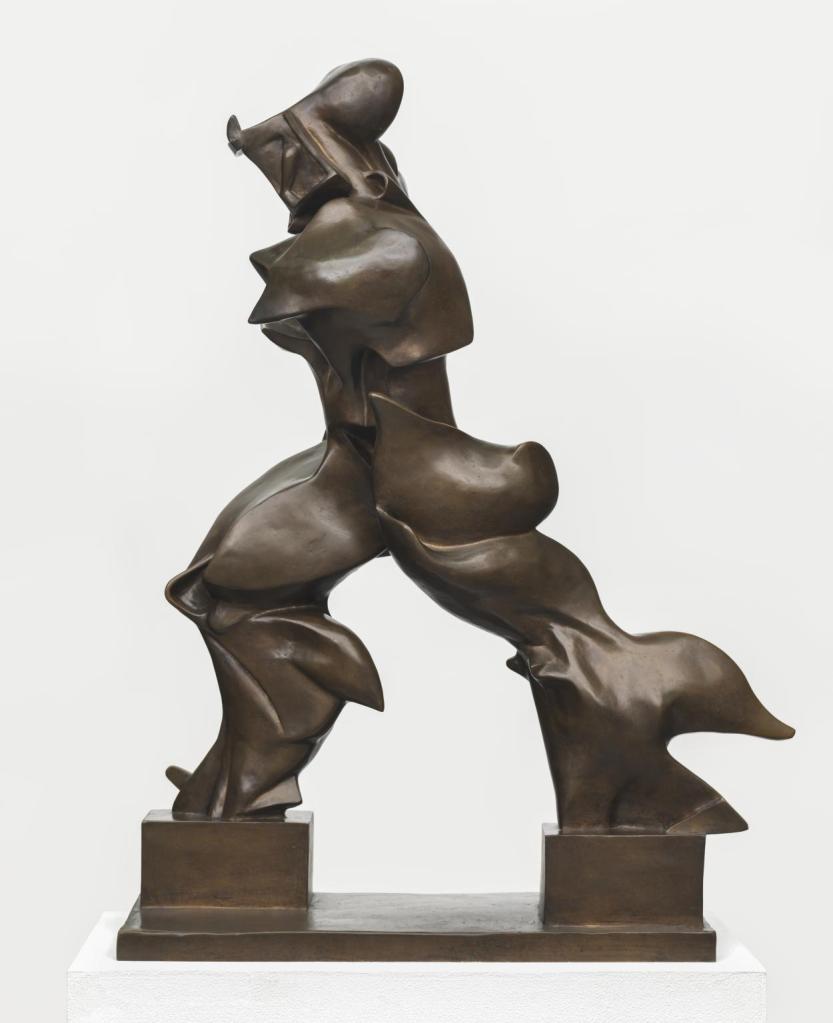
These ideas strongly influenced painter and sculptor Umberto Boccioni, one of the movement’s key artistic figures. Boccioni translated Fututrist theory into visual form through the principles of compenetration and continuity: the belief that bodies, objects, and their surroundings are not separate entities but exist in constant interaction with each other. Rather than depicting the human body as a fixed, self-contained form, Boccioni sought to represent it as fluid and dynamic, corresponding with a world increasingly shaped by speed and technological progress.
His principles are most clearly embodied in Unique Forms of Continuity in Space (1913). The bronze sculpture presents a human-like figure leaning forward as if caught in a moment of rapid movement. The head is reduced to an abstract shape, while the limbs expand into sharp, wind-like curves that appear to slice through space. These exaggerated shapes visually echo the forms of modern machines and evoke the physical sensation of speed experienced through automobiles. The polished bronze surface further increased association with industrial materials and mechanical production. Rather than depicting a machine or specific individual, Boccioni captures the experience of the movement created by new developmentsof modernity, revealing how technology reshapes both daily life and artistic representation of the human body.
A century later, Swiss-born artist Angela Santana also actively engages with technologies in her artistic practice. Unlike the Futurists’ fascination with the progress and latest technological developments, Santana works with technologies that have become an essential part of our everyday life. Social media, characterised by an endless stream of images, plays a central role in shaping contemporary identity and self-perception, particularly in relation to the body. Santana explores how platforms such as Instagram influence the way human, and in particular female, bodies are viewed and judged. By appropriating and transforming images sourced from advertising or personal photographs found online, she reflects on how digital imagery creates idealised, curated versions of the body while producing an excessive amount of visual information that blurs personal identity.
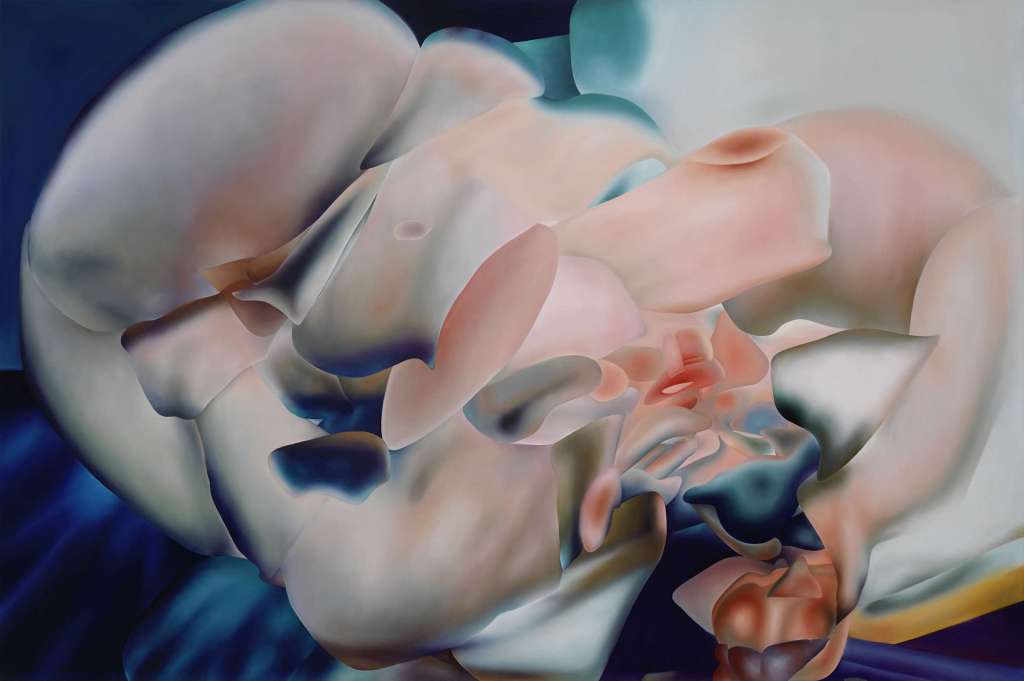
This approach recurs throughout Santana’s practice and in Equipose (2024), a painting that will be exhibited in her upcoming solo exhibition at Saatchi Yates in January 2026. The work depicts a nude female figure in a foreshortened pose, with her head reaching toward the edge of the canvas while her body stretches diagonally across the canvas. Although the woman remains clearly recognizable, it is rendered in a semi-abstract manner. Large fields of colour intersect with each other across the surface, combining smooth gradients with sharp outlines. Warm pink tones associated with the nude body contrast with the cool blues of the background. The body is constructed from blocks of colour that assemble into a female body. This body though is not confined by a strict outline. Instead, the figure flows softly into the surrounding space, dissolving the boundary between body and background. While the pose and colour palette may originate from imagery from social media, Santana transforms it to resist the beauty standards imposed by digital platforms and the male gaze. The body in Equipose is liberated in its fluidity, expressiveness, and freedom from judgement.
Despite being produced in different historical contexts, the works of Boccioni and Santana reveal striking parallels when viewed together. Both artists were in close dialogue with the dominant technologies of their time; they responded to them not through the direct depiction, but through the transaction of their effects onto the human body. For Umberto Boccioni, the automobile reshaped human experience through speed and motion, leading him to transform the human figure into dynamic, continuous form. For Angela Santana, social media mediates the body through the infinite number of images circulated there—in her paintings she resists this influence and tries to liberate the female body from overwhelming restrictions imposed onto it. In both cases, technology acts as a force that sparks an artistic response, as well as alters our perception of life and identity.
The comparison between Italian Futurism and Angela Santana’s contemporary practice reveals how technological change repeatedly encourages artists to rethink the way they represent the human body. While Boccioni embraced the optimism and bright hopes for the future in line with technological development, Sanatana opposes the digital landscape marked by the control and circulation of imagery that dictates the bodily image. At the same time, both artists reveal that the body is never static, as it is continually reshaped by the technologies that now define human experience. In their works we see continuous process of development of relationship between technology human body and experience.
Edited by Alison Grace Zheng
Cover image is of Umberto Boccioni’s ‘Antigraceful’ alongside Angela Santana’s ‘Naissance’
 Paper Galleries
Leave a comment