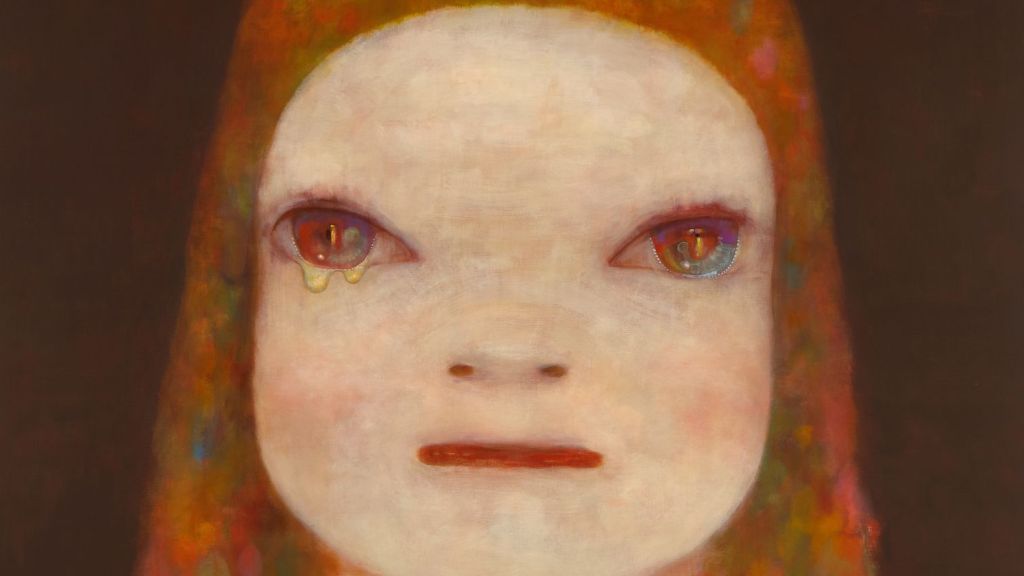
If you’ve seen a pair of opalescent eyes staring at you from the back of a laptop, or a phone case, the chances are that it’s one of the bright-eyed girls painted by Yoshimoto Nara. Born in 1959 in post war Japan, Nara has nearly 40 solo exhibitions since 1984, and it seems like he’s only picking up momentum.
Earlier this year, in March, Nara’s Cosmic Eyes (in the Milky Lake) was auctioned at Sotheby’s for £9 million.
Associated with the Neo-Pop and Superflat movement, Nara’s style is simple: smooth lines, pastel colours and isolated figures. The images appear soft and innocent, drawing comparison to ‘kawaii’ and the ubiquitous culture of cuteness that permeates Japanese consumer life. His works have proved successful and popular, notably among western audiences of women, that find relatability and solace in his works.
While the girls may be seen as cute, they rarely smile. They often hold melancholic, scowling or angry glances that boldly stare at the viewer. The juxtaposition of these elements is at first glance perplexing and adds to this feeling of liminality. The suppressed anger occupied by Nara’s figures explores the complexities of who gets to express emotion, and what happens when they do. ‘Girlboss feminism’ and the expectation for women to do it all, has gone stale. So, the appeal of Nara’s compositions lies not in power or success, but in the permission to feel small, angry, vulnerable or uncertain. The emotional immediacy and relatability felt by many young women interacting with these girls, reflect the need for sincerity, vulnerability and childlike playfulness that is lacking in today’s society. Nara’s popularity is not the only signal for this, the return to youthful aesthetic can be seen not only in paintings, but cultural phenomena like the ‘coquette’ aesthetic trending in online spaces. Nara’s art resonates within that same affective landscape, offering a visual language for quiet resistance.
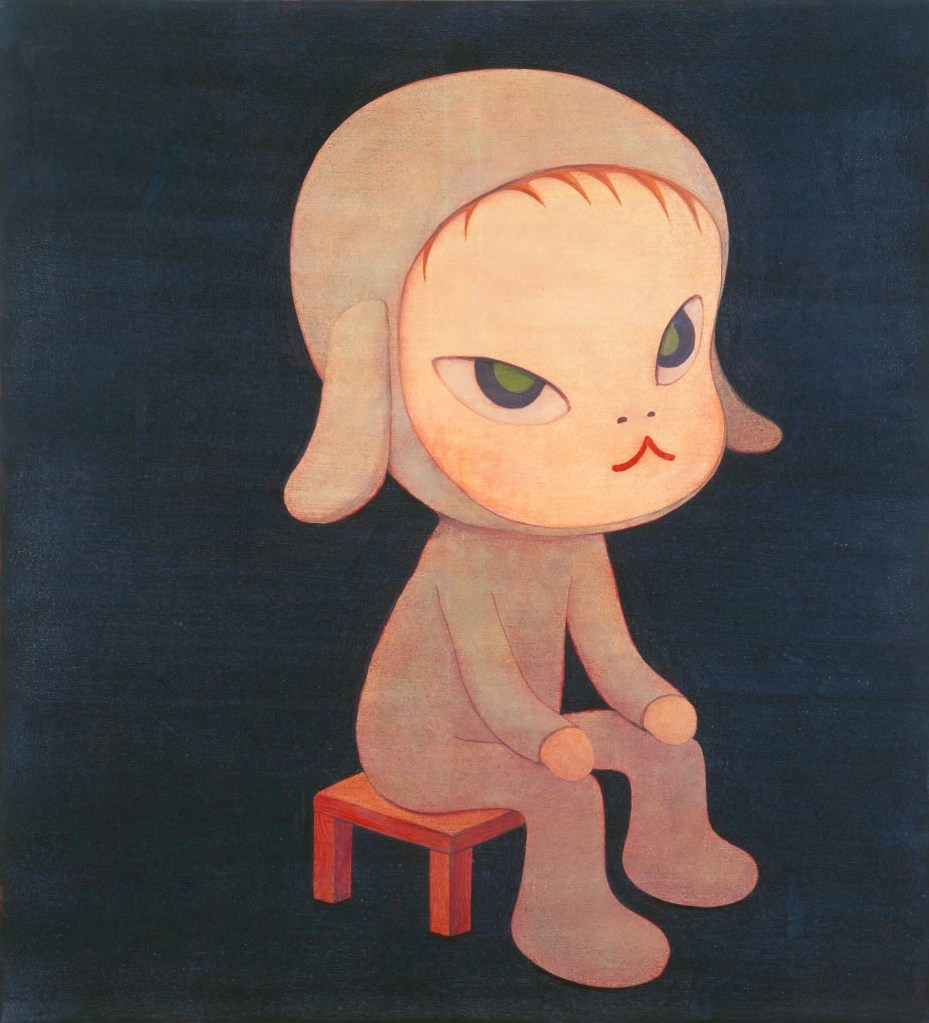
While Nara usually explores the theme of childhood through a female lens, his artworks speak to our shared experience of childhood memory. ‘Sleepless Night (Sitting)’ (1997) depicts a young character in a lamb costume experiencing sleepless reflection. Instead of emphasising narrative context, the composition’s simplicity, the figure alone against a plain background, focuses on a quiet intimacy. A sort of existential loneliness that is inherent to the human condition and not limited by age or gender is evoked by this solitude. The pondering figure turns into a representation of restlessness and the contemporary mind plagued by excessive thought, overstimulation, or a lack of belonging.
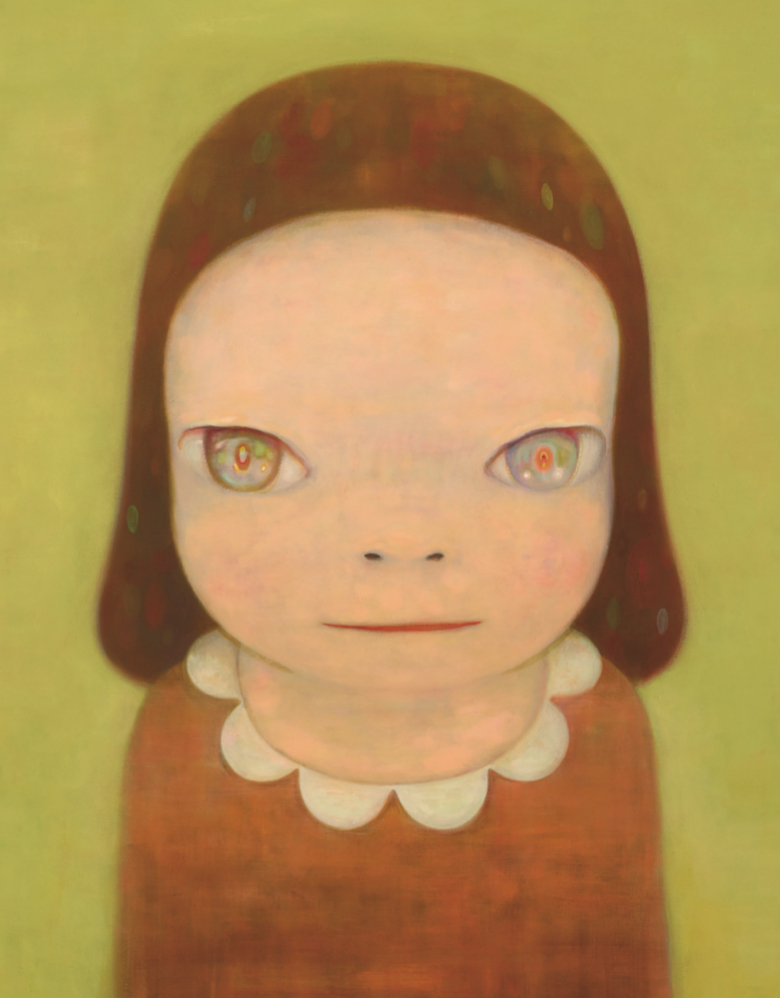
Nara’s characters, while holding these turbulent expressions, also demonstrate reflection and peace. In Miss Margret (2016), the girl stares boldly at the viewer, looking unbothered. Nara’s later paintings especially serve as an indication that vulnerability can coexist with introspection and self-awareness. Even though Nara’s characters frown, pout, or turn away, they also appear to be in a state of inner peace that raises the prospect of resiliency rather than hopelessness. Her eyes contain a shiny gradient of bright colors, shifting from warm yellows to cool blues shows a vibrancy and inner world within her. The soft brushwork and luminous palette lend her an aura of quiet acceptance that can be taken with the viewer.
Edited by Saffron Watkins
Cover image: Yoshitomo Nara, Midnight Tears (2023). Collection of Guggenheim Museum Bilbao. Yoshitomo Nara. Courtesy the artist and David Zwirner. From https://ocula.com/magazine/art-news/yoshitomo-nara-joins-david-zwirner/


 Paper Galleries
Leave a comment