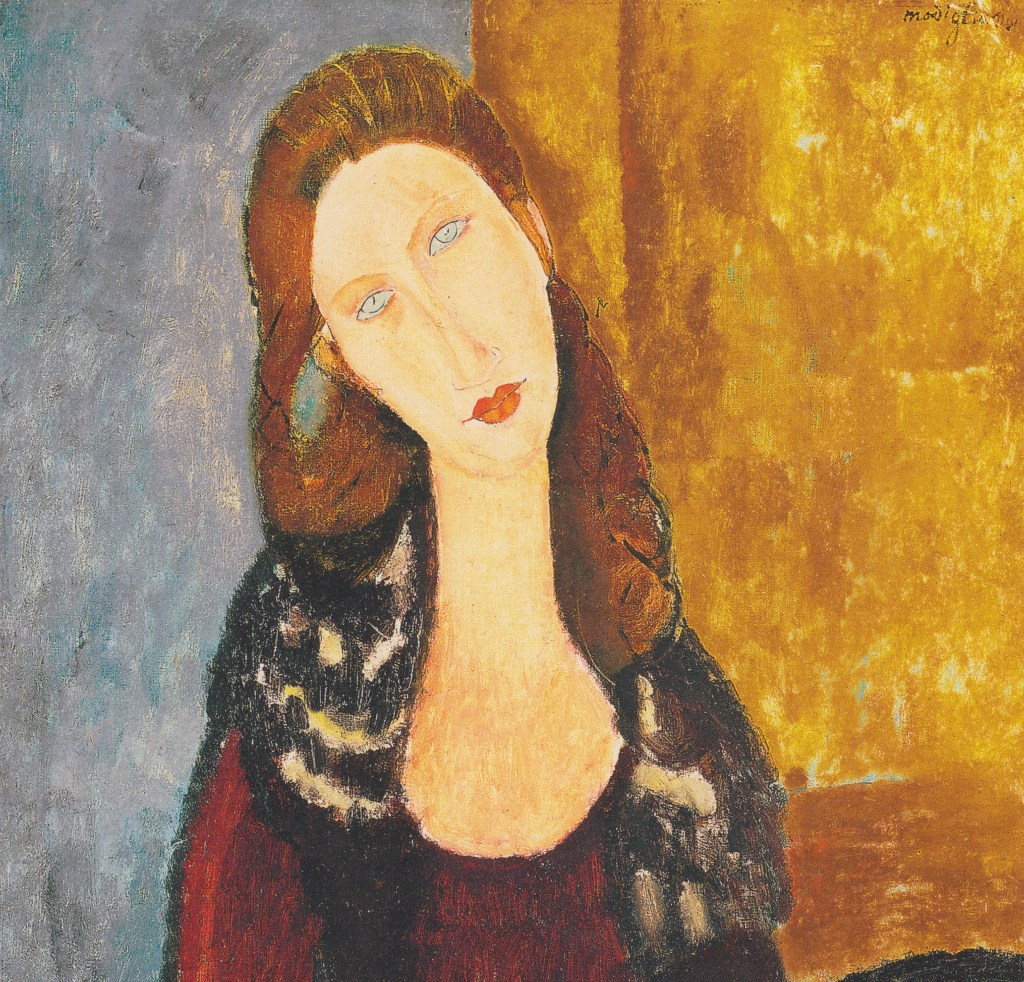
Jeanne Hébuterne: model, lover, muse. The subject of 26 portraits by Italian modernist painter and sculptor, Modigliani, she was also his partner and mother to his child. But Hébuterne had a life of her own. In fact, she was an artist in her own right, who demonstrated a gift for drawing at an early age. In early 1917, at age 18, she began studying at Académie Colarossi, one of the
few art schools that accepted women at the time, and it was here, in the feverish excitement of rue de la Grande Chaumière in Montparnasse, that she met the charismatic, turbulent Modigliani, marking the beginning of their passionate yet fleeting love affair. Hébuterne was undoubtedly influenced by Modigliani’s artistic style, his characteristic almond eyes and narrow noses, but his erratic lifestyle as the enfant terrible of the Belle Epoque left just as deep a mark. Indeed, he was cursed with a heavy, self-destructive presence, both an alcoholic and an addict, who suffered from tuberculosis at the end of his life, resulting in his untimely death on 24 January 1920. Just two days later, Hebuterne, nine months pregnant with her second child, leapt from a five story building. Unlike Modigliani, who has been revered ever since, his name permanently inscribed into art history, Hébuterne, who only had the chance to create 25 paintings, faded into obscurity, her premature death crushing any attempt to cement her artistic reputation. Unfortunately, this is not an anomaly, with countless female artists from centuries prior being forgotten only until recently, with even women who we now consider to be
unequivocal ‘greats,’ from Frida Kahlo to Artemisia Gentileschi, suffering a similar fate. In fact, it is only very recently that Jeanne Hébuterne, the painter, not the muse, has emerged from the shadow cast by Modigliani.
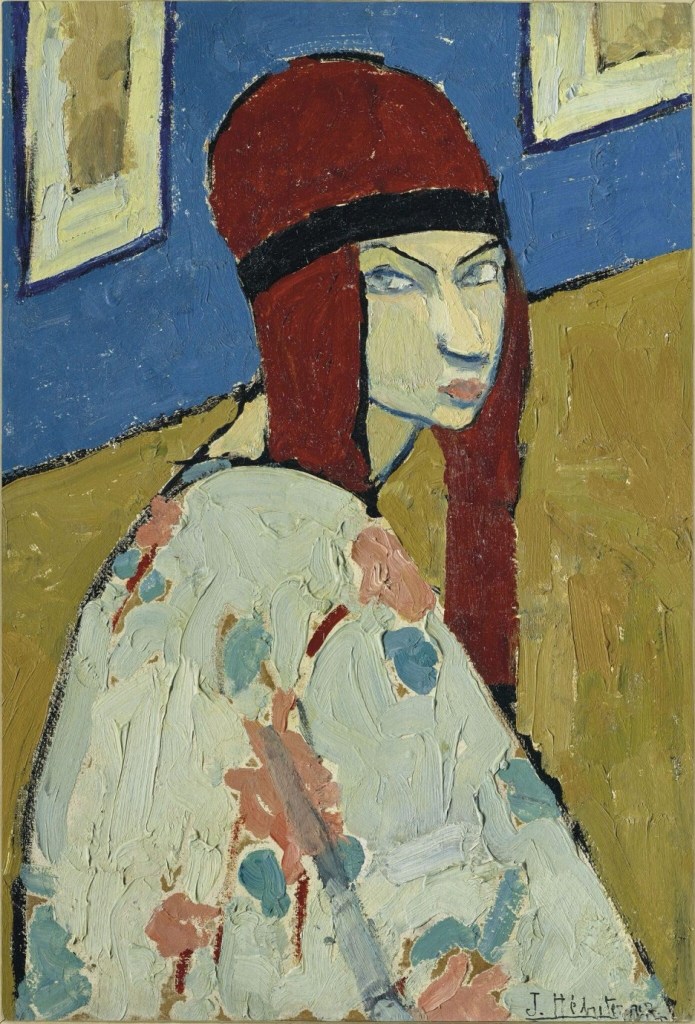
€247,500 on 18 October 2018 at Christie’s in Paris
Hébuterne’s work is largely characterised by its gentle lines and soft, luminous use of colour, with her early paintings embracing a style similar to the work of the Fauves and the Nabis (both French post-impressionist groups, known for their application of colour in flat patches, bold contours and simplified forms). This influence is certainly evident in her self-portrait from c.1917, where the flat background and crisp contours are reminiscent in particular of Matisse’s earlier style. Hébuterne’s style was daring, with her piercing gaze locking eyes with the viewer and intensified by their icy blue tint and sharp shape, a defiant depiction which asserts a sense of self-assured confidence, challenging the known descriptions of Jeanne as being a shy, quiet and delicate character. Moreover, she wears a kimono, thought to have been sewn herself, indicating a somewhat scandalous state of undress, which was certainly provocative for a woman of her class at the time. Indeed, Hébuterne clearly found her artistic medium to be both emboldening and empowering, using it not only to establish a sense of agency, but also to make scathing assessments of character. For example, her Portrait of Chaïm Soutine, a friend of Modigliani, utterly deconstructs his external facade to reveal him as a presumptuous dandy, particularly through the sharp juxtaposition between warm ochre tones and cool hues of purple and blue, as if to reflect the many facets of her model’s persona.
By 1918, her self-portraiture clearly seems to indicate the influence of Modigliani’s characteristic style, with its elongated neck and face, and almond-shaped eyes, certainly revealing their deep artistic dialogue, known to paint side by side in a workshop on Rue de la Grande Chaumière, and even share models. However, Hébuterne had a self-assured painting style, and was often more experimental than Modigliani, whose distinct practice, once pioneered, remained largely the same throughout his lifetime. She also paid greater attention to the interiors in which she depicted her sitters, focusing on pattern and vibrant colour just as much as facial expression or the figure’s form. Moreover, Hébuterne’s art was not bound to just portraiture, also completing landscapes, looking out to the courtyard from her studio window, and still lifes too, in a style reminiscent of Bonnard and Vuillard.

December 2008 at Christie’s in Paris
Hébuterne was a fundamental part of the vibrant artistic community in Paris and although during her lifetime she never exhibited or communicated with art dealers, in 2018, Christie’s sold her 1917 Self Portrait for €247,500, a poignant reminder that although it has taken us until the 21st century to recognise her talent, it was always worth remembering. Despite her brief life, Hébuterne’s contributions to modern art were significant, and she left behind a legacy of touching and intimate artworks that reflect her deep sensitivity, unique perspective and connection to the post-WW1 art scene.
 Paper Galleries
Leave a comment